Image (Credit): NASA Astronaut Mark Vande Hei aboard the International Space Station. (NASA)
“They were, are and will continue to be very dear friends of mine. We support each other throughout everything. And I never had any concerns about my ability to continue working with them – very good professionals and technically competent and wonderful human beings.”
-NASA astronaut Mark Vande Hei, who returned to Earth from the International Space Station (ISS) last week, regarding his US and Russian crew mates, as quoted in the Washington Post. As a result of his latest ISS mission, Mr. Vande Hei has now spent more time in space on a single mission than any other US astronaut.
Image (Credit): USSR’s Luna 2 spacecraft. (Worldhistoryproject.org)
So who owned the rocket stage that hit the Moon earlier this month? I had earlier noted the speculation pertaining to both SpaceX and then the Chinese rockets. Surprisingly, it is still is not clear who owned that rocket stage and maybe we will never know. That is not a good answer for the European Space Agency’s Space Safety Programme, which stated:
The upcoming lunar impact illustrates well the need for a comprehensive regulatory regime in space, not only for the economically crucial orbits around Earth but also applying to the Moon.
While that case has yet to be solved, we are pretty certain about the first Earth-launched rocked to hit the Moon. We can blame the Soviets for that strike back in 1959 with its Luna 2 (nicknamed the Lunik 2). At least the goal in that case was to hit the Moon.
Launched on September 12, 1959, it took 35 hours to travel the distance between the Earth and Moon. Luna 1, launched by the Soviets earlier that year, was supposed to hit the Moon but it missed by about 3,700 miles. You can see more about Luna 2 via this dated news clip.
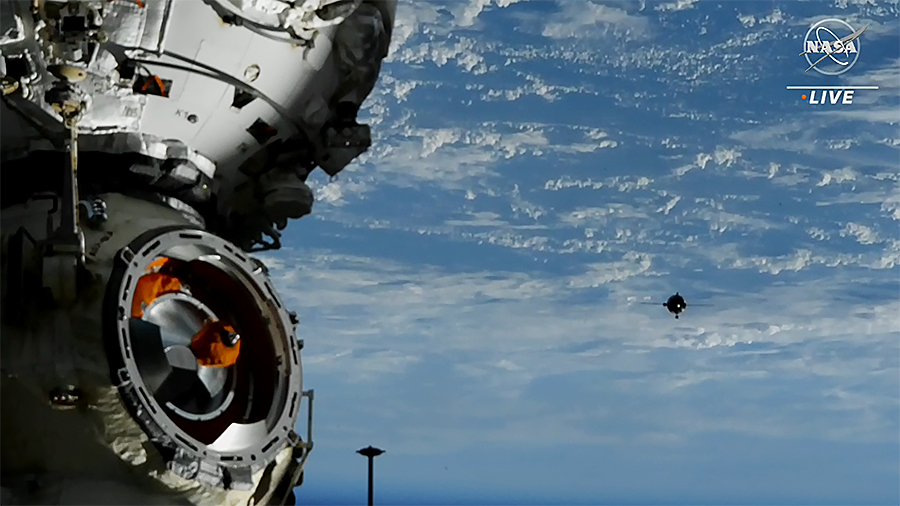
Image (Credit): The Soyuz MS-21 crew ship with three cosmonauts aboard approaches the International Space Station. (NASA)
On Friday, a Soyuz space capsule arrived at the International Space Station (ISS) with three Russian cosmonauts – Oleg Artemyev, Denis Matveev, and Sergey Korsakov. This will bring the ISS crew to 10. On March 30th, three crew members will return to the surface of the Earth – NASA astronaut Mark Vande Hei and Russian cosmonauts Pyotr Dubrov and Anton Shkaplerov. You can read more about the mission here.
With the ongoing disagreements between the Russian and Western governments regarding Ukraine, it is good to see some normal operations related to the ISS. Let’s hope the science can continue in space while discussions continue back here on Earth to end the ongoing war.
Update: The media was abuzz regarding the blue and yellow outfits of the three astronauts arriving at the station. Was it support for Ukraine or their alma mater? One cosmonaut said there was simply an excess of yellow material. Another space mystery.
Image (Credit): Picture of the completely integrated mirrors and detectors before final packaging. (Max Planck Institute for Extraterrestrial Physics)
You may have heard of Germany’s black hole-hunting telescope called the extended ROentgen Survey with an Imaging Telescope Arraye (eROSITA). It was launched in 2019 as part of a larger Russian-German mission called the “Spectrum-Roentgen-Gamma” (SRG) observatory and placed in the L2 Lagrange Point.
The eROSITA has three primary goals:
to detect the hot intergalactic medium of 50-100 thousand galaxy clusters and groups and hot gas in filaments between clusters to map out the large scale structure in the Universe for the study of cosmic structure evolution,
to detect systematically all obscured accreting Black Holes in nearby galaxies and many (up to 3 Million) new, distant active galactic nuclei and
to study in detail the physics of galactic X-ray source populations, like pre-main sequence stars, supernova remnants and X-ray binaries.
Well, similar to other joint Russian space missions, the telescope’s work was put on hold because of continuing events in Ukraine. The German government had this to say:
[Deutsches Zentrum für Luft- und Raumfahrt (DLR)] and the German Space Agency at DLR have been cooperating with Russian institutions on a number of research projects, in some cases with the participation of other German research organisations and universities, and international partners.
Against the backdrop of the aggressive attack on Ukraine, the DLR Executive Board is taking the following measures:
All collaboration activities with Russian institutions on current projects or projects in the planning stage will be terminated.
There will be no new projects or initiatives with institutions in Russia.
Where necessary, DLR will enter into coordination with other national and international partners.
We are slowly blocking our view of the bigger universe because of the reckless actions of a few. Hopefully, we can open up our eyes again shortly.
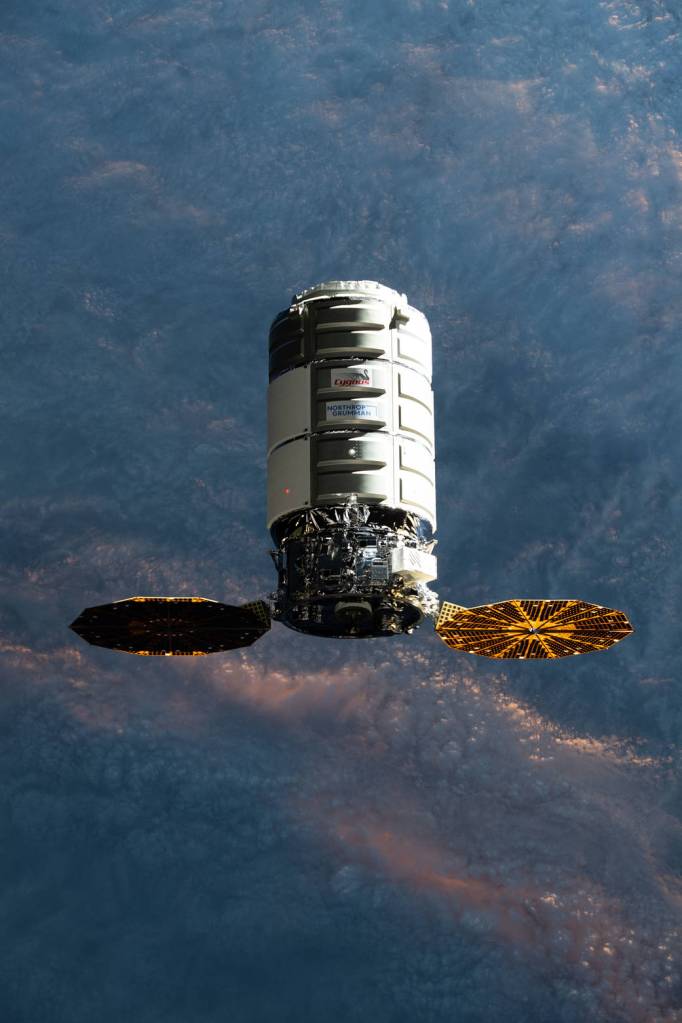
Image(Credit): Northrop Grumman’s Cygnus space freighter approaching the International Space Station (NASA).
Over the weekend, the Washington Post published an editorial by Homer Hickam, former NASA engineer and advisor to the National Space Council, titled, “Our space partnership with Russia can’t go on.” In the piece, Mr. Hickam argues that the International Space Station (ISS) has accomplished its goals and the US can now move onto other projects without the Russians:
With our flourishing commercial space companies, who are already cutting metal on their own future space stations, plus our federal government’s Artemis moon program, the United States is entering a new golden age of space exploration. The Russians, meanwhile, are stuck in the past with antiquated spacecraft and nowhere to go except the ISS.
Mr. Hickam appears to believe pushing out the Russians may mean the end of the ISS. Of course, this is just one man’s view, and whatever we do we need to do it in conjunction with our other ISS partners.
We could continue to maintain the ISS through 2030, as planned, and schedule more useful science even without the Russians as partners. This may make sense until we have another viable station that we can use, such as NASA’s planned lunar Gateway. Russia will not be part of the Gateway given that it is working with China on other lunar plans, so we do not need to worry about another breakup.
It would be better if Russia had focused on its space accomplishments rather than territorial ambitions as it prepares for the future. Joint space programs are a great way to use rockets for peaceful missions. I am not against a space race that pushes us even farther into space, yet I would prefer it be fueled by scientific achievement rather than nationalist angst.
Image(Credit): Artist rendering of the Artemis lunar Gateway (NASA).