Source/Credit: International Space Station (ISS) from NASA.
“If you block cooperation with us, who will save the ISS from uncontrolled deorbiting and falling on US or European territory?”
–Dmitry Olegovich Rogozin, Director General of Roscosmos, commenting on US sanctions against Russia’s aerospace industry resulting from that country’s invasion of Ukraine this week. The ISS is expected to stay aloft until 2031, assuming everyone cooperates.
Source/Credit: Yutu 2 rover on the dark side of the moon from the China National Space Administration.
As much as we talk about cooperation in space, it is always nice to be the first nation to pass a milestone, be it the first man on the Moon or the first probe of Pluto. The U.S. has plenty of great stories about space travel, as do the Russians, and now the Chinese are creating their own stories. For instance, China’s Yutu 2 rover was the first rover to explore the dark side of the Moon.
A linchpin of the NASA moon effort is the Space Launch System, the Boeing-built mega-rocket that has been beset by years of delay and cost overruns that is finally set to make its maiden test flight in 2022.
The U.S., Russia, and China all have designs on the moon:
The U.S. moon program has been enlisting international partners in the form of the Artemis Accords, which now includes more than a dozen countries. But Russia and China, which are pursuing a lunar research station, are also seeking partners.
We already know that the U.S. hopes to have astronauts on the Moon in 2024, so what are the Russian and Chinese schedules for their projects? It appears the two nations are working on a joint lunar research base scheduled for the 2030s. However, not everyone is convinced this will happen. A Foreign Policy article, “A Chinese-Russian Moon Base? Not So Fast,”voiced skepticism that the two nations can generate sufficient funding, technological know-how, and political unity to pull off such a mission, citing earlier joint attempts, including a Martian mission:
In 2007, China and Russia signed an agreement for “joint Chinese-Russian exploration of Mars,” culminating in a 2011 launch of a Mars orbiter and landing craft. However, the Russian rocket malfunctioned, causing Russian and Chinese spacecraft to come crashing back down to Earth, an embarrassing conclusion to bothcountries’ first attempt to reach the red planet.
The two nations seems to be even more unified against the U.S. since this Foreign Policy article was published, so anything is possible. However, the U.S. did pretty well in the 1960s and 1970s after initially trailing the Russians, so my money is still on the U.S. in this latest race.
Source/Credit: Astronaut Leroy Chiao (right) attending a Red Square Memorial Ceremon in September 2004. Image from CNN.
As we await peace or war between Russia and Ukraine, US astronaut Leroy Chiao shared his thoughts about his cooperation with Russians at the International Space Station (ISS). He served as the copilot of a Russian Soyuz spacecraft to the ISS as well as the commander during Expedition 10. In his CNN editorial, he emphasizes the importance of continued cooperation at the station even when partners are on opposing sides during ongoing conflicts:
In the early 2000s, a few years after the Kosovo war, I started training for my ISS mission in Star City, outside of Moscow. Not long after I started training in Russia there were conflicts in and around the Balkans and I remember times when we would hear heavy Russian transport aircraft taking off all night from the air base next to us, bringing troops and materiel to the conflict zones. We Americans discussed these issues with our Russian friends in the training program and I learned one of the wonderful things about living in other worlds is you develop perspective. You don’t necessarily agree, but you can appreciate the viewpoints of the other side.
Let’s hope the two-nation relationship is not tested further in the weeks to come. I like the idea of international cooperation as well as maintaining healthy competition in the realm of space endeavors.
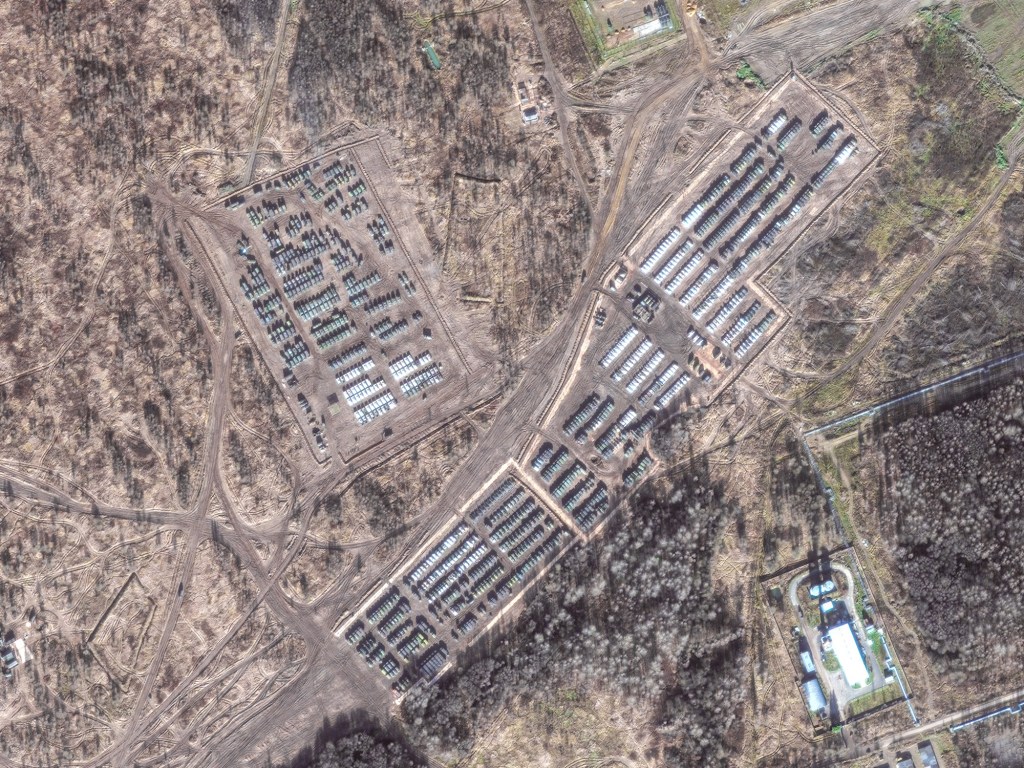
Source/Credit: Satellite imagery showing the military buildup in Yelnya, Russia as of November 1, 2021 fromMaxar Technologies/Getty Images.
Politico reported this week that Russia has asked that next week’s discussion at the United Nations (U.N.) about arms in space be delayed. It is possible the Russians are busy preparing for war in Ukraine and have little time to look up. But it should be possible to resolve matters here on the surface and in space.
The U.N. Committee on Disarmament established a working group after seeking member input on the “…development and implementation of norms, rules and principles of responsible behaviours and on the reduction of the risks of misunderstanding and miscalculations with respect to outer space.” Sounds like a good idea to me. You can find the report with the members’ input here.
Here is part of what the United States submitted in its response to the U.N. query:
Some States are developing, operationalizing, and stockpiling a variety of [anti-satellite] weapons that could be used to, or have the potential to, deny, disrupt, degrade, or destroy civil, commercial, ornational security space capabilities and services. Some of these anti-satellite weapons could be used to deny or disrupt space services temporarily, while others are designed to permanently degrade or destroy satellites.
These threats against satellites and their supporting systems can generally be divided into four categories: 1) ground-space; 2) space-space; 3) ground-ground; and 4) space-ground. Within these categories, the threats can be described as 1) reversible, which include temporary effects such as interference with radiofrequency signals or dazzling of remote sensing systems, or 2) irreversible, which include measures that degrade or destroy a satellite. The consequences of all categories of threats could include loss of mission data; decreased lifespan or capability of space systems or constellations; the loss of positive control of space vehicles, potentially resulting in collisions that could impair systems or generate harmful orbital debris; or damage to or destruction of the space system.
The working group should have plenty to discuss if it can get everyone together. Let’s hope the Ukrainian matter can be resolved peacefully to allow work to start on a stable peace in space as well.
Note: The dates on the article and U.N. schedule do not align, but the main point about the Russians being too busy to worry about a space war remains the same.
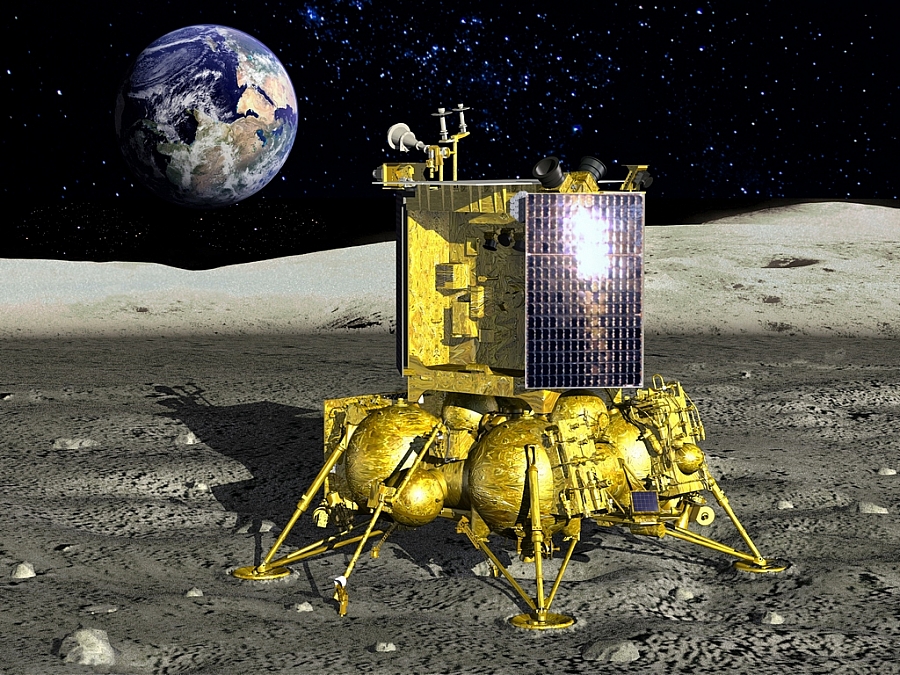
Source/Credit: The Luna-25 Moon Station from Russia’s Lavochkin Research and Production Association.
The image above is an artist’s rending of Russia’s Luna-25 Moon Station that was to be launched last year and is now scheduled to be launched in July 2022. It will be the first domestic spacecraft in the country’s modern history on the surface of the Moon. Luna-25 will be equipped with a soil-sampling robotic arm and camera to image the terrain. The last lunar mission was Luna-24 in 1976 by the then Soviet Union, which returned Moon samples to the Earth.


 Our Awesome Universe