Image (Credit): Five spaceships are parked at the space station including the SpaceX Dragon Freedom; the Cygnus space freighter; the Soyuz MS-21 crew ship; and the Progress 80 and 81 resupply ships.(NASA)
Earlier today, NASA announced that an uncrewed Russian cargo ship, Progress 81, arrived at the International Space Station (ISS) without incident. Work continues among the Americans and Russians aboard the ISS regardless of the situation on the ground, which is reassuring.
As NASA administrator Bill Nelson said last month at a Senate Appropriations Committee hearing, there have been a number of “misleading headlines” about the end of Russia’s participation in the ISS program. He also highlighed how US astronauts were able to work together with Soviets during the Cold war. Specifically, he stated:
I see nothing in the very even-keeled professional relationship between the cosmonauts and the astronauts, between mission control in Moscow and Houston, in the training of Russian cosmonauts in America and the training of American astronauts in Moscow and Baikonur…I see nothing that has interrupted that professional relationship, no matter how awful Putin is conducting a war with such disastrous results in Ukraine.
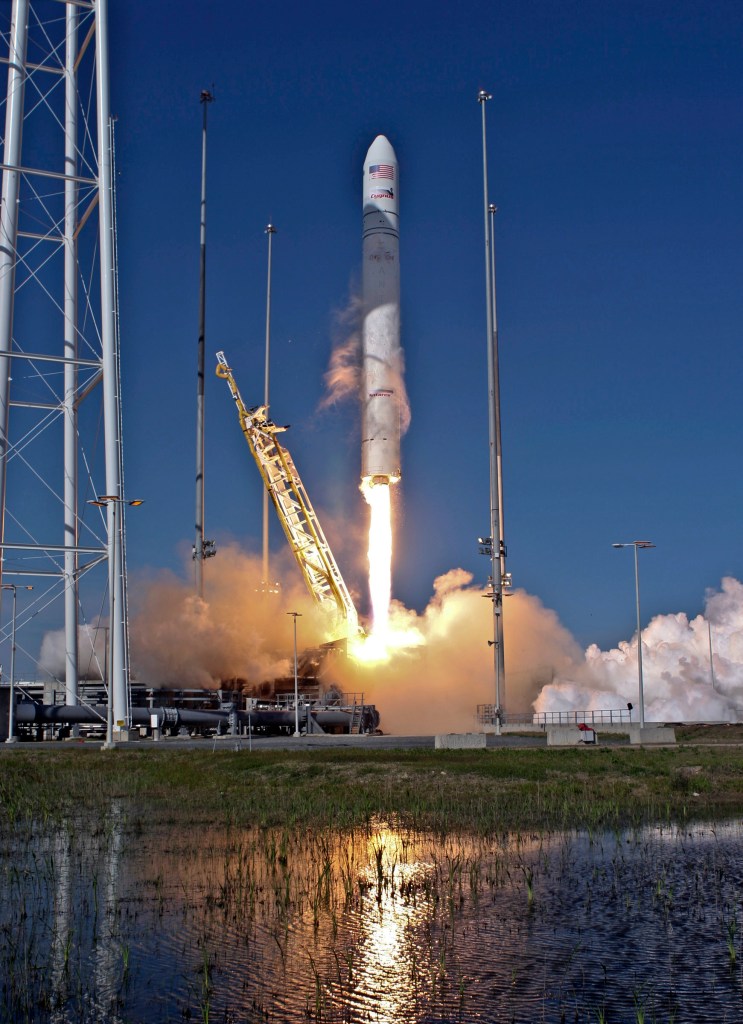
Image (Credit): Rocket being launched from Virginia’s spaceport. (Mid-Atlantic Regional Spaceport)
When you think of NASA space launches you most likely think of Cape Canaveral in Florida, but what about Virginia? The Eastern Shore of Virginia hosts the Mid-Atlantic Regional Spaceport (MARS), which is currently being used for resupply missions to the International Space Station (ISS). Created by the Commonwealth of Virginia in 1995 at the site of a World War II Navy air station, it is the only other official spaceport on the east coast.
Northrup Grumman has been using the site for various missions, including resupplying the ISS as well as other federal payloads. Orbital Sciences Corporation (now part of Northrup Grumman) launched NASA’s Lunar Atmosphere and Dust Environment Explorer (LADEE) mission from the site in 2013. In addition, last year Rocket Lab announced it planned to use MARS for launches of its new reusable Neutron rockets.
In February 2022, Northrop Grumman successfully launched its 17th ISS resupply rocket from the spaceport. The Cygnus space freighter carried needed supplies to the astronauts conducting research in orbit. The freighter will also be used to “boost” the ISS, or adjust its orbit, as noted by NASA:
This Cygnus mission is the first to feature enhanced capabilities that will allow the spacecraft to perform a reboost, using its engines to adjust the space station’s orbit as a standard service for NASA. The agency has one reboost is planned while Cygnus is connected to the orbiting laboratory. A test of the maneuver was performed in 2018 during Cygnus’ ninth resupply mission.
You may recall that such boosting is something the Russian’s claimed earlier could not occur if they abandoned the space station. Fortunately, NASA has other rocket options should they be needed. Moreover, we have additional spaceports to keep our astronauts in the sky and well supplied.
Image (Credit): Northrop Grumman’s Cygnus space freighter is pictured moments before its capture with the International Space Stations’s robotic arm in February of 2021. (NASA)
Extra: Below is a map showing the location of MARS on the Wallop Islands. The address of the facility is 7414 Atlantic Rd, Wallops Island, VA 23337.
Image (Credit): Location of MARS on the Virginia shore. (Google Maps)
Earlier this week, Vice President Harris announced that the United States will no longer conduct anti-satellite missile testing in space. In her statement, she highlighted the dangers caused by the related satellite debris.
From Vandenberg Air Force Base in California, she stated:
I am pleased to announce that as of today, the United States commits not to conduct destructive direct-ascent anti-satellite missile testing.
Simply put: These tests are dangerous, and we will not conduct them.
We are the first nation to make such a commitment. And today, on behalf of the United States of America, I call on all nations to join us.
Whether a nation is spacefaring or not, we believe this will benefit everyone, just as space benefits everyone.
In the days and months ahead, we will work with other nations to establish this as a new international norm for responsible behavior in space. And there is a direct connection between such a norm and the daily life of the American people.
If a satellite was taken out by debris, it could affect the daily weather forecast, GPS driving directions, and even your favorite TV station.
Critical infrastructure, like wind turbines that power our homes, well, they rely on satellites for connectivity.
Satellites help us track the climate crisis. They enable our commercial activities. And they help us protect our troops and our people.
All of this is threatened by the debris created by these reckless tests.
These tests also threaten the lives of astronauts in the International Space Station.
In fact, I spoke earlier this month with Mark Vande Hei who just returned from 355 days in space on the Space Station. An American record.
While he was in space, Russia conducted its anti-satellite missile test. He had to shelter in an escape capsule in case the Space Station was hit by debris.
Russia’s action was a threat not just to his life, but also to those of Russian cosmonauts.
Let’s hope other nations are quick to follow. Further discussions and decisions on limiting the number of satellites in low-Earth orbit would also be helpful. That said, it’s a start.
Image (Credit): Artist’s drawing of the Soviet Union’s Salyut 1 with a Soyuz spacecraft (upper left) approaching it. (NASA)
On this day in 1971, the Soviet Union launched Salyut 1, mankind’s first space station. The station was visited only once by a Soyuz 11 crew for 24 days, who had to cut their mission short do to technical problems, including an electrical fire. The crew died of asphyxia on the trip back to Earth.
While an earlier Soyuz 10 crew had attempted to dock with the Salyut 1, they were unsuccessful. This unsuccessful docking, followed by the death of the Soyuz 11 crew, led to a redesign of the Soyuz spacecraft. Unfortunately, the new spacecraft could not be launched in time to save the Salyut 1. The station burned up in the Earth’s atmosphere in October 1971.
The Salyut 1 was followed by the successful launch of five more stations, the last one being the Zvezda Service Module, launched in 2000. This module is still in orbit and part of the International Space Station.
Even with all of the issues, it was a great accomplishment for the Soviet Union. The United States did not have its own space station in orbit until the launch of Skylab 1 on May 14, 1973.
No one said space missions were easy or safe, as NASA has also learned over the years.
You can read more about the Soviet and Russian space stations at this NASA site.
Image (Credit): Russian cosmonaut Yuri Gagarin before his first flight on April 12, 1961. (London Science Museum)
On this day in 1961, Russian cosmonaut Yuri Gagarin became the first human to go into outer space. He was launched into orbit aboard the Soviet Vostok 1 spacecraft. He orbited the Earth for 108 minutes before landing in Kazakstan. He did not come down in the capsule, but instead landed separately using a parachute.
Yuri Gagarin was later quoted as saying:
When I orbited the Earth in a spaceship, I saw for the first time how beautiful our planet is. Mankind, let us preserve and increase this beauty, and not destroy it!
It was his only flight into space. He died in 1968 in a training flight accident.
The following month, on May 5, 1961, Alan B. Shepard became the first American in space. He was aboard a Mercury capsule named Freedom 7.
Image (Credit): Reentry capsule of the Vostok 1 with charring and its parachute on the ground after landing in Kazakhstan. (European Space Agency)