The Shutting Down of Earth Science at NASA

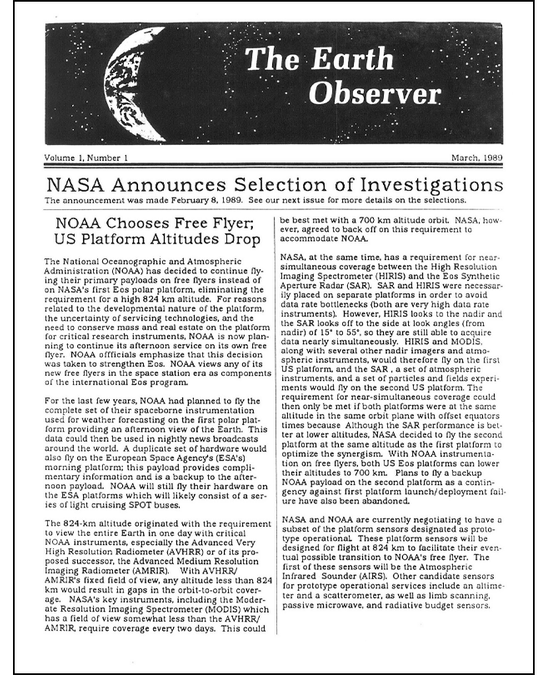
Image (Credit): The first edition of The Earth Observer from March 1989. (NASA)

While most of the press stories have been focused on this week’s closing of a NASA largest research library located at the Goddard Space Flight Center in Maryland, NASA is quietly shutting down a key news source called The Earth Observer. This newsletter was a source of information and data related to the multiple satellites surrounding the Earth and monitoring its health.

In its October to December 2025 edition, Executive Editors Alan Ward stated:

It is with a heavy heart that I announce that NASA Earth Science Communications has directed The Earth Observer to conduct an orderly shutdown of the publication. No new content will be published after Dec. 31, 2025.

This comes at a time when the White House is drastically cutting the Earth science programs at NASA, somehow assuming that if we don’t know what it happening with our planet then we do not need to worry. NASA is being told to shift its focus to other distant worlds where we will probably never go instead of helping to preserve the only world we have.

Space Daily reported that we have already witnessing the end of three critical satellites monitoring Earth as a natural product of time – Terra, Aqua, and Aura – but they are not being replaced to keep the monitoring alive.

In the article, Space Daily noted:

Satellite aging was expected. What was not, Earth scientists say, is the policy shift coming from Washington. The FY26 presidential budget request would cut NASA’s Science Mission Directorate by nearly half, with Earth science funding falling from about 2.14 billion dollars to roughly 1.04 billion dollars, a 52 percent reduction. Commentators and advocacy groups describe the proposal as the steepest single year hit to NASA science since the post Apollo drawdown.

Shutting libraries, deleting data, and ending investments in the future will come back to bite us. Many in the world are interested in keeping this world vibrant and alive, and will do so with our without the United States. While cost-cutting can be justified if it done intelligently, the ongoing scientific suicide is something else entirely.

As Carl Sagan said in his very relevant book, The Demon-Haunted World: Science as a Candle in the Dark:

We’ve arranged a global civilization in which most crucial elements profoundly depend on science and technology. We have also arranged things so that almost no one understands science and technology. This is a prescription for disaster. We might get away with it for a while, but sooner or later this combustible mixture of ignorance and power is going to blow up in our faces.

Study Findings: Satellite Megaconstellations will Threaten Space-based Astronomy

Image (Credit): The Hubble Space Telescope. (NASA)

Nature abstract of the study findings:

Rapidly growing satellite constellations have raised strong concerns among the scientific community. Reflections from satellites can be visible to the unaided eye and extremely bright for professional telescopes. These trails already affect astronomical images across the complete electromagnetic spectrum, with a noticeable cost for operations and mitigation efforts. Contrary to popular perception, satellite trails affect not only ground-based observatories but also space observatories such as the Hubble Space Telescope. However, the current number of satellites is only a fraction (less than 3%) of those to be launched in the next decade. Here we show a forecast of the satellite trail contamination levels for a series of international low-Earth-orbit telescopes on the basis of the proposed telecommunication industry constellations. Our results show that if these constellations are completed, one-third of the images of the Hubble Space Telescope will be contaminated, while the SPHEREx (Spectro-Photometer for the History of the Universe, Epoch of Reionization and Ices Explorer), ARRAKIHS (Analysis of Resolved Remnants of Accreted galaxies as a Key Instrument for Halo Surveys) and Xuntian space telescopes will have more than 96% of their exposures affected, with 5.6,  69 and 92 trails per exposure, respectively, with an average surface brightness of μ = 19 ± 2 mag arcsec−2. Our results demonstrate that light contamination is a growing threat for space telescope operations. We propose a series of actions to minimize the impact of satellite constellations, allowing researchers to predict, model and correct unwanted satellite light pollution from science observations.

Citation: Borlaff, A.S., Marcum, P.M. & Howell, S.B. Satellite megaconstellations will threaten space-based astronomy. Nature 648, 51–57 (2025).

https://doi.org/10.1038/s41586-025-09759-5

Study-related stories:

Scientific American – “Satellites Swarming Low-Earth Orbit Threaten Space Telescopes”

News Scientist – “Planned Satellite Launches Could Ruin Hubble Space Telescope Images”

Orbital Today – “Satellite Boom Set To Disrupt Space Telescopes As Researchers Warn Of ‘Growing Threat’”

Space Quote: British Satellite to Study Impact of Stars on Exoplanets

Credit: Blue Skies Space

“Mauve will open a new window on stellar activity that has previously been largely hidden from view…By observing stars in ultraviolet light, wavelengths that can’t be studied from Earth, we’ll gain a much deeper understanding of how stars behave and how their flares may impact the environment of orbiting exoplanets. Traditional ground-based telescopes just can’t capture this information, so a satellite like Mauve is crucial for furthering our knowledge.”

Statement by Professor Giovanna Tinetti, Chief Scientist and Co-founder of Blue Skies Space, regarding today’s launch of the Mauve cubesat satellite. This satellite contains a 13 cm telescope that will be used to observe hundreds of stars in the ultraviolet and visible wavelengths over a three-year period. Data from this mission will be sold via subscriptions, and used to study the stars and how their activity influences the habitability of distant exoplanets. You can find more information on the mission here.

Space Quote: It’s Raining Satellites

Credit: Image by Mohamed Hassan from Pixabay.

“Jonathan McDowell, an astronomer at the Harvard–Smithsonian Center for Astrophysics in the US, recorded an average of between one to two Starlink satellites deorbiting each day in 2025. That figure is expected to rise to around five per day as SpaceX continues to grow its space internet constellation.”

-Statement in the UK’s Independent newspaper regarding SpaceX’s Starlink satellites burning up in the Earth’s atmosphere. Given that the satellites are only expected to last 5 years and there are already 8,500 in orbit, this should come as no surprise. Fortunately, the satellites are designed to burn up after their useful life space. Of course, that does not necessarily mean that burning debris and the related pollutants are welcome. It will only get worse once Amazon and China start pumping even more satellites into orbit.

The X37-B Mini-Shuttle Returns to Orbit

Image (Credit): The X37-B space plane. (US Space Force)

While the space shuttles are all safely stored in space museums around the country, the U.S. Space Force’s X37B space plane (or uncrewed mini-shuttle) is still in business.

The spacecraft returned to Earth orbit late last week, launched from the Kennedy Space Center. The X-37B can stay in orbit for multiple years, powered by both batteries and solar cells. The latest launch is the eighth such mission.

While the missions are generally classified, they are thought to be basic experiments to enhance the U.S. Space Forces capabilities. For example, the latest mission is testing a quantum navigation sensor that can detect a spacecraft’s location without GPS. Of course, other have said the spacecraft are spying on the Chinese space station and Russian satellites. It is certainly possible that the little shuttle has been busy with all of this.

The two X-37Bs, called autonomous, reusable orbital test vehicles, were built by Boeing and started flying in 2010, one year before the end of the crewed space shuttles servicing the International Space Station (ISS).

It is odd that Boeing has done so well with this shuttle yet so poorly getting a manned capsule safely to and from the ISS, but maybe it has more to do with the skills of Rockwell International, which build the manned shuttles and was later acquired by Boeing.