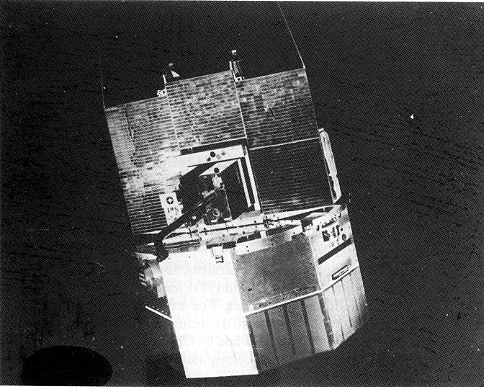
Image (Credit): Artist’s impression of NASA’s Orbiting Solar Observatory 7 circling the Earth. (NASA)
On this day in 1971, NASA launched the Orbiting Solar Observatory 7 satellite to study the Sun. It successfully completed its mission and remained in orbit through July 9, 1974.
According to a December 31, 1972 report by Ball Brothers Research Corporation, the goal of the Orbiting Solar Observatory program was to make observations and measurements contributing to:
Determination of details of the sun’s atmospheric structure, composition and physical state and the process of energy transport radially outward and inward;
Determination of origin, energy supply, and solar/terrestrial consequences of transient solar phenomena such as sun spots, flares, radio bursts, and particle bursts;
Prediction of transient solar events and their consequences by combining data with those from other spacecraft, rockets, balloons, and ground-based observations; and
Secondary objectives including study of the earth and celestial objects.
You can read more about the Orbiting Solar Observatory 7 mission here.
NASA launched eight successful Orbiting Solar Observatory missions in all, but the program had some problems along the way. One satellite launched in 1965 failed to reach orbit, with the satellite burning up in the atmosphere. In another case, a rocket motor test in 1964 went awry, killing three men and wounding eight others.
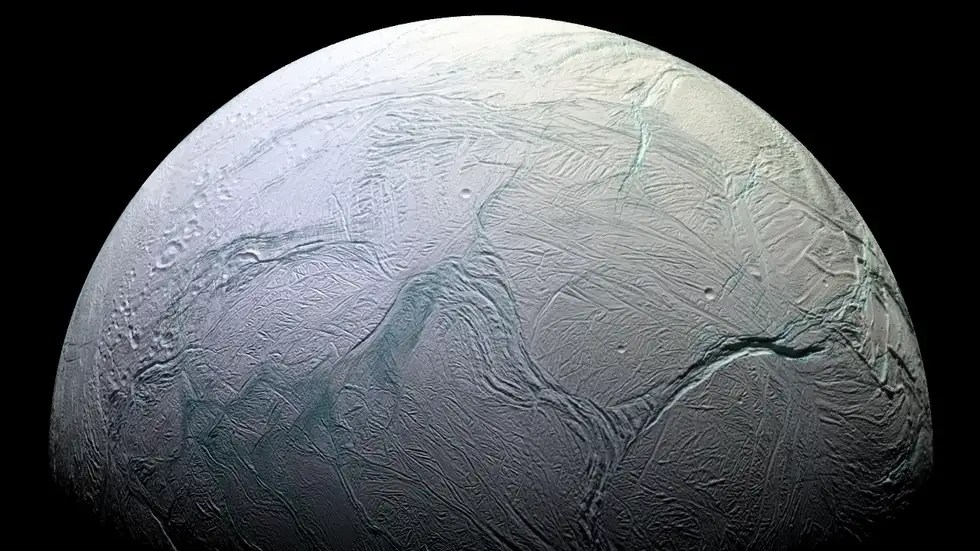
Previously, NASA’s Saturn-studying Cassini spacecraft had discovered Enceladus’ subsurface liquid water as well as the plumes of ice grains and water vapour that erupted from cracks in the moon’s icy surface.Analysis of the plumes had revealed that they contain almost all the basic requirements of life as we know it. But while the bioessential element phosphorus is yet to be identified directly, scientists have now found evidence of its availability in the ocean beneath the moon’s icy crust.
Maarten Schmidt, the Dutch-born American astronomer who explained the mysterious heavenly bodies known as quasars and in so doing helped create the modern picture of the universe, its structure and its history, died Sept. 17 at his home in Fresno, Calif. He was 92.
The space launch services giant was recently rejected for nearly $900 million dollars in rural connectivity funding from the Wireline Competition Bureau (a branch of the Federal Communications Commission, or FCC). SpaceX characterized that decision(opens in new tab) as “grossly unfair” in its Sept. 9 appeal to the regulator, which is under review.
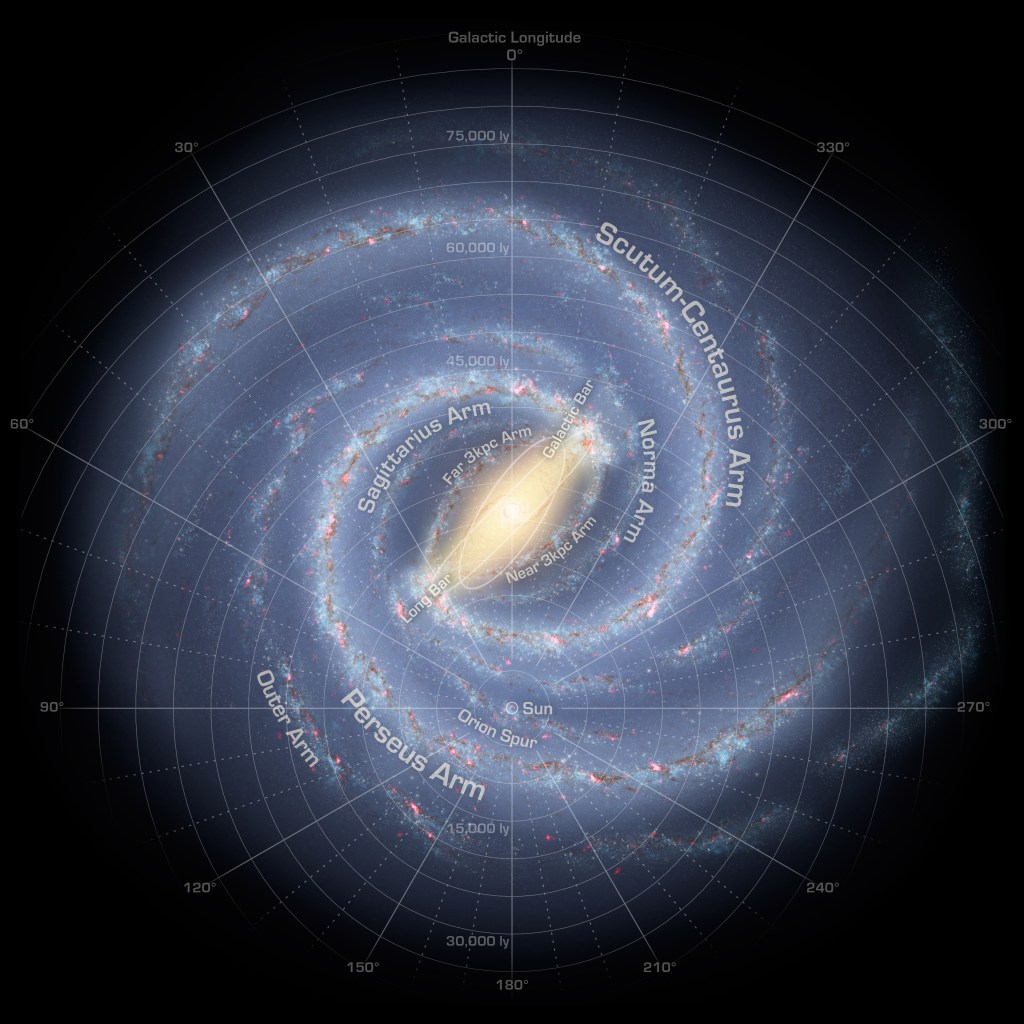
Image (Credit): This annotated artist’s concept illustrates the new view of the Milky Way, along with other findings presented at the 212th American Astronomical Society meeting in 2008 in St. Louis, Missouri. The galaxy’s two major arms (Scutum-Centaurus and Perseus) can be seen attached to the ends of a thick central bar, while the two now-demoted minor arms (Norma and Sagittarius) are less distinct and located between the major arms. The major arms consist of the highest densities of both young and old stars; the minor arms are primarily filled with gas and pockets of star-forming activity. The artist’s concept also includes a new spiral arm, called the “Far-3 kiloparsec arm,” discovered via a radio-telescope survey of gas in the Milky Way. This arm is shorter than the two major arms and lies along the bar of the galaxy. Our sun lies near a small, partial arm called the Orion Arm, or Orion Spur, located between the Sagittarius and Perseus arms. (NASA/JPL-Caltech/R. Hurt (SSC/Caltech))
Earth’s journey through the Milky Way might have helped create the planet’s first continents. Comets may have bombarded Earth every time the early solar system traveled through our galaxy’s spiral arms, a new study suggests. Those recurring barrages in turn helped trigger the formation of our planet’s continental crust, researchers propose August 23 in Geology.
An international team of astronomers reports the discovery of two new “super-Earth” exoplanets orbiting a nearby late-type M dwarf star. The newfound alien worlds, designated LP 890-9 b and LP 890-9 c, are slightly larger than the Earth. The finding has been published in Astronomy & Astrophysics.
Germany and Japan have pledged not to conduct destructive anti-satellite tests that could create dangerous clouds of space debris in orbit. The announcements of these pledges were both made at the second session of the United Nations’ open-ended working group on reducing space threats, which is being held in Geneva from Sept. 12 to Sept. 16…Germany’s and Japan’s announcements follow similar pledges made by the United States, Canada and New Zealand in the wake of Russia’s irresponsible destruction of a satellite in November 2021 that created a massive cloud of space debris.
Image (Credit): USAF’s X-37B Orbital Test Vehicle at Vandenberg AFB, California in June 2009. (USAF)
You may have heard of the U.S. Air Force’s (USAF) X-37B unmanned mini-space shuttle that has been sent into orbit many times in the past. It performed secretive missions for the USAF, yet it now falls under the U.S. Space Force. The X-37B is currently orbiting the Earth and has been doing so since May 2020. While it has been said to carry various NASA experiments, this is probably cover for its other work (given that the International Space Station is more than able to carry out these experiments).
So while we are still trying to figure out the real mission of the X-37B, China is experimenting with its own secret space plane and saying even less. On August 4th, China launched its space plane aboard a Long March 2F rocket for a spin around the globe. This is part of continuing experimental flights.
And just in case you might think Russia is falling behind, it already has spacecraft in orbit that seem to be tracking some U.S. satellites.
What are these nations up to? The role of the U.S. Space Force relates to:
…organizing, training, and equipping Guardians to conduct global space operations that enhance the way our joint and coalition forces fight, while also offering decision makers military options to achieve national objectives.
That does not sound like a scientific mission, which is why the USAF and not NASA owned the spacecraft years back.
More likely than not, while these spacecraft will be able to repair and protect the parent nation’s satellites, they will also be able to block, disable, and destroy the satellites of other nations. Yes, this is the militarization of space and all that means in a time or war – potentially endless debris threatening the missions of the other satellites orbiting the planet.
Like it or not, the space race continues on in many forms.
Note: The U.S. Air Force still has a page on the X-37B that highlights its mission. The page states:
The X-37B Orbital Test Vehicle, or OTV, is an experimental test program to demonstrate technologies for a reliable, reusable, unmanned space test platform for the U.S. Air Force. The primary objectives of the X-37B are twofold; reusable spacecraft technologies for America’s future in space and operating experiments which can be returned to, and examined, on Earth.
Here are the specs for the X-37B:
Primary Mission: Experimental test vehicle
Prime Contractor: Boeing
Height: 9 feet, 6 inches (2.9 meters)
Length: 29 feet, 3 inches (8.9 meters)
Wingspan: 14 feet, 11 inches (4.5 meters)
Launch Weight: 11,000 pounds (4,990 kilograms)
Power: Gallium Arsenide Solar Cells with lithium-Ion batteries
Launch Vehicles: United Launch Alliance Atlas V (501) and SpaceX Falcon 9
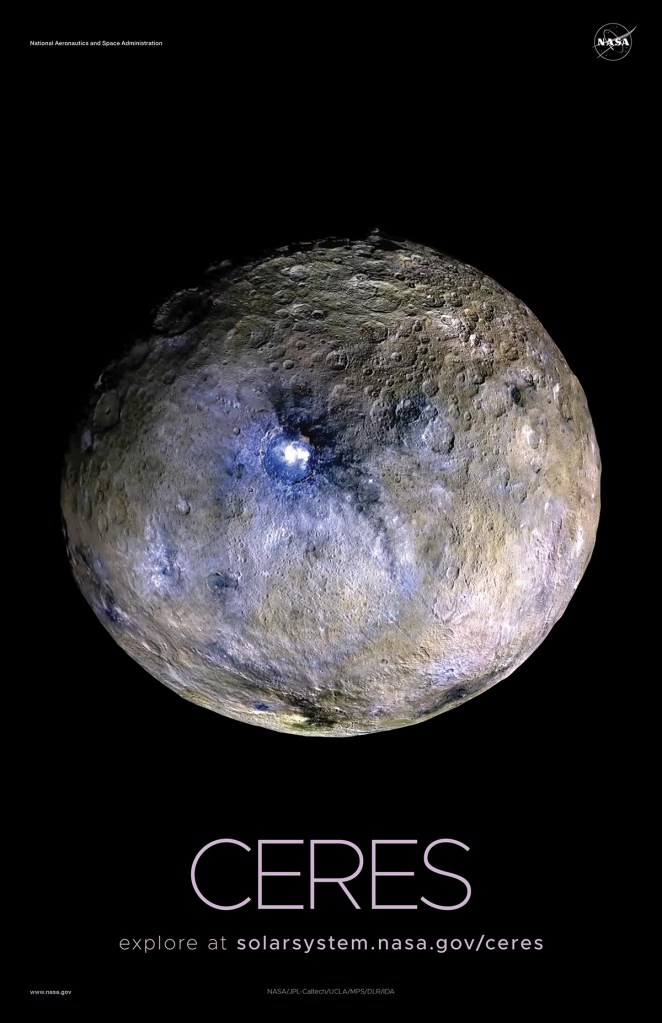
A team of U.S. planetary scientists has shown that unexpected surface features on the dwarf planet Ceres can be explained by radioactive decay in its interior long ago. If they are right, their model could explain features not just on other dwarf planets, but also on some of the icy moons in the outer solar system.
Researchers discover the first definitive proof that the Moon inherited indigenous noble gases from the Earth’s mantle. The discovery represents a significant piece of the puzzle towards understanding how the Moon and, potentially, the Earth and other celestial bodies were formed.
The new generation of Starlink satellites remain above the accepted brightness threshold. It’s one of the stranger sights of the modern Space Age. Recently, we found ourselves under the relatively dark skies of southern Spain. Sure enough, within a few minutes, we caught sight of a chain of flashing ‘stars’ winking in and out of view in quick succession.


 Our Awesome Universe