Second TROPICS Launch a Success

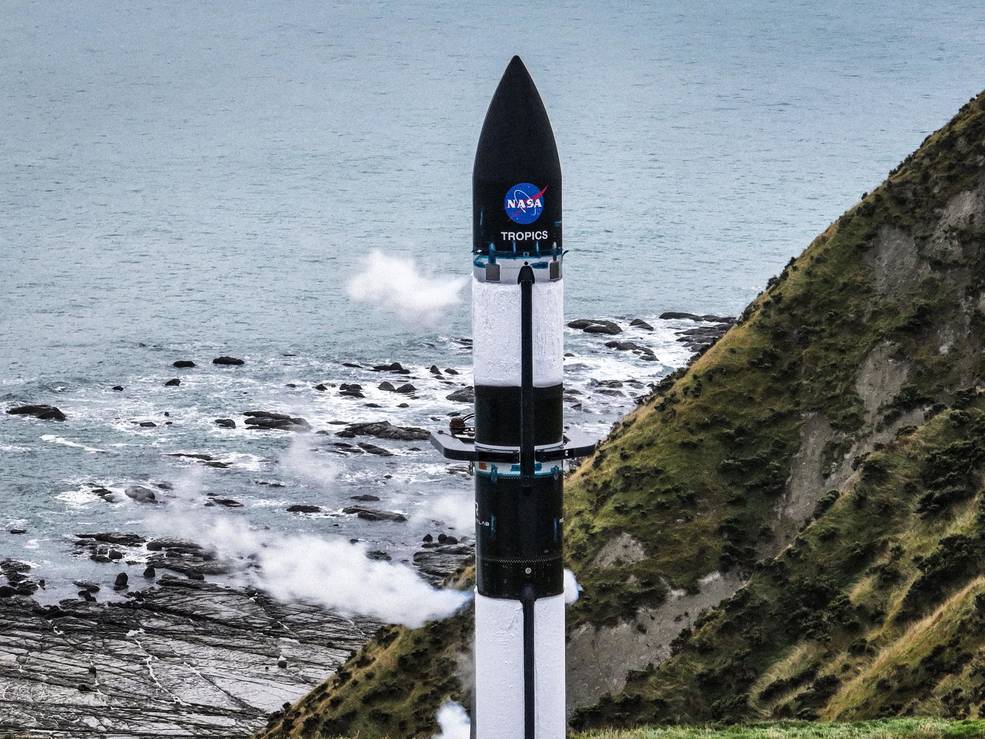
Image (Credit): The TROPICS launch this week from New Zealand. (Rocket Lab)

The second and final TROPICS satellites, also known as Time-Resolved Observations of Precipitation structure and storm Intensity with a Constellation of Smallsats, were launched late yesterday via a Rocket Lab rocket in New Zealand. The first pair were launched earlier this month.

Rocket Lab sent out this message:

Payload deployment confirmed! Congratulations to the launch team on our 37th Electron launch, and to our mission partners at @NASA @NASA_LSP @NASAAmes: the TROPICS constellation is officially on orbit!

NASA now has more eyes on the world’s weather patterns. The lead of NASA’s Earth Science Division, Karen St. Germain, stated:

As we move into hurricane season for 2023, TROPICS will be in position to provide unprecedented detail on these storms, helping us better understand how they form, intensify, and move across the ocean.
TROPICS Starts its Mission

Image (Credit): Rocket Lab’s Electron rocket at Launch Complex 1 in Mahia, New Zealand. (NASA)

On Sunday, the TROPICS mission was successfully launched after an earlier delay. The Rocket Lab Electron launch took place in New Zealand and involved two small CubeSats tasked with monitoring deadly storms. This is the first pair to be launched, with a total of four satellites planned to accomplish the TROPICS mission.

And yes, TROPICS is an acronym (fortunately) for Time-Resolved Observations of Precipitation structure and storm Intensity with a Constellation of Smallsats. And you thought the Congress was going crazy with its acronyms for legislation.

You can read more about the TROPICS mission here.

If You Thought the Skies Were Crowded, Just Wait

Credit: Starlink.

The Washington Post recently published a story, “China’s military aims to launch 13,000 satellites to rival Elon Musk’s Starlink,” that can only terrify astronomers here on Earth trying to view the stars. The title says it all – the space race continues to clutter the skies with more and more low-Earth satellites broadcasting back to the surface. It is a dippy Dyson Sphere that contains scientists rather than energy.

Starlink’s success in Ukraine really bothers the Chinese, who see the network as a lifeline for Taiwan as well. The article quotes Chinese military researchers, who state:

Once the Starshield is completed, it will be tantamount to installing networked surveillance cameras all over the world. At that time, military operations including the launch of ballistic missiles, hypersonic missiles and fighter jets will hardly escape the monitoring of the United States.

I would prefer the space race between the US and China focused on the Moon or Mars rather than local invasions, but that is the state of the world at the moment. Not that the race to the Moon was a completely tame affair. For instance, the US contemplated exploding a nuclear bomb on the surface of the Moon to impress the Russians and everyone else. Fortunately, Project A119 never happened.

One More Rocket Mishap, This Time in Japan

Image (Credit): Japan’s Advanced Land Observing Satellite-3, which was lost in the latest rocket failure. (JAXA)

The string of rocket failures continues. I had earlier mentioned the UK and Alaskan mishaps, while an Arianespace Vega C rocket launch from French Guiana when awry last December, and now Japan has suffered its own failure this week. Tuesday’s failed launch of the Japan Aerospace Exploration Agency’s (JAXA) H3 rocket is a setback for this new rocket. When the second stage of the rocket failed to ignite, the rocket self-destructed. The destruction included the rocket’s payload – the Advanced Land Observing Satellite-3.

In additional to assisting with key Japanese defense and research satellite payloads, the H-3 rocket is part of Japan’s plan to assist with cargo to the International Space Station (ISS) as well as future Artemis missions. Japan will need to figure out what happened here and get back into the game as soon as possible.

Following the recent failure of two Russian capsules at the ISS, this latest mishap demonstrates that both new and well-tested government-run space missions are subject to failure and delays. Redundancy within the commercial space industry will be critical as a backstop to these government-run programs.

SpaceX Agrees to Work with Scientists to Reduce Impact of its Satellites

Image (Credit): Artist’s rendering of a Starlink satellite in orbit. (SpaceX)

Earlier this month, the National Science Foundation (NSF) and SpaceX came to an agreement to “mitigate potential interference” from its Starlink satellites. These satellites have been impacting ground-based radio, optical, and infrared astronomy facilities.

Basically, SpaceX agreed to continue working on recommendations and best practices from the scientific community, ensure the second generation of Starlink satellites are darker and less intrusive in the night sky, continue to assist with studies on the satellites impact on astronomy facilities, and improve overall coordination with these scientific facilities.

It is a tall order, but any company pumping thousands of satellites into the night sky should have some responsibilities to others using that same sky. SpaceX is just the first of many companies with big plans for the night sky, so maybe this will set a precedent for the satellites that follow, or at least the U.S. satellites. I am note sure we can do anything about the Chinese and others, but the United Nations cans certainly create similar standards at the international level.

In the agreement, the NSF stated:

NSF and SpaceX have collaborated from the beginning on how best to meet the goals of protecting astronomy while also providing maximum internet access for communities across the United States. The mitigation steps taken can and should serve as a model for coordination among satellite operators and the astronomy community within the United States and beyond.

Let’s hope the NSF is right.