Prepare for Thousands More LEO Satellites

Image (Credit): Launch vehicles for Amazon’s Project Kuiper. (Amazon)

Watch out SpaceX, Amazon is getting into the Internet satellite business as well. More importantly, beware astronomers and orbiting spacecraft, because the skies are going to be really crazy, and China has not even started with its massive program.

This week, Amazon announced plans to more forward with Project Kuiper, which will involve about 83 rocket launches involving Arianespace, Blue Origin, and United Launch Alliance. The Project will place 3,236 satellites into low Earth orbit (LEO) over a five-year period.

This is how Amazon describes Project Kuiper:

Project Kuiper aims to provide high-speed, low-latency broadband to a wide range of customers, including individual households, schools, hospitals, businesses, government agencies, disaster relief operations, mobile operators, and other organizations working in places without reliable internet connectivity. Amazon is designing and developing the entire system in-house, combining a constellation of advanced LEO satellites with small, affordable customer terminals and a secure, resilient ground-based communications network. 

Of course, this is what SpaceX’s Starlink is already doing as it aims for 42,000 such satellites. In addition, Oneweb aims for about 600 such satellites (to be launched by SpaceX of all firms). And China is considering a similar system of 10,000 LEO satellites. This is just the list to date, which is quite a cluster of problems already.

So let me get this straight. We can get Dish TV cable services to every spot in the US using only 9 satellites, but we will need thousands and thousands of competing satellites crowding LEO and jeopardizing our space stations, weather and intelligence satellites, and astronomy efforts all for Internet services?

Why does it appear we are going backwards. I understand that the Dish satellites are about 22,000 miles away in geosynchronous orbits, but why can’t that be the model going forward rather than the billions of satellites that Mr. Musk thinks is possible? It strikes me as crazy to go down this path. All we need is one bad collision, and the cascading impact of that collision, to doom all of LEO.

We really need to think this through.

Ukraine and Starlink

Source/Credit: Starlink terminals posted in a Ukrainian tweet.

Three cheers for SpaceX’s assistance to Ukraine during this difficult time. After Ukrainian Vice Prime Minister Mykhailo Fedorov made a plea to SpaceX for assistance with its Internet, Mr. Must approved the shipment of Starlink terminals to Ukraine to allow the country to use the company’s satellites for its communications.

Vice Prime Minister Fedorov had tweeted:

@elonmusk, while you try to colonize Mars — Russia try to occupy Ukraine! While your rockets successfully land from space — Russian rockets attack Ukrainian civil people! We ask you to provide Ukraine with Starlink stations and to address sane Russians to stand.

We can haggle about the number of Starlink satellites in orbit another time. Fortunately, such satellites are there when the beleaguered Ukrainians need them.

You can read more about it via The Verge.

Russia Interrupts Space Missions

Source/Credit: Guiana Space Center launch pads from the ESA.

Be prepared. With the ongoing Russian invasion of Ukraine and the related U.S. and European sanctions, we can expect some delays and cancellations in upcoming space missions. The latest news story is Russia’s pull out of the Guiana Space Center in Kourou, French Guiana, leading to the delayed launch of two European Space Agency (ESA) Galileo navigation satellites that were to be sent into orbit on Soyuz rockets.

Director General of Russia’s Roscosmos tweeted:

In response to EU sanctions against our enterprises, Roscosmos is suspending cooperation with European partners in organizing space launches from the Kourou cosmodrome and withdrawing its technical personnel, including the consolidated launch crew, from French Guiana.

Luckily, the world is becoming less and less reliant on Russian rockets. Nonetheless, it would be better for Russia to focus on scientific missions again rather than military missions. Rockets should be aimed at the stars instead of the Ukrainian people.

Disarming Space Will Have to Wait

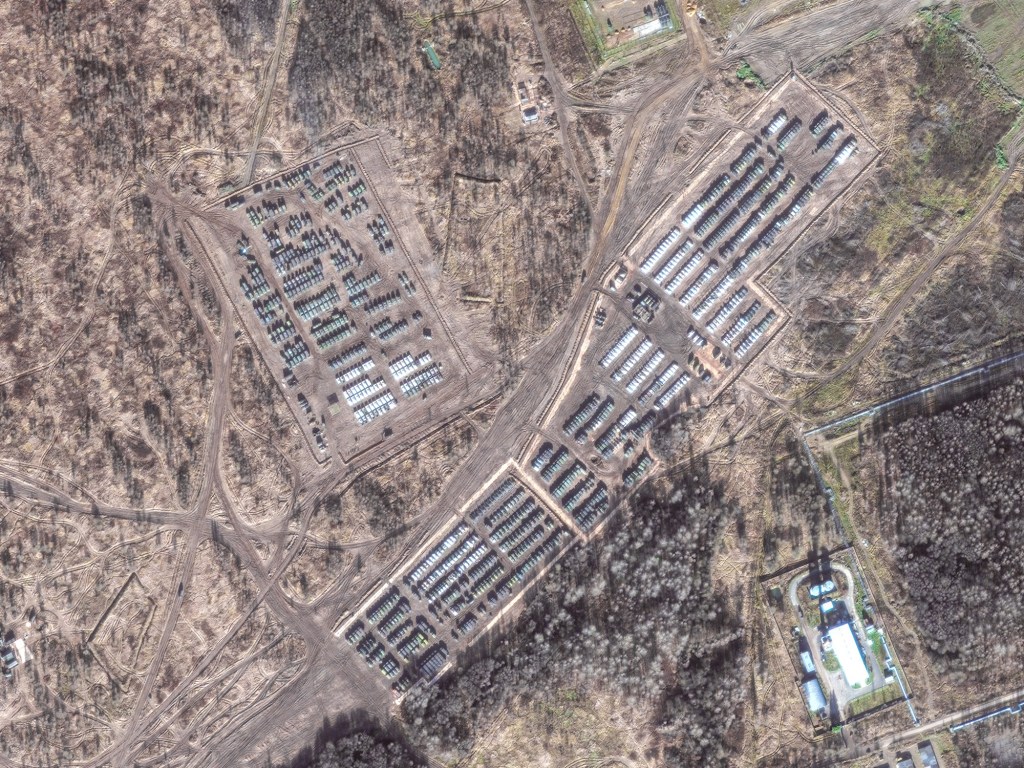
Source/Credit: Satellite imagery showing the military buildup in Yelnya, Russia as of November 1, 2021 from Maxar Technologies/Getty Images.

Politico reported this week that Russia has asked that next week’s discussion at the United Nations (U.N.) about arms in space be delayed. It is possible the Russians are busy preparing for war in Ukraine and have little time to look up. But it should be possible to resolve matters here on the surface and in space.

The  U.N. Committee on Disarmament established a working group after seeking member input on the “…development and implementation of norms, rules and principles of responsible behaviours and on the reduction of the risks of misunderstanding and miscalculations with respect to outer space.” Sounds like a good idea to me. You can find the report with the members’ input here.

Here is part of what the United States submitted in its response to the U.N. query:

Some States are developing, operationalizing, and stockpiling a variety of [anti-satellite] weapons that could be used to, or have the potential to, deny, disrupt, degrade, or destroy civil, commercial, or national security space capabilities and services. Some of these anti-satellite weapons could be used to deny or disrupt space services temporarily, while others are designed to permanently degrade or destroy satellites.

These threats against satellites and their supporting systems can generally be divided into four categories: 1) ground-space; 2) space-space; 3) ground-ground; and 4) space-ground. Within these categories, the threats can be described as 1) reversible, which include temporary effects such as interference with radiofrequency signals or dazzling of remote sensing systems, or 2) irreversible, which include measures that degrade or destroy a satellite. The consequences of all categories of threats could include loss of mission data; decreased lifespan or capability of space systems or constellations; the loss of positive control of space vehicles, potentially resulting in collisions that could impair systems or generate harmful orbital debris; or damage to or destruction of the space system.

The working group should have plenty to discuss if it can get everyone together. Let’s hope the Ukrainian matter can be resolved peacefully to allow work to start on a stable peace in space as well.

Note: The dates on the article and U.N. schedule do not align, but the main point about the Russians being too busy to worry about a space war remains the same.

Chinese Space Debris Clean-up or Something Else?

Source/Credit: Chinese Shijian-21satellite from Asia Times.

Phys.org reported the success of a Chinese mission to retrieve a dead satellite, a hopeful sign given the increasing number of satellites and related debris in orbit. The story, “A Chinese space tug just grappled a dead satellite,” discusses how the Chinese spacecraft, Shijian-21, retrieved a dead navigation satellite belonging to the Chinese CompassG2 network. The story also included a video from ExoAnalytic Solutions demonstrating the retrieval and eventual release of the CompassG2 satellite into a graveyard orbit.

Of course, every pro comes with a con. Is this just a maintenance spacecraft or could it be part of a future offensive strategy to take other non-Chinese satellites out of orbit? The media in India were skeptical, as you can see from this headline: “China Preparing for War in Space?” Not that China is alone should it be looking for an anti-satellite spacecraft. Other countries, including the US, have similar dual-use spacecraft.

According to the Phys.org article, the Chinese have been silent, so the whole operation is somewhat opaque. Given the various attempts by other nations to solve the debris problem, it benefits each nation to share information on debris mitigation efforts so everyone can learn from them. Greater transparency from China would be nice.