Space Stories: Radioactive Ceres, Moon Clues, and Starlink’s Shine

Here are some recent stories of interest.

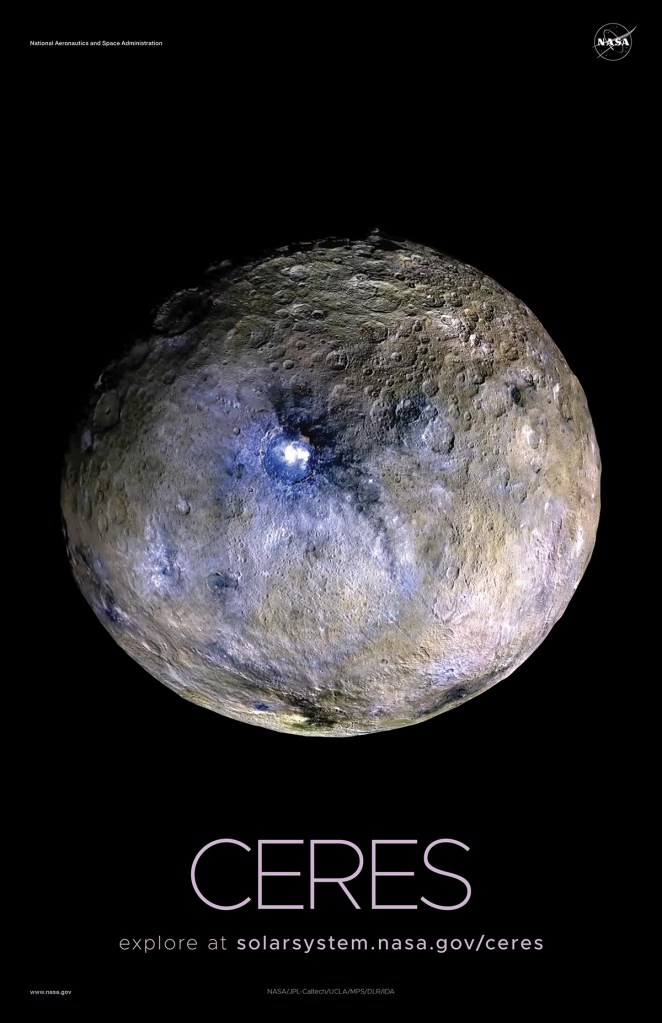
—SkyandTelescope.org: “Asteroid Ceres Was Radioactive — And That Could Explain a Lot“

A team of U.S. planetary scientists has shown that unexpected surface features on the dwarf planet Ceres can be explained by radioactive decay in its interior long ago. If they are right, their model could explain features not just on other dwarf planets, but also on some of the icy moons in the outer solar system.

—ScienceDaily.com: “One More Clue to the Moon’s Origin“

Researchers discover the first definitive proof that the Moon inherited indigenous noble gases from the Earth’s mantle. The discovery represents a significant piece of the puzzle towards understanding how the Moon and, potentially, the Earth and other celestial bodies were formed.

—UniverseToday.com: “Starlink Satellites Are Still Bright“

The new generation of Starlink satellites remain above the accepted brightness threshold. It’s one of the stranger sights of the modern Space Age. Recently, we found ourselves under the relatively dark skies of southern Spain. Sure enough, within a few minutes, we caught sight of a chain of flashing ‘stars’ winking in and out of view in quick succession.
Profile: The Cosmosphere

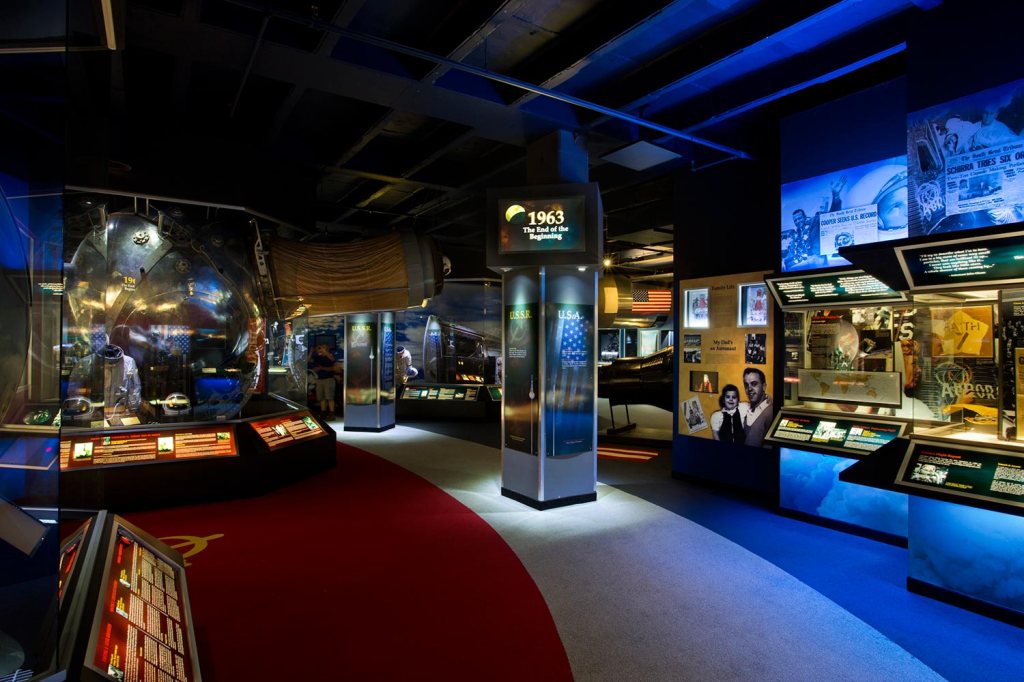
Image (Credit): Exhibits at the Cosmosphere’s Hall of Space Museum. (Cosmosphere)

You may have visited the Smithsonian National Air and Space Museum or ventured down to Florida to visit the Kennedy Space Center, but have you heard of the Cosmosphere in Kansas?

Started in 1962, the Cosmosphere in Hutchinson, Kansas claims to host “…the largest combined collection of U.S. and Russian space artifacts in the world and telling the comprehensive story of mankind’s race to space unlike anywhere else on Earth.”

For example, here are a few of the items you can view at the museum:

  • Flown Liberty Bell 7 Mercury spacecraft;
  • Flown Gemini X spacecraft;
  • Flown unmanned Russian Vostok;
  • Flown Apollo 13 command module, Odyssey;
  • Apollo space suits; and
  • Russian Sokul Spacesuit.

You can also find material related to German V-1 and V-2 rockets, Cold War spying, X-planes, and more. The expanded multinational coverage of space and conflict makes this a unique destination.

Image (Credit): A German V-1 rocket from World War II in the Hall of Space Museum. (Cosmosphere)

Astra Rocket Failure Impacts TROPICS Mission

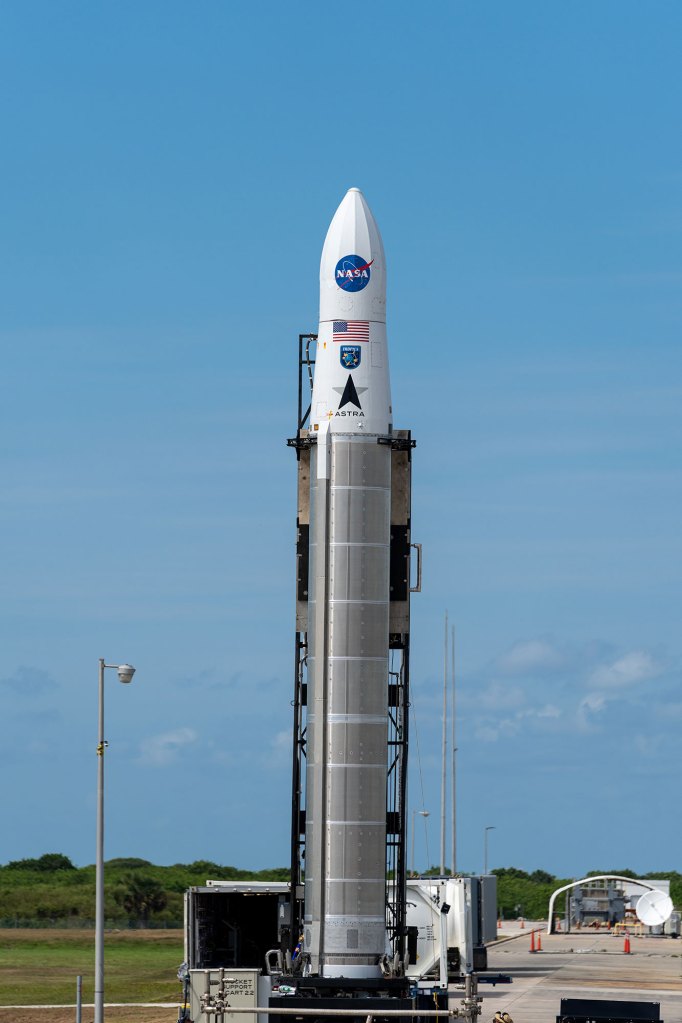
Image (Credit): Astra rocket for the TROPICS satellites. (Astra)

This weekend we witnessed another example that space operations are risky. On Sunday, Astra’s Rocket LV0010 launched from Cape Canaveral but was unable to place two satellites into orbit. The satellites were part of NASA’s TROPICS-1 mission. The main issue was the engine on the upper portion of the rocket.

As described by Astra on its website, the launch of the Time-Resolved Observations of Precipitation structure and storm Intensity with a Constellation of Smallsats (TROPICS) mission was awarded to Astra in February of this year and “consists of a constellation of six small satellites that will observe tropical cyclones, aiming to improve the scientific community’s understanding of these dangerous weather events.” This was the first of three such launches, leaving four satellites untouched and ready to go once Astra, NASA, and the Federal Aviation Administration figure out what happened this weekend.

This is not the first NASA mishap. Back in February, Rocket LV0008 (also launched from Cape Canaveral) suffered an in-flight anomaly during stage separation. As a result, NASA’s Educational Launch of Nanosatellites (ELaNa 41) mission to place CubeSats into orbit failed. CubeSats are miniature satellites designed to provide a low-cost plat­form for NASA missions.

Astra is a relatively new entrant to in the commercial space industry having been founded in 2016. Let’s hope the lessons learned from this mishap and persistence will allow the company to thrive in this competitive and risky industry.

The Chinese Elon Musk?

Credit: Geely Auto

Have you read about the Chinese car company with space ambitions? In a June 2 press release, we learn that a unit of the Chinese automaker Geely (owner of Volvo, Polestar, and Group Lotus) already sent 9 communications satellites into orbit this year, with plans for a total of 240 such satellites in a constellation that will assist car drivers with autonomous driving.

Of course, automaker Elon Musk is also launching satellites into space as part of the Starlink program, but that is about the end of the similarities for now. In addition to planning to launch fewer satellites with a more restricted mission, Geely will depend upon Chinese government rockets to launch these satellites. Mr. Musk has his own SpaceX rockets to assist Starlink.

That does not mean Geely lacks in ambition elsewhere. In the same press release, Geely stated:

With the successful launch and operation of Geespace’s first satellites, the company will become one of the world’s first providers of combined commercial Precise Point Positioning and Real-Time Kinematic services (PPP-RTK)…

Tony Wang, CEO and Chief Scientist of Geespace said: “Many favourable factors such as policy support and market demand is accelerating the growth of the commercial aerospace sector...new opportunities to develop have been opened in various sectors including smart mobility, consumer electronics, unmanned systems, smart cities, and environmental protection.”

And while Geely is not building rockets at this time, it is building satellites:

Early in September 2021, Geely’s Intelligent Satellite Production and Testing Centre began mass production of commercial satellites with an annual production capacity of 500 units. Through intelligent modular manufacturing, Geespace is able to produce high-quality, easily customizable satellites to meet the growing global demand for commercial satellites. The GeeSAT-1 is only the first of many new satellite models from Geespace and its successful launch into orbit is just the first of many to come.

Watch out, Elon!

Another Member of the Reusable Rocket Club

Credit: Rocket Lab

Blue Origin did it, SpaceX did it, and now Rocket Lab wants to do it. The “it” is to successfully retrieve rocket boosters so they can be reused in the future. Back on April 6th, Rocket Lab stated:

For the first time, Rocket Lab will also attempt a mid-air capture of Electron’s first stage as it returns from space after launch, the next major step in the Company’s development program to make Electron a reusable rocket. Rocket Lab will be attempting the catch with a customized Sikorsky S-92, a large twin engine helicopter typically used in offshore oil & gas transport and search and rescue operations.

According to CNN, after a few delays the Rocket Lab mission called “There and Back Again” was successful in grabbing the rocket booster. Time will tell whether the captured booster is in fact reusable. As of this posting, Rocket Lab had yet to post its own press release on the mission.

It seems like a risky approach to use pilots rather than a self-controlled landing, but Rocket Lab has explained that its Electron rocket is too small to carry the amount of fuel necessary to land itself. The CNN article also pointed out that the U.S. retrieved material mid-air in the past when planes were used to capture film canisters dropped from spy satellites.

Rocket Lab has been a quiet player so far in the space race, but its showing steady gains. It’s website stated it has already launched 146 satellites, and another 1,700+ satellites in orbit are using Rocket Lab technology. It is great to have some depth in the commercial space market.