Space Stories: Stargazing Apps, Ringless Jupiter, and Detecting Exoplanets

Image (Credit): This enhanced color view of Jupiter’s south pole was created by citizen scientist Gabriel Fiset using data from the JunoCam instrument on NASA’s Juno spacecraft. (NASA/JPL-Caltech/SwRI/MSSS/Gabriel Fiset)

Here are some recent stories of interest.

Mashable.com:The Best Astronomy Apps for Stargazing This Summer

Thanks to these astronomy apps, you can use your phone to see which stars and constellations are above you in real time, day or night. Whether you’re planning on stargazing, are curious about which constellations are in your location, or simply want to flex on your family and friends around the campfire, the following apps can show you what you’re seeing in the sky.

Technology.org:Why Jupiter Doesn’t Have Rings Like Saturn

To understand the reason Jupiter currently looks the way it does, Kane and his graduate student Zhexing Li ran a dynamic computer simulation accounting for the orbits of Jupiter’s four main moons, as well as the orbit of the planet itself, and information about the time it takes for rings to form. Their results are detailed here, soon to be published in the Planetary Science journal.

ScienceDaily.com:A New Method to Detect Exoplanets

In recent years, a large number of exoplanets have been found around single ‘normal’ stars. New research shows that there may be exceptions to this trend. Researchers suggest a new way of detecting dim bodies, including planets, orbiting exotic binary stars known as Cataclysmic Variables (CVs).

A Day in Astronomy: Cassini Orbits Saturn

Image (Credit): On July 29, 2011, Cassini captured five of Saturn’s moons in a single frame with its narrow-angle camera. This is a full-color look at a view that was originally published in September 2011. Moons visible in this view: Janus is on the far left; Pandora orbits just beyond the thin F ring near the center of the image; brightly reflective Enceladus appears above center; Saturn’s second largest moon, Rhea, is bisected by the right edge of the image; and the smaller moon Mimas is seen just to the left of Rhea.. (NASA/JPL-Caltech/Space Science Institute)

On this day 2004, the Cassini spacecraft entered the orbit of Saturn. A collaboration of NASA, the European Space Agency (ESA), and the Italian Space Agency, the mission containing NASA’s Cassini space probe and ESA’s Huygens probe was launched in October 15, 1997. Cassini remained in orbit around Saturn from 2004 to 2007. The Cassini spacecraft spent 20 years in space – 13 of them exploring Saturn and its moons.

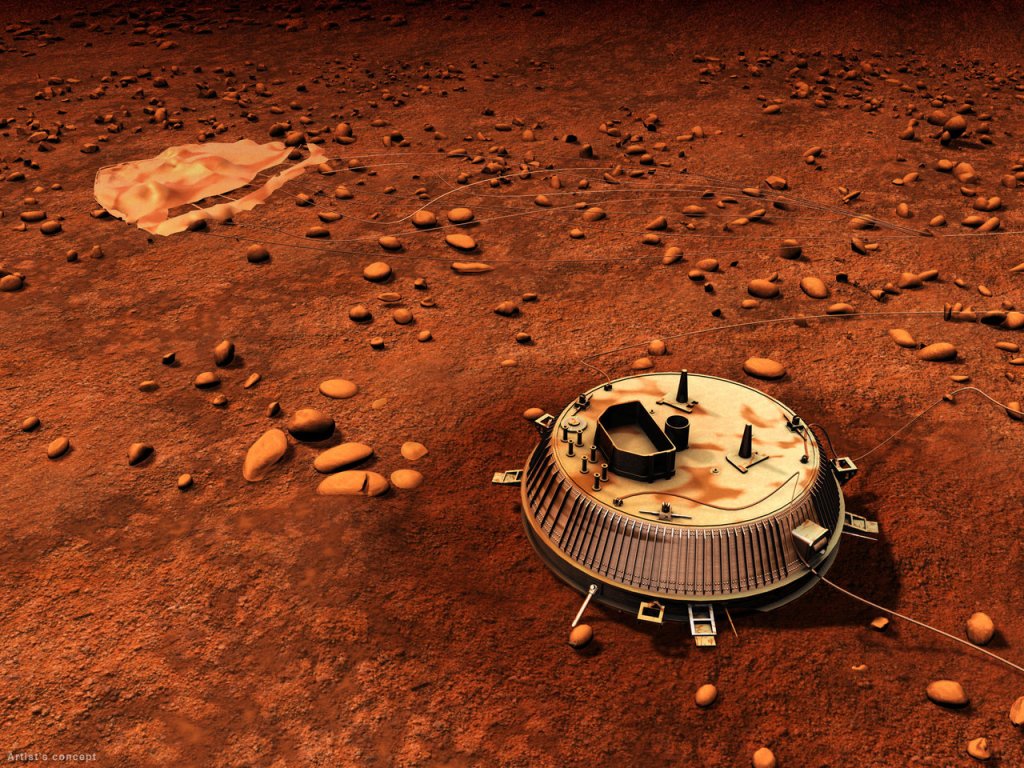
The ESA’s Huygen’s probe entered the atmosphere of Saturn’s largest moon Titan on January 14, 2005 to study the moon’s smog-like atmosphere and take pictures from the surface. The probe was not designed to survive past landing, though it was able to take photos for about three hours before it died. You can watch the probe enter Titan’s atmosphere in this video from ESA.

Image (Credit): An artist’s concept of the Huygens probe on Titan. (NASA)

Television: The End of “The Expanse”

Source: The Expanse on Amazon Prime.

This week Amazon Prime released the final episode of the The Expanse, a brilliant space drama that has been running for six seasons, first on Syfy and later on Amazon Prime. Based on a series of books written by James S. A. Corey (a two-person team), it tells the story of a settled solar system where the old problems dividing all of us are simply moved onto a larger playing field. Mars and Earth are jockeying for power while the miners in the asteroid belt creating the necessary resources feel forgotten and abused. War ensues as does new discoveries (and related weapons), which simply get folded into the ongoing battles. And the playing field widens again as a portal, called the Ring, gives the warring factions access to more star systems and planets.

The television series is a wonder to watch, with excellent acting, fantastic story-lines, and the creative use of venues in our solar system, from Ceres in the asteroid belt to the various moons of Jupiter, Saturn, and Uranus. It is also a very dark show as it illustrates an ugly side to our expansion into new worlds – ruthless ambition, terrorism, revolution, and civil war.

I have not seen anything like it since the remake of Battlestar Galactica, and I would put it on the same level (with some better special effects given the time that has passed). But the most important part is the characters, and you will find a team in the center of this series that you would follow anywhere.

If you are new to the series, you are in for a lot of fun. If you are finishing the series like me and you have only experienced the television show, I think the next step is to dig into the books to live in this world a little longer.

Extra: Check out this Den of Geek article concerning whether The Expanse will continue in any format – “The Expanse: The Possibility of a Season 7 or Sequel Series.”