Are We Too Focused on the Goldilocks Zone?

Image (Credit): Saturn’s moon Enceladus. (NASA)

Astronomers peering into the night sky always talk about exoplanets located in the “Goldilocks Zone,” or “Habitable Zone,” similar to the Earth’s location from the sun. But what if that is too limited? What if we should also be focusing on colder regions as well as exomoons?

The new study released this week based on data from NASA’s spacecraft Cassini has found that Saturn’s moon Enceladus contains the ingredients for life as we know it. The study states:

Saturn’s moon Enceladus harbours a global ice-covered water ocean. The Cassini spacecraft investigated the composition of the ocean by analysis of material ejected into space by the moon’s cryovolcanic plume. The analysis of salt-rich ice grains by Cassini’s Cosmic Dust Analyzer enabled inference of major solutes in the ocean water (Na+, K+, Cl, HCO3, CO32–) and its alkaline pH. Phosphorus, the least abundant of the bio-essential elements, has not yet been detected in an ocean beyond Earth. Earlier geochemical modelling studies suggest that phosphate might be scarce in the ocean of Enceladus and other icy ocean worlds. However, more recent modelling of mineral solubilities in Enceladus’s ocean indicates that phosphate could be relatively abundant.

Again, this represents the building blocks of life and it is the first time all these ingredients have been discovered in our solar system outside of Earth. We did not find it on Venus or Mars, two other planets in the Goldilocks Zone. No, it was found in a much colder part of the solar system on a tiny moon.

This discovery certainly mixes up the situation and provides a much broader region for life to appear in other solar systems. It’s not a new idea, but it has more credibility now that we know a little more about our own neighborhood.

Maybe Goldilock’s concerns about something being too cold was not such a problem after all.

Note: It seems James Cameron figured this out years ago. The planet visited in the Avatar movies, Pandora, is portrayed as a moon (or exomoon) in the Alpha Centauri System.

Image (Credit): Pandora and its host  gas giant Polyphemus from the movie Avatar. (20th Century Fox)

A Day in Astronomy: The Founding of the European Space Agency

On this day in 1975, the European Space Agency (ESA) was founded after the combination of  the European Space Research Organisation (ESRO) and the European Launcher Development Organisation (ELDO). Ten countries were part of this new organization, which has since grown to 22 members (noted below). The Agency also has associate members and other cooperating partners.

You can find a list of the ESA’a past, present, and planned space missions here, which includes:

Note: According to the International Astronautical Federation, the ESA member include Austria, Belgium, the Czech Republic, Denmark, Estonia, Finland, France, Germany, Greece, Hungary, Ireland, Italy, Luxembourg, the Netherlands, Norway, Poland, Portugal, Romania, Spain, Sweden, Switzerland and the United Kingdom. Latvia, Lithuania and Slovenia are Associate Members. Canada takes part in certain programmes under a cooperation agreement. ESA has signed European Cooperating States Agreements with Bulgaria, Cyprus and Slovakia, and cooperation agreements with Croatia and Malta.

Saturn is Winning the Moon Contest

Image (Credit): Saturn’s Death Star-like moon Tethys. (NASA)

So Saturn now has 145 moons due to the discovery of 62 new moons, which is 50 more than the next closest competitor, Jupiter, with 95 moons. You can thank the University of British Columbia (UBC) for the new moon count.

The new discoveries come from a process used by UBC astronomers called ‘shift and stack’:

Shifting a set of sequential images at the rate that the moon is moving across the sky results in enhancement of the moon’s signal when all the data is combined, allowing moons that were too faint to be seen in individual images to become visible in the stacked image. The team used data taken using the Canada-France-Hawaii Telescope (CFHT) on top of Mauna Kea, Hawaii between 2019 and 2021. By shifting and stacking many sequential images taken during three hour spans, they were able to detect moons orbiting Saturn down to about 2.5 kilometres in diameter.

So, as you can read, some of these moons are pretty small. As of today, NASA was still showing 124 moons around Saturn, and another site, theplanets.org, is showing only 62 moons total around the planet. It appear the space agency and others will need to update their pages to show the new mini-moons.

For some reason I doubt the counting is over, just like identified dwarf planets, that seem to range from 5 to 19 at the moment, depending on the source.

Space Stories: Jovian Moons, Charon’s Canyons, and a New Space Telescope

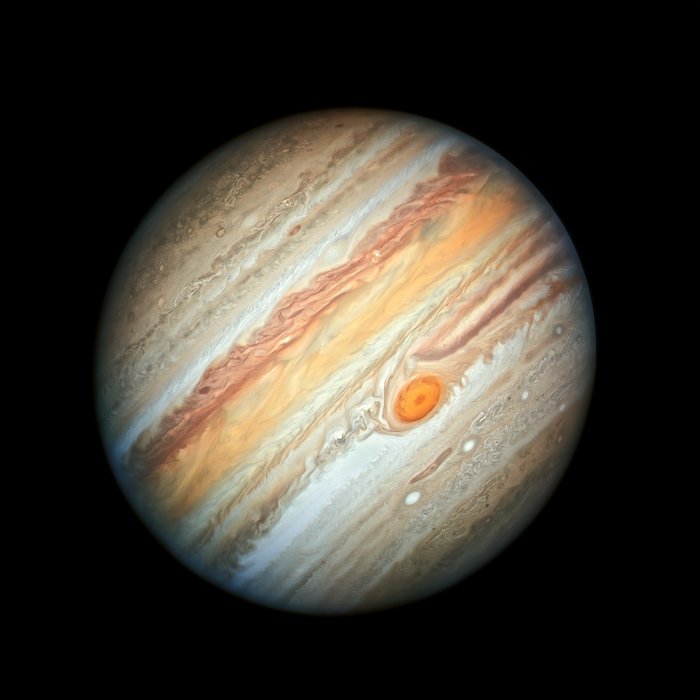
Image (Credit): Jupiter as seen by the NASA/ESA Hubble Space Telescope. (NASA, ESA, A. Simon (Goddard Space Flight Center), and M.H. Wong (University of California, Berkeley)

Here are some recent stories of interest.

Live Science: “Jupiter Officially has the Most Moons in the Solar System, Discovery of 12 New Satellites Confirms

Jupiter was already the king of the solar system, and new discoveries give the massive planet another way to reign supreme: It now has the most moons. Twelve new moons discovered orbiting Jupiter have been confirmed, bumping the count from 80 to 92, and knocking Saturn — which has 83 moons — down a peg. 

Phys.org: “Models Explain Canyons on Pluto’s Large Moon Charon

In 2015, when NASA’s New Horizons spacecraft encountered the Pluto-Charon system, the Southwest Research Institute-led science team discovered interesting, geologically active objects instead of the inert icy orbs previously envisioned. An SwRI scientist has revisited the data to explore the source of cryovolcanic flows and an obvious belt of fractures on Pluto’s large moon Charon. These new models suggest that when the moon’s internal ocean froze, it may have formed the deep, elongated depressions along its girth but was less likely to lead to cryovolcanoes erupting with ice, water and other materials in its northern hemisphere.

Big Think: “NASA’s Habitable Worlds Observatory to Finally Answer the Epic Question: “Are we Alone?”

…perhaps the biggest question of all — that of “Are we alone in the Universe?” — remains a mystery. While the current generation of ground-based and space-based telescopes can take us far into the Universe, this is a question that’s currently beyond our reach. To get there, we’ll need to directly image Earth-like exoplanets: planets with sizes and temperatures similar to Earth, but that orbit Sun-like stars, not the more common red dwarf stars like Proxima Centauri or TRAPPIST-1. Those capabilities are precisely what NASA is aiming for with its newly announced flagship mission: the Habitable Worlds Observatory. It’s an ambitious project but one that’s well worth it. After all, finding out we’re not alone in the Universe would quite possibly be the biggest revolution in all of science history.

Space Quote: Nukes in Space

Image (Credit): NASA’s Cassini spacecraft lifts off on Oct. 15, 1997, atop a Titan IVB rocket. (NASA)

“NASA should educate the public about why nuclear propulsion is not only something nice to have, but is a necessity if human civilization is to spread beyond the Earth on a greater scale than a few explorers. Access to the mineral and energy resources of the solar system would be a boon to all humankind and would be worth the infinitesimal risk of launching nuclear fuel into space.”

-Statement by Mark R. Whittington in an editorial in The Hill titled “Will the NASA-DARPA nuclear engine test cause environmental protests?” In his piece, Mr. Whittington discusses plans to build a nuclear-powered rocket for a Mars mission and highlights how protests surrounded the 1997 launch of the nuclear-powered Cassini probe to Saturn, with one scientist estimating that “an explosion on the launch pad could spread radioactive plutonium across Central Florida, potentially cause more than 1 million casualties…” Mr. Whittington is the author of various space exploration studies, such as Why is It So Hard to Go Back to the Moon?