Image (Credit): The stellar nursery 30 Doradus, nickname of the Tarantula Nebula, captured by the James Webb Space Telescope. (webb.nasa.gov)
Given that 2022 was a busy year, I thought I would highlight the top astronomy stories on the site – the good and the bad covering space missions to TV shows. Unlike other websites, I waited until the new year to create the list just in case we were visited by extraterrestrials. In this way, we now have a full catalog of the 2022 happenings.
Here is the list in no particular order other than science first, politics and commercial space second, and entertainment third.
On a recent episode of the Clear + Vivid podcast, Alan Alda interviewed NASA engineer Les Johnson about his efforts to develop a solar sail that can take us to the stars. He is the Principal Investigator for the NEA Scout, which was launched into space during the Artemis I mission and is now heading towards a near-Earth asteroid via solar sails (see above).
During the interview, Mr. Johnson discussed the NEA Scout as well as his hopes for future human travel to the stars using solar sails, noting that while slow, the sails can outperform modern rocket engines in the long-run. He also pointed out that a solar sail may be able to get us to Proxima Centauri, the closest neighboring star, in hundreds of years versus the 70,000 years it will take the Voyager spacecraft to travel that same distance. I like how he puts such a mission in perspective, pointing out it took hundreds of years to build some of the great cathedrals.
Messrs. Alda and Johnson also discussed the ethics of space travel considering astronauts will be spending generations in space with many humans never seeing either the Earth or the destination in their lifetime. Mr. Johnson said space lasers may be another option for interstellar travel at some point in the future, reducing the travel time to Proxima Centauri to 40-50 years. Given the time spans, he said it may make sense to initially send robots into space first.
Finally, the podcast covered missions closer to Earth, such as mining asteroids for water and minerals, as well as 3D printing to create what we need in space. It sounded a lot like the situation in find in the science fiction TV series The Expanse.
Overall, it was a great conversation worth a few minutes of your day. Check it out.
Extra: Mr. Johnson is also the author of several books, including the co-authored Saving Proxima. Here is a quick summary of that tale:
2072. At the lunar farside radio observatory, an old-school radio broadcast is detected, similar to those broadcast on Earth in the 1940s, but in an unknown language, coming from an impossible source—Proxima Centauri. While the nations of Earth debate making first contact, they learn that the Proximans are facing an extinction-level disaster, forcing a decision: will Earth send a ship on a multiyear trip to render aid?
Interstellar travel is not easy, and by traveling at the speeds required to arrive before disaster strikes at Proxima, humans will learn firsthand the time-dilating effects of Einstein’s Special Relativity and be forced to ponder ultimate questions: What does it mean to be human? What will it take to share the stars with another form of life? What if I return younger than my own children? The answers are far from academic, for they may determine the fate of not one, but two, civilizations.
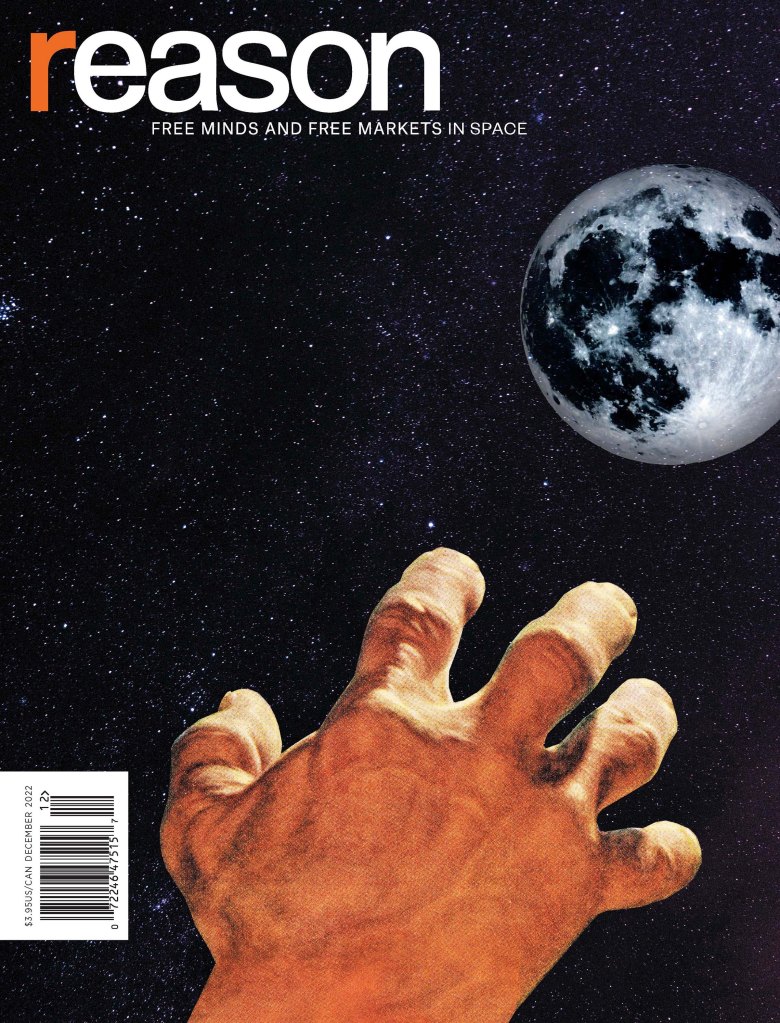
The December issue of Reason Magazine has plenty of fun articles on space travel, the ethics of terra-forming, science fiction books and films, and more. The magazine tends to favor privatization of just about everything, so expect some cheering for space billionaires like Elon Musk and Jeff Bezos, but overall it is a nice collection of thought-provoking articles.
Here is a sample of the articles:
We Are Going to the Moon: Thanks to the rise of private spaceflight companies, mankind will have a future off-Earth.
Why We Should Terraform the Galaxy: One critic calls it “arrogant vandalism,” but advocates say it might be a necessary form of self-preservation.
Image (Credit): Scene with Diego Luna from Star Wars: Andor. (Lucasfilm)
I am 10 episodes into Disney+’sStar Wars: Andor series and I love it. I am impressed that Disney+ finally dug a little deeper into the Star Wars material to find a new perspective, for now we get to see the Imperial bureaucracy in action.
This is the first of the four new live action Star Wars series that does not lean on the stars from the earlier movies – no Baby Yoda, Luke Skywalker, Princess Leia, Darth Vader, Tusken Raiders, or Jabba the Hutt. Instead, you get an original story, similar to how the Star Wars movie Rouge One took its own path.
Of course, the series has Storm Troopers, but they are there to lock down the period rather than becoming comic relief by allowing our “heroes” to blast away 50 of them at a time while coming away unharmed. Instead, the new series slowly kills off some of the heroes to demonstrate the true stakes involved.
The acting and dialogue is also much improved from earlier Star Wars iterations. Thankfully, Disney kept away from horrible Lucas-talk, never assuming that laser fights would cover over weak dialogue and a flimsy plot. Even the business side of Star Wars here is so much more interesting than the trade federation blather from The Phantom Menace. In Andor, the trade and smuggling is an important and believable thread carefully wound into the overall story.
But best of all, Andor gives us an inside look at Imperial operations. Your massive, mind-numbing bureaucracy here represents a form of slavery within the machine doing the oppressing. The back-biting among the off-white-clad officers of the Imperial Security Bureau is fun to behold, even without a Darth Vader ending each meeting with someone being choked to death.
The Imperial “justice” system is another fascinating story line, showing how the Empire’s reaction to terrorist attacks leads to gang-pressing innocent citizens. It’s a perfect merging of Putin and a Tesla factory. All the while, political intrigue continues in the Senate and family dynamics are used as a poisonous glue.
This is not to say the series lacks action scenes. If you are looking for shootouts and space battles, they are in the story. But they assist the plot rather than being the main plot. Andor is about the people (software) behind the Empire more than the hardware.
I am not saying all of the spin-off series need to follow the Andor model. I’m just glad an Andor exists at all. It’s about time the adults had something to watch that meshes more with their reality – less flash, more angst. You can put Baby Yoda to bed with the kids and stay up late with Andor.
I look forward to watching the remaining two episodes of this season as well as the next and final season. I also ask Disney to keep the adults in mind as it develops more StarWars programs. You have an eager fan base.
Image (Credit): Scene with Denise Gough from Star Wars: Andor. (Lucasfilm)
Image (Credit): The “Destination Moon” exibition at the refurbished National Air and Space Museum. (Smithsonian Museum)
If you have been awaiting the refurbishing of the Smithsonian’s National Air and Space Museum, then you will be happy to know that the museum reopened on October 14th. Only now you cannot simply stroll into the museum. Instead, you need to obtain a free timed-entry pass. Unfortunately, this seems to be the current system used by numerous museums to control traffic as well as capture all of your personal information so they can swamp you with junk mail and offers. Anyway…
Here are the a few of the new exhibits the museum is highlighting (go here for the full list):
“Walking On Other Worlds”: Experience what it’s like in distant parts of our solar system in the “Walking on Other Worlds” interactive experience in the Kenneth C. Griffin Exploring the Planets Gallery. This immersive media exhibit presents visitors with a seven-minute “tour” of seven different worlds: Venus, Earth’s Moon, Mars, Jupiter, Saturn’s moon Titan, asteroid Ryugu, and comet 67P.
Science Fiction Artifacts: New to display is a full-sized T-70 X-wing Starfighter “flown” by Poe Dameron (Oscar Isaac) in Star Wars: The Rise of Skywalker (2019). The screen-used vehicle is on long-term loan from Lucasfilm and is displayed hanging outside the planetarium. Star Trek is also represented in the new exhibitions.
ISS Cupola: In the One World Connectedgallery, put yourself in the shoes of astronauts on the International Space Station (ISS) with the ISS Cupola interactive. Every 90 minutes, astronauts on board the ISS can see the Sun rise from the station’s Cupola, a European Space Agency-built observatory module.
Given that NASA’s Artemis 1 mission is shooting for the Moon again, the timing is perfect. Of course, in December 2022 it will have been 50 years since the last human walk on the Moon’s surface, so we have a lot to celebrate as well as a lot of time to make up. Let’s hope a future update to the National Air and Space Museum includes models of spacecraft used to get humans to Mars.
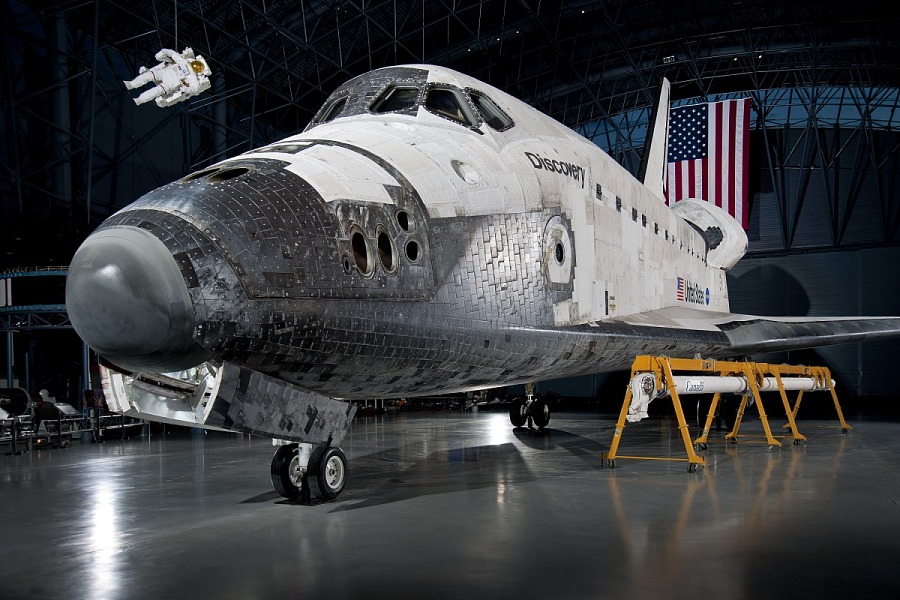
And remember, you can also visit the Steven F. Udvar-Hazy Center outside the Washington Beltway that contains large planes, jets, and spacecraft that cannot fit in the DC museum, including the Space Shuttle Discovery. Last time I went there I could walk right in without using a timed-entry pass.
Image (Credit): Space Shuttle Discovery at the Steven F. Udvar-Hazy Center. (Smithsonian Museum)





 Our Awesome Universe