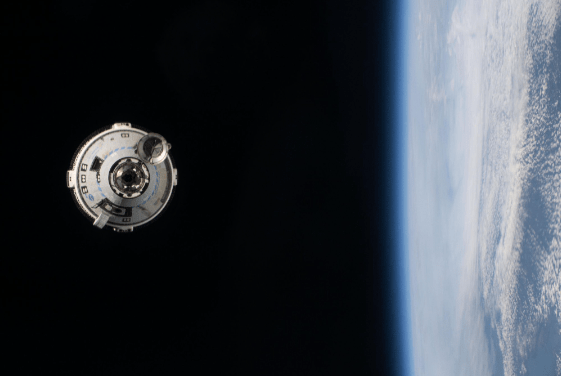
Image (Credit): The Boeing Starliner approaching the International Space Station. (NASA)
“We are strategically using the extra time to clear a path for some critical station activities while completing readiness for Butch and Suni’s return on Starliner, and gaining valuable insight into the system upgrades we will want to make for post-certification missions.”
–Statement by Steve Stich, manager of NASA’s Commercial Crew Program, regarding delays in the return of Boeing’s Starliner capsule. The language is becoming as flowery as SpaceX’s language when something goes wrong. NASA has already nixed the June 26 return date and has yet to provide a new date.
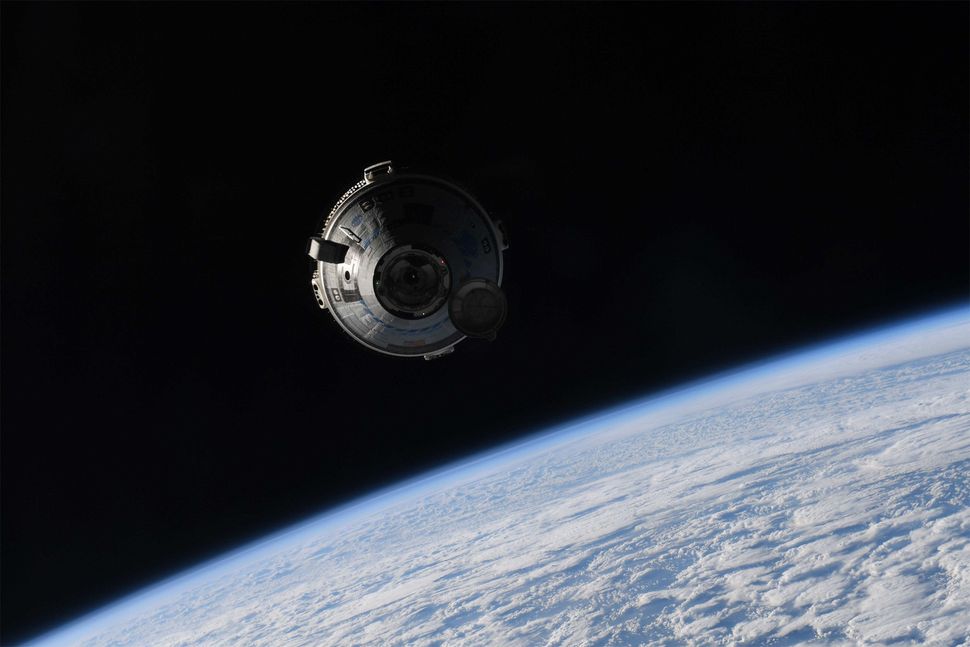
Image (Credit): Boeing’s Starliner approaching the ISS. (Samantha Cristoforetti/European Space Agency)
The return of the two astronauts from the earlier Starliner mission has been bumped a few times now, with the latest return scheduled for this Saturday (June 22).
The Boeing Starliner arrived at the International Space Station with thruster problems, and then encountered further helium leaks after that, so the need for additional time to study the issue makes some sense. NASA will address the status of the mission requirements and weather conditions at a press conference tomorrow (June 18).
It took long enough to get the two astronauts to the ISS after many delays, so maybe should not surprise anyone that we have a few delays on the return.
Boeing needs good press these days, so a quick and simple mission would have been nice. Yet this would be a bad time to throw caution into the wind when they are so close to the finish line.
NASA and SpaceX are planning for the possibility of modifying the Artemis III mission. Instead of landing on the Moon, a crew would launch in the Orion spacecraft and rendezvous with Starship in low-Earth orbit. This would essentially be a repeat of the Apollo 9 mission, buying down risk and providing a meaningful stepping stone between Artemis missions. Officially, NASA maintains that the agency will fly a crewed lunar landing, the Artemis III mission, in September 2026. But almost no one in the space community regards that launch date as more than aspirational. Some of my best sources have put the most likely range of dates for such a mission from 2028 to 2032. A modified Artemis III mission, in low-Earth orbit, would therefore bridge a gap between Artemis II and an eventual landing.
The satellite galaxy Crater II (or Crater 2) of the Milky Way is located approximately 380,000 light-years away from Earth in the constellation of Crater. This galaxy is extremely cold and exceptionally diffuse, and has low surface brightness. According to new research, Crater II exists thanks to a self-interacting dark matter.
Using NASA’s Chandra X-ray Observatory and ESA’s (European Space Agency’s) XMM-Newton, astronomers are exploring whether nearby stars could host habitable exoplanets, based on whether they emit radiation that could destroy potential conditions for life as we know it. This type of research will help guide observations with the next generation of telescopes aiming to make the first images of planets like Earth. A team of researchers examined stars that are close enough to Earth that future telescopes could take images of planets in their so-called habitable zones, defined as orbits where the planets could have liquid water on their surfaces. Any images of planets will be single points of light and will not directly show surface features like clouds, continents, and oceans. However, their spectra — the amount of light at different wavelengths — will reveal information about the planet’s surface composition and atmosphere.
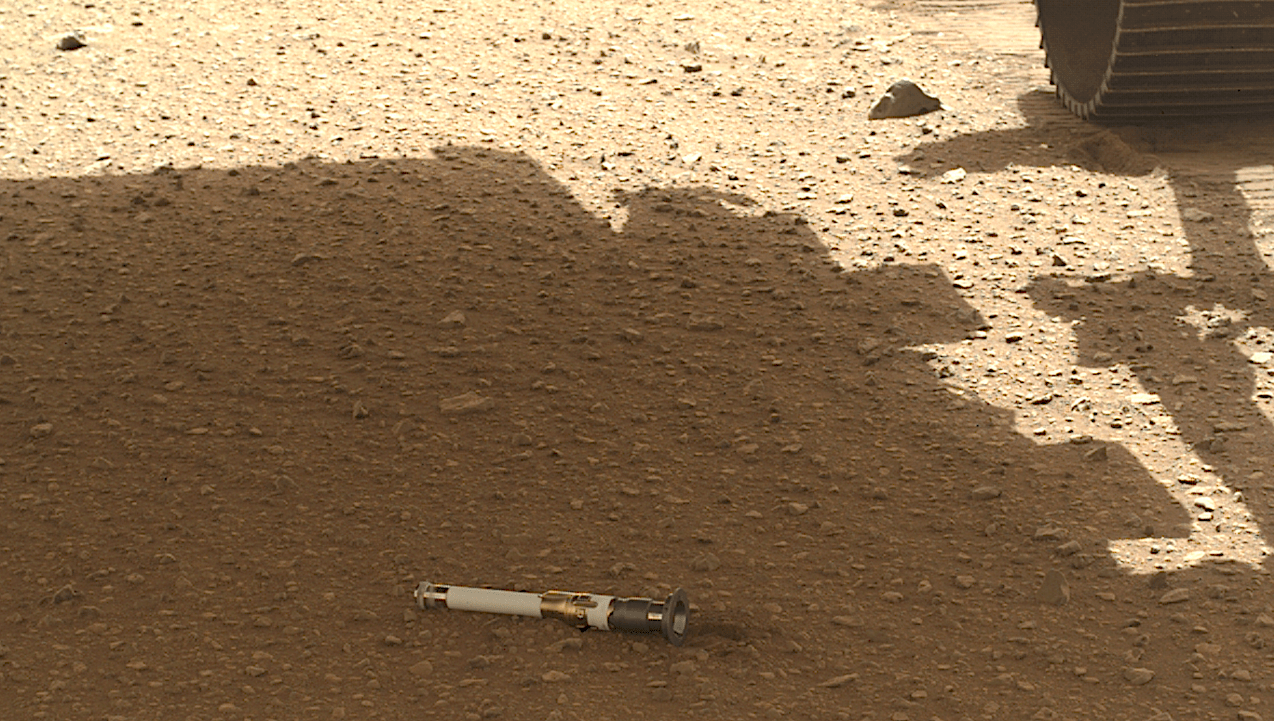
Image (Credit): One of the sample return canisters on the surface of Mars. (NASA)
With the pending budget cuts at NASA, the space agency is exploring new options for getting soil and rock samples back to Earth from MARs. To do this, NASA is setting it sights on 10 studies to identify new approaches to accomplish this mission, 7 of which come from private contractors and the other 3 from NASA centers, the Jet Propulsion Laboratory in Southern California, and Johns Hopkins’ Applied Physics Laboratory.
The seven private sector parties of interest and related proposals from earlier this year are as follows:
Lockheed Martin in Littleton, Colorado: “Lockheed Martin Rapid Mission Design Studies for Mars Sample Return”
SpaceX in Hawthorne, California: “Enabling Mars Sample Return With Starship”
Aerojet Rocketdyne in Huntsville, Alabama: “A High-Performance Liquid Mars Ascent Vehicle, Using Highly Reliable and Mature Propulsion Technologies, to Improve Program Affordability and Schedule”
Blue Origin in Kent, Washington: “Leveraging Artemis for Mars Sample Return”
Quantum Space in Rockville, Maryland: “Quantum Anchor Leg Mars Sample Return Study”
Northrop Grumman in Elkton, Maryland: “High TRL MAV Propulsion Trades and Concept Design for MSR Rapid Mission Design”
Whittinghill Aerospace in Camarillo, California: “A Rapid Design Study for the MSR Single Stage Mars Ascent Vehicle”
It is not clear why such a review needed to wait until so late in the game. NASA is always facing budget crunches. Maybe this can be a model for other ventures in the future as well.
Image (Credit): A graphic explaining the various instruments on the Chandra X-ray Observatory. (NASA)
Even with a good space week in hand, we still need to keep an eye on NASA’s budget to maintain a robust set of programs to explore the cosmos. A recent Youtube video by Cool Worlds Labs, “NASA’s in Trouble,” highlights those budgetary issues and focuses on what individuals can do as well, such as visiting https://www.savechandra.org/ and asking Congress to restore funds cut from the Chandra X-ray Observatory.
Professor David Kipping makes it clear he is not going to remain silent while these cuts are being considered. He and his team demonstrate their love for astronomy in every video and podcast, making them great ambassadors in this debate for continued NASA funding.
The video is forthright about the internal issues creating budgetary issues. For example, the considerable cost overruns and delays prior to the launch of the now successful James Webb Space Telescope came at a cost to other NASA programs over many years. And similar overruns are expected with future large projects as well, further squeezing other line items in the budget.
The video also highlights some promising developments that could help to lower costs in the future, though the issue on the table now is NASA’s FY 2025 budget.
View the video for yourself to learn more about the proposed budget cuts as well as what you can do to help.