A Day in Astronomy: Loss of the Apollo 1 Astronauts

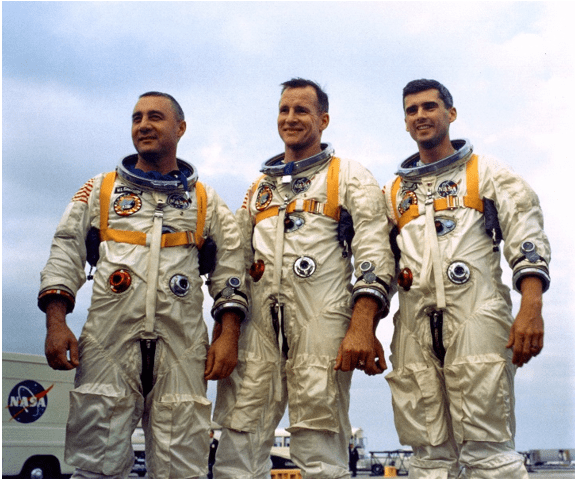
Image (Credit): Apollo 1 astronauts Virgil I. “Gus” Grissom, left, Edward H. White, and Roger B. Chaffee. (NASA)

On this day in 1967, the Apollo 1 capsule caught fire on the launchpad, killing the three astronauts in the capsule – Virgil “Gus” Grissom, Ed White, and Roger Chaffee.

A frustrated Gene Kranz, NASA flight director, had this to say shortly after the fire and tragic loss of three astronauts:

Spaceflight will never tolerate carelessness, incapacity, and neglect. Somewhere, somehow, we screwed up. It could have been in design, build or test. Whatever it was, we should have caught it. We were too gung-ho about the schedule, and we locked out all of the problems we saw each day in our work. Every element of the program was in trouble and so were we. The simulators were not working, Mission Control was behind in virtually every area, and the flight and test procedures changed daily. Nothing we did had any shelf life. Not one of us stood up and said, “Dammit, stop!” I don’t know what Thompson’s committee will find as the cause, but I know what I find. We are the cause! We were not ready! We did not do our job. We were rolling the dice, hoping that things would come together by launch day, when in our hearts we knew it would take a miracle. We were pushing the schedule and betting that the Cape would slip before we did.

Did the Apollo space program recover? Absolutely. Did NASA avoid deaths on future space missions. Not at all. Do we give up on human space missions or keep moving forward? I think you know the answer to that one.

Credit: NASA

Japanese Moon Mission: It’s Not Pretty, But it’s There

Image (Credit): Japan’s SLIM moon lander, as viewed by small rover LEV-2. (JAXA/Takara Tomy/Sony Group Corporation/Doshisha University)

If you were wondering about the status of the latest Japanese Moon mission, you can rest assured that the Smart Lander for Investigation Moon (SLIM) lander is now safe on the surface of the moon. It also had time to release two small Lunar Excursion Vehicle (LEV) rovers on the lunar surface.

Above is an image from one of those LEV rover’s showing a precariously placed lander. It appears to be standing on its head. Unfortunately, the solar panels are facing west rather than east, as planned.

As noted earlier, it is possible that the SLIM lander could get enough sunlight in the next few days to reactivate for a short period, but after that the lunar evening will drop to -200°F. The lander and rovers are not built for such temperatures.

Update: Good news! As of earlier today (January 29), SLIM has power again and it is back online.

Pic of the Week: The End of Ingenuity

Image (Credit): Shadow of the Ingenuity helicopter’s rotor blade on the surface of Mars. (NASA, JPL-Caltech)

This week’s image shows the shadow of little helicopter that could and continued to do so for 72 flights on Mars. The photo taken by NASA’s Ingenuity Mars helicopter shows one of its rotor blades after it finished its last flight on January 18, 2024. During the landing, one of the blades was damaged, permanently grounded the helicopter forever more.

The amazing little helicopter surpassed all expectations and became a very helpful buddy to the Perseverance rover. It may be the end of Ingenuity, but it should also be seen as the start of more missions that pair rovers and helicopters on Mars.

NASA Administrator Bill Nelson has some final words regarding this unique helicopter in a video that you can watch here.

In addition, Teddy Tzanetos, Ingenuity’s project manager at NASA JPL, had this to say:

It’s humbling Ingenuity not only carries onboard a swatch from the original Wright Flyer, but also this helicopter followed in its footsteps and proved flight is possible on another world.

The End of Two Moon Missions?

Image (Credit): Artist’s rendering of Japan’s SLIM mission over the Moon. (JAXA)

Within a two day period, we saw one Moon lander become a burning wreck plummeting towards Earth and another land on the Moon with an immediate problem that threatened its mission. The Moon may be closer, but it is becoming a hazardous place for space missions, similar to Mars.

First, the NASA-contracted Astrobotic Peregrine lander mission ended yesterday as the spacecraft entered the Earth’s atmosphere and burned up. The $108 Moon mission burned up with its cargo, including NASA’s scientific instruments, various rovers, and the DNA remains of humans whose families hoped would be at rest on the Moon’s surface. I expect a few Native Americans may be saying “I told you so” to themselves.

It was almost comical reading a Scientific American article trying to put a good spin on the lost cargo:

In addition, all nine of the payloads that were designed to communicate with Peregrine successfully returned data to Earth. Iris, a rover built by Carnegie Mellon University, sent back a “Hello Earth!” message. COLMENA, a set of five small rovers built by the Mexican Space Agency, also succeeded in sending data back—making it the first Mexican scientific instrument to operate in the moon’s vicinity.

I expect “Hello Earth!” fell far below the ground crew’s expectations, but I guess you take what you can get. And Mexico will probably hold off on any celebrations for the moment.

The second set of bad news related to the latest Japanese Moon mission. The good news is that the Smart Lander for Investigation Moon (SLIM) spacecraft was a success in terms of a soft landing on the Moon. The problem is that the solar array is not getting sufficient solar power for the lander to remain operational for more than a few hours. It is possible that the situation may correct itself as the sunshine shifts over time, but this is not a good start to the mission.

Whatever happens, Japan can still claim to be the fifth nation to successfully land on the Moon. It is not perfect, but the Japanese have more reason to celebrate than the Mexicans at this point.

Sample Return: NASA Just Needed the Right Tool

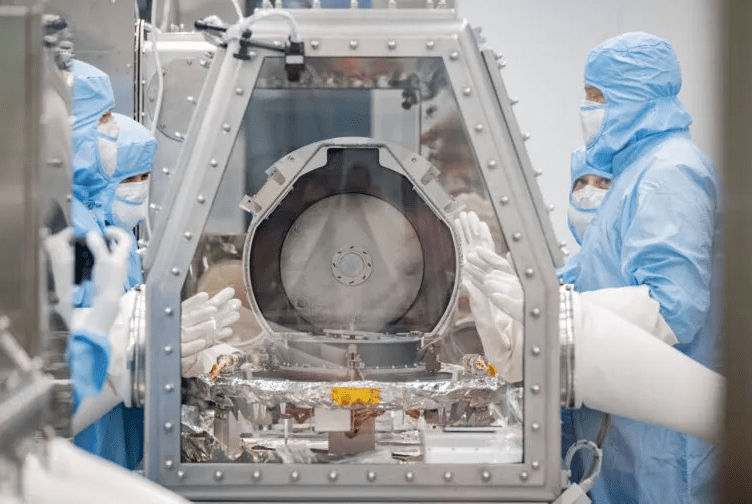
Image (Credit): The NASA and Lockheed Martin team observing the sample return canister. (NASA/Robert Markowitz)

It is amazing that we have the ability to launch a spacecraft that can chase an asteroid millions of miles away, but we lack a wrench here on Earth to open the sample container when some of that asteroid is sent home.

You may remember the problems NASA had last year opening the lid on the sample canister that Origins, Spectral Interpretation, Resource Identification, and Security–Regolith Explorer (OSIRIS-REx) returned from its encounter with the asteroid Bennu. Well, NASA finally opened up the canister.

NASA stated:

Curation processors paused disassembly of the TAGSAM head hardware in mid-October after they discovered that two of the 35 fasteners could not be removed with the tools approved for use inside the OSIRIS-REx glovebox. In response, two new multi-part tools were designed and fabricated to support further disassembly of the TAGSAM head. These tools include newly custom-fabricated bits made from a specific grade of surgical, non-magnetic stainless steel; the hardest metal approved for use in the pristine curation gloveboxes.

That’s a lengthy way to simply say we found the right tool. Now the rest of the asteroid sample can be cataloged and shared with the scientific community.

I am just glad the capsule did not contain an astronaut.