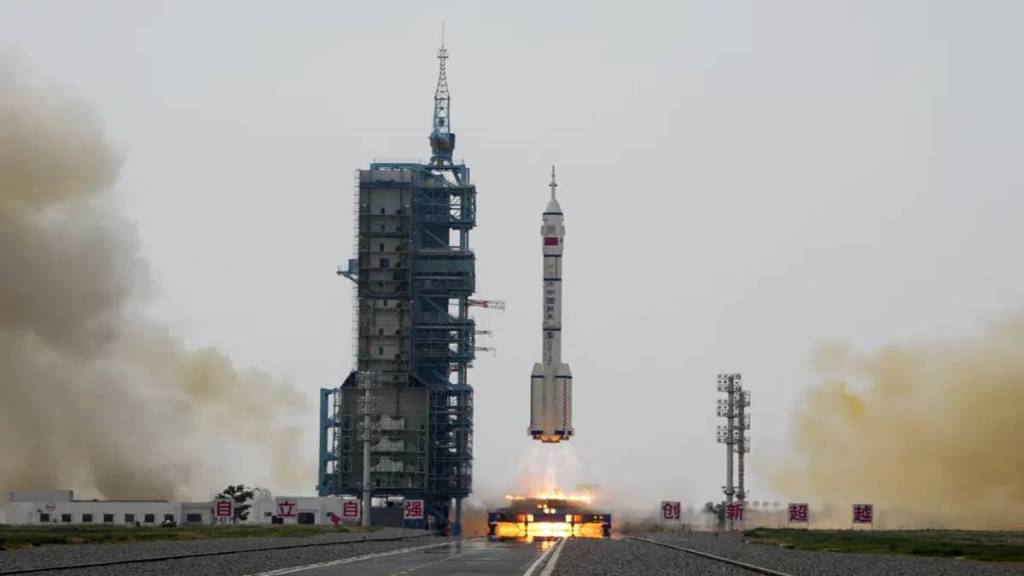
Image (Credit): Launch of China’s Shenzhou 16 spacecraft. (AP)
This week’s image shows China’s launch of the Shenzhou 16 spacecraft earlier this week atop a Long March 2-F rocket. The launch included a three-man crew, one being the first civilian astronaut in the Chinese crew rotation, who will relieve the current crew on the Tiangong Space Station.
Image (Credit): The TROPICS launch this week from New Zealand. (Rocket Lab)
The second and final TROPICS satellites, also known as Time-Resolved Observations of Precipitation structure and storm Intensity with a Constellation of Smallsats, were launched late yesterday via a Rocket Lab rocket in New Zealand. The first pair were launched earlier this month.
Payload deployment confirmed! Congratulations to the launch team on our 37th Electron launch, and to our mission partners at @NASA @NASA_LSP @NASAAmes: the TROPICS constellation is officially on orbit!
NASA now has more eyes on the world’s weather patterns. The lead of NASA’s Earth Science Division, Karen St. Germain, stated:
As we move into hurricane season for 2023, TROPICS will be in position to provide unprecedented detail on these storms, helping us better understand how they form, intensify, and move across the ocean.
Image (Credit): Scott Pelley on 60 Minutes discussing JWST. (CBS)
Last month 60 Minutes had a piece on the James Webb Space Telescope (JWST), titled The Origin of Everything, that provided viewers with more amazing images. I recommend the episode. I also plan to watch a few more times myself.
For a taste of the episode, here is Matt Mountain, who heads up JWST’s operations as president of the Association of Universities for Research in Astronomy, discussing the speckled images captured at the very start as engineers used a star to align the telescope’s 18 mirrors.
Matt Mountain: These were not artifacts from the detector. These were not strange stars. The whole of the sky was filled with galaxies. There was no empty sky. And that’s when I went, “This telescope’s going to be phenomenal.”
Scott Pelley: No empty sky? What do you mean by that?
Matt Mountain: On almost every image we’re taking now, we see galaxies everywhere. I mean, we took a simple picture of a planet in our own system, Neptune. You know, it was this beautiful orb just sitting there and we saw some rings. In the background are galaxies again. It tells us that our universe is filled with galaxies. We knew this theoretically but when you go out to the night sky, we’re used to saying, “Well, look up at the night sky, we see those stars.” We can no longer say that. We now have to say, “Look up at the night sky and there are galaxies everywhere.”
Scott Pelley: We call it space because we thought there was nothing out there.
Matt Mountain: There is no empty sky with James Webb. That is what we have discovered.
NASA has pulled the plug on its Lunar Flashlight project, which was designed to look for sources of ice on our nearest neighbor. The agency spent the last few months trying, and failing, to get the craft to generate the necessary amount of thrust to get the small satellite to its intended destination. Officials say that the issue was likely caused by debris buildup in the fuel lines, which prevented the CubeSat from working to its full potential.
NASA’s Mars Perseverance rover has taken new images that reveal that some of the red planet’s ancient rivers were much wilder than scientists previously thought. “It’s the first time we’re seeing environments like this on Mars,” Katie Stack Morgan, Perseverance’s deputy project scientist, said in a NASA release. Scientists studying rock formations, features, and valleys on Mars, so far, have found evidence to suggest Mars was once covered by water.
Rocket Lab USA, Inc., a leading launch and space systems company, is preparing for the second of two dedicated Electron launches to deploy a constellation of storm monitoring satellites for NASA. The launch, called ‘Coming To A Storm Near You,’ is scheduled for lift-off no earlier than 17:30 on May 22nd NZST from Rocket Lab Launch Complex 1 on New Zealand’s Mahia Peninsula. The launch follows on from the successful ‘Rocket Like a Hurricane’ Electron launch on May 8th 2023, which deployed the first two CubeSats of NASA’s TROPICS constellation. The ‘Coming To A Storm Near You’ launch will deploy the final two TROPICS CubeSats, completing the constellation.
Image (Credit): Upper stage of the Ariane 5 rocket that will launch ESA’s Juice mission. (ESA)
On April 13th, the European Space Agency (ESA) will launch its Jupiter Icy Moons Explorer (Juice) mission from French Guiana. The purpose of the mission is to conduct a detailed study of Jupiter as well as three of its moons (and their oceans) – Ganymede, Callisto and Europa. The spacecraft will eventually go into orbit around Ganymede, which will be the first orbit of a moon in our solar system other than Earth’s Moon.
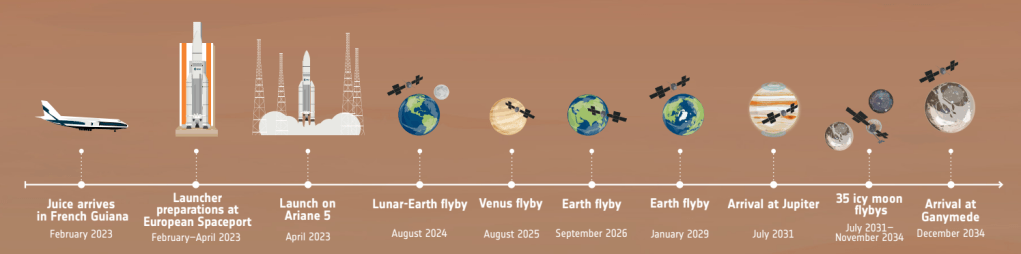
The key milestones for the mission are listed below and shown in greater detail within the graphic as well:
–February 2023: Juice arrives in French Guiana
–April 13, 2023: Launch on Ariane-5 rocket
–July 2031: Arrival at Jupiter
-July 2031 – November 2034: 35 icy moon flybys
–December 2034: Arrival at Ganymede
Image (Credit): Juice mission milestones. (ESA JUICE Launch Kit)
In addition to ESA/European scientific instruments and equipment, the spacecraft will also carry items from NASA, the Japan Aerospace Exploration Agency, and the Israel Space Agency.
The delayed arrival at Jupiter relates to the need for multiple flybys cover this great distance. In The Financial Times, Justin Byrne, head of science for lead contractor Airbus, stated, “Ariane-5 is a very powerful rocket but it can only give us about half the energy we need to get to Jupiter…We get the rest by doing planetary fly-bys, each one giving us a gravitational assist through a slingshot manoeuvre.”
The ESA put together a useful Launch Kit that answers any question you may have about the Juice mission, as well as related missions.



 Our Awesome Universe