Space Mission: ESA’s Euclid Telescope

To follow up on the previous post, Russia also lost out on launching the European Space Agency’s (ESA) Euclid spacecraft. Russia was supposed to launch it on a Soyuz-ST/Fregat rocket this December, but the country’s invasion of Ukraine led to a change in plans. SpaceX will now be launching the spacecraft next year.

Euclid was designed to study dark energy and dark matter, and make a 3D-map of the Universe. The project includes scientists from 14 countries: Austria, Denmark, France, Finland, Germany, Italy, Netherlands, Norway, Spain, Switzerland, Portugal, Romania, the UK, and the US.

Euclid hopes to answer the following questions:

  • How did the Universe originate? What were the conditions just after the Big Bang, and how did these give rise to the large-scale structures we see today?
  • Why is the Universe expanding at an accelerating rate today?
  • Is dark energy – a term often used to signify the mysterious force behind this cosmic acceleration – real? If so, is it a constant energy density intrinsic to and spread throughout space, or a new force of nature that slowly evolves as the Universe expands?
  • What is the nature of dark matter, and how do neutrinos possibly contribute? Are there other as-yet-undetected massive particles in the Universe?

Once launched, Euclid will operate in the Sun-Earth Lagrange point 2 (L2), which is where the James Webb Space Telescope is located as well as ESA’s Gaia spacecraft. Gaia, launched in December 2013, is currently mapping the stars in the Milky Way galaxy. It seems L2 is the place to be.

NASA is contributing infrared flight detectors for one of Euclid’s two science instruments. You can read more about the NASA contribution here.

Space Mission: Preparing for a Launch to Europa in 2024

Image (Credit): Artist’s rendering of Europa orbiting Jupiter. (NASA)

Earlier this year, NASA’s Jet Propulsion Laboratory started assembling the Europa Clipper spacecraft so it is ready for its launch in 2024 (you can find the latest update here). Once it arrives at Jupiter, the spacecraft will have at least 50 flybys to study the Jovian moon and learn more about its inside, outside, and atmosphere.

Why Europa? NASA explains it this way:

Extraterrestrial life might exist under all sorts of conditions that humans would struggle to imagine. But we know of one set of conditions in which life flourishes in a multitude of shapes and sizes: the conditions found on Earth. Because we know Earth has the right conditions for life, humans can then sharply narrow down the search for extraterrestrial life by searching only in places that have the conditions that Earth life requires: a source of energy, the presence of certain chemical compounds, and temperatures that allow liquid water to exist. Jupiter’s icy moon Europa seems to be just such a place.

And water exists in abundance, as the NASA graphic shows below.

The Europa Clipper will not make it to Jupiter until 2030, so we have a long wait ahead of us. It also gives us plenty of time to guess about what we will find.

You can follow the status of the Europa Clipper here.

Image (Credit): Illustration comparing water on the Earth and Europa. (NASA)

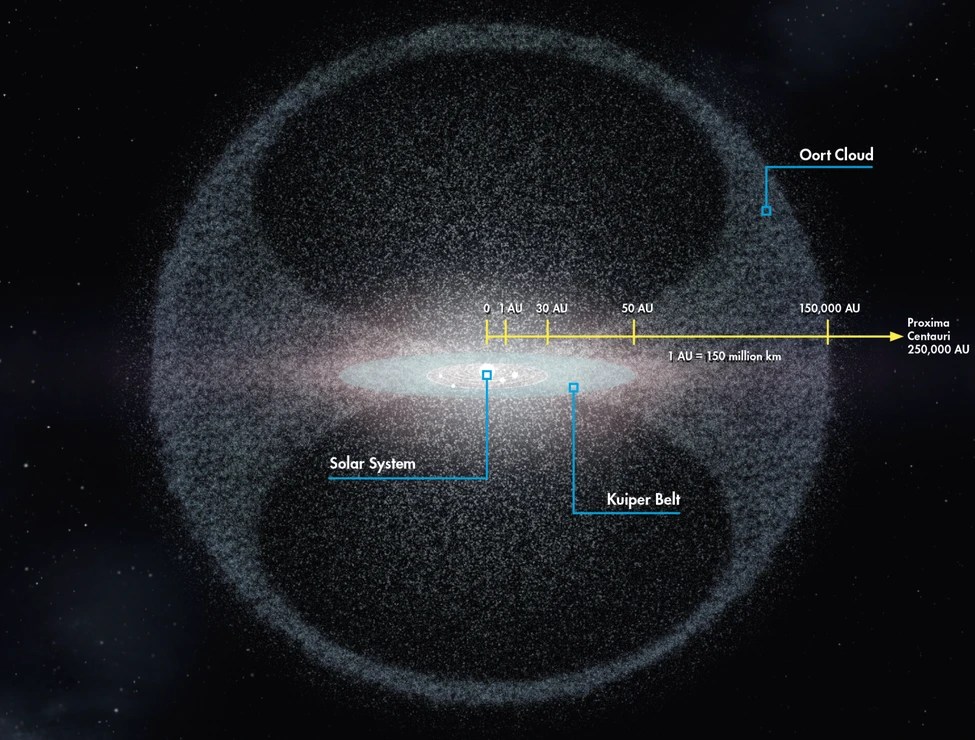
Space Mission: A Trip to the Oort Cloud?

Image (Credit): Illustration of the Oort Cloud – not to scale. (Mikkel Juul Jense / Science Photo Library)

While NASA does not have any plans to send a specific missions to study the Oort Cloud, the most distant region in our solar system containing trillions of frozen objects, it has already sent five spacecraft in that direction. Two Voyager spacecraft, two Pioneer spacecraft, and the New Horizons spacecraft are all heading that way, but it is quite a distant.

For example, the Voyager spacecraft will not hit the Oort Cloud for another 300 years and will continue to travel through the cloud for another 30,000 years before escaping the solar system. As a result, all of these spacecraft will be dead as a rock before ever hitting that region and of no use to anyone back here, yet they will still carry messages from all of us to the stars. So in that sense, they still have a mission to perform should anyone be out there.

The Oort Cloud is still a theory since it has not been observed, but there is plenty evidence regarding its existence, including the comets that come into the center of our solar system from that region. The cloud itself is believed to be a sphere rather than on the same plane as the planets, so it forms a protective ring around the planets potentially becoming a hazard to any incoming or outgoing spacecraft. What this will mean for interstellar space travel, should that day come, is anyone’s guess at this point.

You can read more about the Oort Cloud here.