Space Stories: Fancy Space Suits, Giant Blinding Satellites, and More Russian Space Station Leaks

Credit: Dezeen

Here are some recent stories of interest.

Dezeen: “Prada Designing Lunar Spacesuits for NASA Moon Mission

Fashion house Prada has teamed up with commercial space company Axiom Space to create lunar spacesuits for NASA’s Artemis III mission, which will be the first crewed moon landing since 1972. Called Axiom Extravehicular Mobility Unit (AxEMU), the suits will be designed to give astronauts “advanced capabilities for space exploration,” Prada said. They are an evolution of NASA’s Exploration Extravehicular Mobility Unit (xEMU) spacesuit design and will use “innovative technologies and design” to be more flexible and provide more protection against the harsh lunar environment, according to the brand.

Scientific American: “Giant Satellite Outshines Most Stars in the Sky

On some nights, one of the brightest objects in the sky is neither a planet nor a star. It is a telecommunications satellite called BlueWalker 3, and at times it outshines 99% of the stars visible from a dark location on Earth, according to observations reported today in Nature. BlueWalker 3 is the most brilliant recent addition to a sky that is already swarming with satellites. The spaceflight company SpaceX alone has launched more than 5,000 satellites into orbit, and companies around the globe have collectively proposed launching more than half a million satellites in the coming years — a scenario that astronomers fear could hamper scientific observations of the Universe.

The Guardian: “Third Space Station Leak in a Year Prompts Doubts About Russia’s Programme

The Russian segment of the International Space Station (ISS) has sprung its third coolant leak in under a year, raising new questions about the reliability of the country’s space programme even as officials said crew members were not in danger. Flakes of frozen coolant spraying into space were seen in an official live feed of the orbital lab provided by Nasa on Monday, and confirmed in radio chatter between US mission control and astronauts. “The Nauka module of the Russian segment of the ISS has suffered a coolant leak from the external (backup) radiator circuit, which was delivered to the station in 2012,” Russian space agency Roscosmos said on Telegram, adding temperatures remained normal in the affected unit.

Space Stories: Psyche Ready to Go, Interesting Exoplanets, and Protecting Astronaut Health

Image (Credit): Artist’s rendering of NASA’s Psyche mission approaching the asteroid Psyche. (NASA)

Here are some recent stories of interest.

Universe.com: “NASA’s Psyche Now Set to Launch October 12

With just under two weeks until its planned launch, NASA’s Psyche mission has been rescheduled. As per a NASA blog post, the agency along with SpaceX are now aiming for liftoff on October 12 at 10:16 A.M. EDT from the Kennedy Space Center in Florida — the first of several NASA science missions that will ride to space on a Falcon Heavy Rocket. The mission was originally set to launch October 5.

Trottier Institute for Research on Exoplanets: “UdeM-Led Study of Exoplanet TRAPPIST-1 b Reveals New Insights into its Atmosphere and Star

A team of astronomers has made an important leap forward in our understanding of the intriguing TRAPPIST-1 exoplanetary system. Not only has their research shed light on the nature of TRAPPIST-1 b, the exoplanet orbiting closest to the system’s star, but it has also shown the importance of parent stars when studying exoplanets. The findings, published today in Astrophysical Journal Letters, shed light on the complex interplay between stellar activity and exoplanet characteristics.

NASA: “NASA Funds Eight Studies to Protect Astronaut Health on Long Missions

NASA is funding eight new studies aimed at better understanding how the human body reacts to spaceflight. These studies will be done on Earth without the need for samples and data from astronauts. Collectively, these studies will help measure physiological and psychological responses to physical and mental challenges that astronauts may encounter during spaceflight. With this information, NASA may be better able to mitigate risks and protect astronaut health and performance during future long-duration missions to the International Space Station, the Moon, Mars, and beyond. 

Space Stories: Remembering the Solar System Delivery System, Many More Milky Ways, and AI Investigates Alien Life

Credit: USPS

Here are some recent stories of interest.

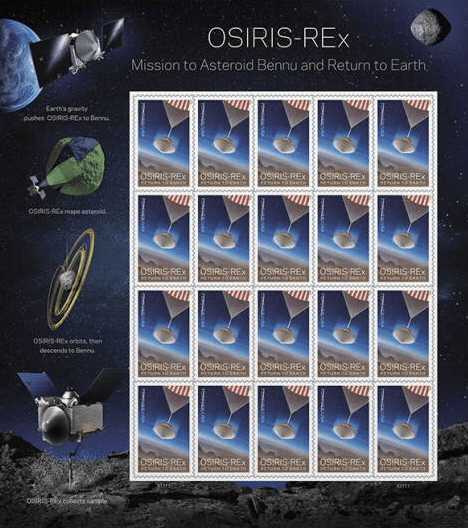
NASA:New US Postage Stamp Commemorates NASA’s Asteroid Sample Delivery

On Sept. 24, NASA’s OSIRIS-REx (Origins, Spectral Interpretation, Resource Identification and Security – Regolith Explorer) spacecraft will speed past Earth and – at precisely the right moment – jettison its sample capsule containing material from asteroid Bennu…To help celebrate this engineering and scientific achievement, the U.S. Postal Service issued a commemorative stamp featuring an artist’s impression of the sample capsule as it parachutes to Earth over its landing site on the Department of Defense’s Utah Test and Training Range…Although OSIRIS-REx has already had many scientific accomplishments, at its heart, the mission’s research goals circle around the sample delivery from Bennu. That influenced the Postal Service’s decision to select the capsule’s descent as the subject of the new stamp.

LiveScience.com:James Webb Telescope Spots Thousands of Milky Way Lookalikes That ‘Shouldn’t Exist’ Swarming Across the Early Universe

The James Webb Space Telescope (JWST) has found more than 1,000 galaxies mysteriously resembling our own Milky Way hiding out in the early universe. Shaped like warped vinyls and sporting delicate spiral arms, the Milky Way doppelgangers were found by JWST more than 10 billion years into the universe’s past — during a period when violent galactic mergers were thought to have made an abundance of such fragile galaxies impossible. Yet the disk galaxies are 10 times more common in the early universe than astronomers previously thought, new research reveals.

Astronomy.com:Can AI Find Life in the Universe?

Scientists could soon use common lab technology along with sophisticated algorithms to answer one of the biggest questions in all of astronomy — are we alone in the universe? In new research published today in Proceedings of the National Academy of Sciences (PNAS), a team of scientists announced a novel technique that can take a sample of a material, feed it through a machine-learning algorithm, and find out if the material did — or didn’t — come from a living organism with 90 percent accuracy.

Space Stories: New Lunar Water Estimates, Coronal Mass Ejection, and Oxygen on Mars

Image (Credit): Shadows on the Moon’s south pole. (NASA)

Here are some recent stories of interest.

Southwest Research Institute: “New Findings Suggest Moon May Have Less Water Than Previously Thought

A team recently calculated that most of the Moon’s permanently shadowed regions (PSRs) are at most around 3.4 billion years old and can contain relatively young deposits of water ice. Water resources are considered key for sustainable exploration of the Moon and beyond, but these findings suggest that current estimates for cold-trapped ices are too high.

Scientific American: “Massive Sun Outburst Smacks NASA Spacecraft

NASA’s Parker Solar Probe was built to withstand the ravages of the environment near our sun—and with good reason. The car-size spacecraft has now flown through a giant solar outburst of charged particles called a coronal mass ejection (CME). If that CME had it hit Earth instead, it may have caused vast, continent-wide blackouts, scientists say. Some of those searing particles whipped through space at about three million miles per hour.

BGR: “NASA Successfully Generated Oxygen on Mars

NASA’s Perseverance rover has done the unthinkable. Or, at least, a small device on the rover has. According to a tweet and article shared by NASA’s Perseverance team on Twitter, a device known only as MOXIE has proven that we can generate oxygen on Mars using the planet’s CO2-concentrated atmosphere. This tech is a huge boon, and the success of this story could help pave the way for future oxygen generation on the Red Planet, something that would make long-term exploration of the planet far more feasible.

Space Stories: Strange Asteroid Behavior, Another Earth in Our Solar System, and the Study of Galaxy Clusters

Image (Credit): Photo of Dimorphos taken by the DATA spacecraft. (NASA)

Here are some recent stories of interest.

Futurism: “Something Weird is Going On with the Asteroid NASA Smashed

Nearly a year ago, NASA successfully smashed an asteroid for the first time, in a landmark test to see whether we could divert a killer space rock before disaster — but now, the asteroid in question is behaving strangely. As New Scientist reports, a schoolteacher and his pupils seem to have discovered that the orbit of Dimorphos, the space rock socked by the Double Asteroid Redirection Test (DART) last September, has apparently continued slowing down, unexpectedly, in the year since the refrigerator-sized craft smashed into it.

Kindai University: “Possible Existence of Earth-Like Planet Predicted in the Outskirts of the Solar System

Researchers from Japan predict, based on computer simulations, the likely existence of an Earth-like planet in the distant Kuiper Belt. There are many unexplained anomalies in the orbits and distribution of trans-Neptunian objects, small celestial bodies located at the outer reaches of the solar system. Now, based on detailed computer simulations of the early outer solar system, researchers from Japan predict the possibility of an undiscovered Earth-like planet beyond Neptune orbiting the Sun. Should this prediction come true, it could revolutionize our understanding of the history of the solar system.

European Space Agency:X-ray mission lifts off to study high-energy Universe

The Japan Aerospace Exploration Agency’s (JAXA) X-Ray Imaging and Spectroscopy Mission (XRISM) lifted off on a H-IIA rocket from the Tanegashima Space Center in Japan at 08:42 JST / 00:42 BST / 01:42 CEST on 7 September 2023. The successful launch marks the beginning of an ambitious mission to explore the growth of galaxy clusters, the chemical make-up of the Universe, and the extremes of spacetime. XRISM is a collaboration between JAXA and NASA, with significant participation from ESA.