Space Stories: An Exoplanet’s Atmosphere, A Cosmic Explosion, and Stars Halfway to the Andromeda Galaxy

Here are some recent stories of interest.

WebbTelescope.org: “Weather Report: Expect Scattered, Patchy Clouds Made Up of Silicates on Planet VHS 1256 b

Ever had hot sand whip across your face? That’s a soothing experience compared to the volatile conditions discovered high in the atmosphere of planet VHS 1256 b. Researchers using NASA’s James Webb Space Telescope proved that its clouds are made up of silicate particles, ranging from fine specks to small grains. Plus, its near-constant cloud cover is on the move! The team projects that the silicates swirling in these clouds periodically get too heavy and rain into the depths of the planet’s atmosphere. Webb’s observations also show clear signatures of water, methane and carbon monoxide, and provide evidence for carbon dioxide. This is only the beginning of the team’s research – many more findings are expected as they continue to dig in to Webb’s “downpour” of data.

The Guardian: “Cosmic Explosion Last Year May be ‘Brightest Ever Seen’”

A cosmic explosion that blinded space instruments last year may be the brightest ever seen, according to astronomers. The blast took place 2bn light years from Earth, producing a pulse of intense radiation that swept through the solar system in October last year. The cosmic event, known as a gamma-ray burst (GRB), produced some of the strongest and brightest explosions in the universe, triggering detectors on multiple spacecraft. The October blast was deemed so exceptional that astronomers said it was the brightest of all time since the beginning of human civilisation.

Astronomy.com: “Milky Way Stars Found Nearly Halfway to Andromeda Galaxy

Astronomers have discovered a slew of stars lingering in the far fringes of our galaxy. And when we say far, we mean far. The most distant of these stars is located more than 1 million light-years away. That’s almost halfway to our largest galactic neighbor, the Andromeda Galaxy, which is located some 2.5 million light-years away. “This study is redefining what constitutes the outer limits of our galaxy,” said Raja GuhaThakurta, professor and chair of astronomy and astrophysics at UC Santa Cruz, in a news release. “Our galaxy and Andromeda are both so big, there’s hardly any space between the two galaxies.”

Space Stories: Possible Starship Launch, South Korean Rocket Test, and Massive Early Stars

Here are some recent stories of interest.

Forbes: “Elon Musk Gets More Specific About Starship’s First Rocket Launch to Space

We’ve been waiting for nearly two years to see Elon Musk’s big rocket blast off again, and now the SpaceX founder is starting to narrow the targeted time frame for Starship’s first orbital attempt. The controversial entrepreneur said on Twitter last week that the next generation vehicle destined to take astronauts to the moon and perhaps start a civilization on Mars “will be ready to launch… in a few weeks, then launch timing depends on FAA license approval.”

Space News: “South Korea’s Innospace Succeeds in Test Launch

South Korean rocket startup Innospace successfully launched a suborbital rocket from Brazil over the weekend, demonstrating a hybrid motor it plans to scale up into a small orbital launch vehicle. The launch of Innospace’s HANBIT-TLV suborbital rocket took place March 19 from the Alcântara Space Center, and the company called the flight a success, although it did not disclose the rocket’s peak altitude. 

Space.com: “The Early Universe was Crammed with Stars 10,000 Times the Size of our Sun, New Study Suggests

The first stars in the cosmos may have topped out at over 10,000 times the mass of the sun, roughly 1,000 times bigger than the biggest stars alive today, a new study has found. Nowadays, the biggest stars are 100 solar masses. But the early universe was a far more exotic place, filled with mega-giant stars that lived fast and died very, very young, the researchers found.

Space Stories: Deorbiting the ISS, Impounded Russian Rockets, and a Telescope on the Dark Side of the Moon

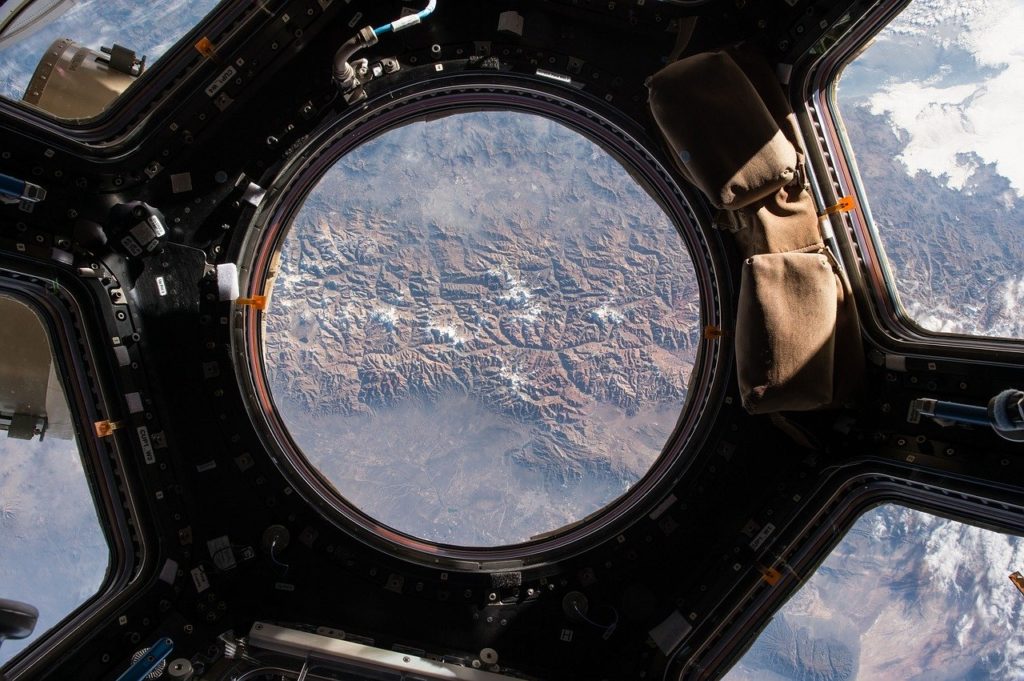
Image (Credit): View of Earth from the International Space Station (ISS). (NASA)

Here are some recent stories of interest.

Space News: “NASA Planning to Spend up to $1 Billion on Space Station Deorbit Module

NASA is projecting spending nearly $1 billion on a tug to deorbit the International Space Station at the end of the decade to provide redundancy for safely disposing of the station. NASA released additional details March 13 about its fiscal year 2024 budget proposal. An outline of the proposal, published by the White House March 9, requested $27.2 billion for the agency, a 7.1% increase from 2023 that roughly keeps pace with inflation.

Radio Free Europe: “Kazakhstan Impounds Property Of Russian Cosmodrome Operator In Baikonur

Kazakh authorities have impounded the property of Russia’s main operator of spacecraft launching sites in Baikonur (Baiqonyr) in the Central Asian nation’s southern region of Qyzylorda…According to the media outlet, the decision was made due to the Russian state company’s debt of 13.5 billion tenges ($29.7 million) to the Baiterek Kazakh-Russian joint venture for work related to estimating ecological damage caused by Souyz-5 rockets.

SciTechDaily: “NASA, DOE Telescope on Far Side of the Moon Will Reveal the Dark Ages of the Universe

NASA and the Department of Energy (DOE) are working together to develop a science instrument that will survive the harsh and unforgiving environment of the lunar surface at night on the far side of the Moon to attempt first-of-its-kind measurements of the Dark Ages of the Universe. The instrument, named the Lunar Surface Electromagnetics Experiment – Night (LuSEE-Night), is a collaboration between DOE’s Brookhaven National Laboratory, the DOE Office of Science, UC Berkeley’s Space Sciences Laboratory, and NASA’s Science Mission Directorate.

Space Stories: Ancient Water, Nearby Black Hole, and a Lunar Time Zone

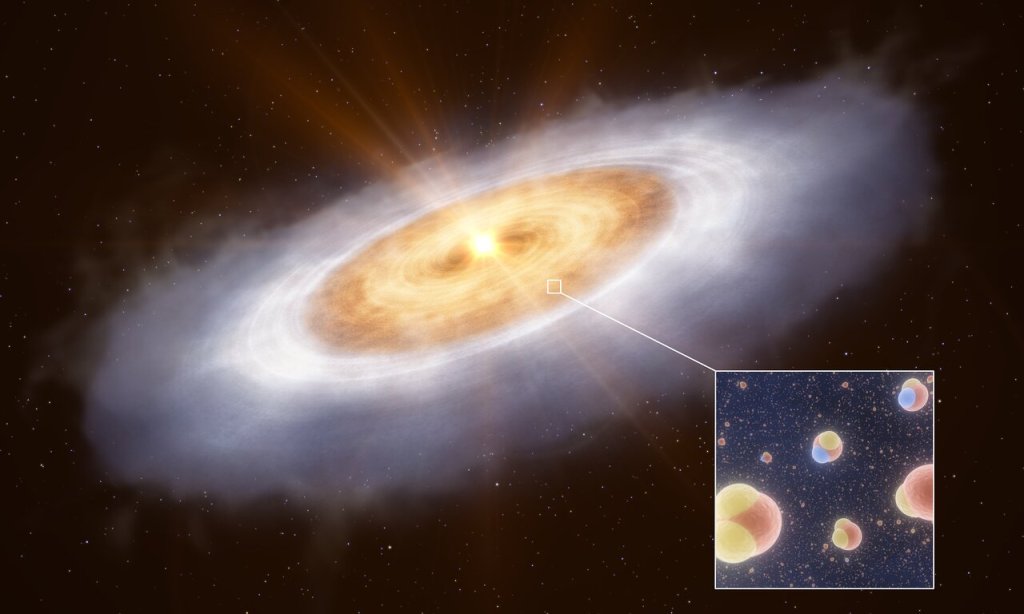
Image (Credit): Illustration showing gaseous water in the planet-forming disc around the star V883 Orionis. (European Southern Observatory)

Here are some recent stories of interest.

European Southern Observatory: “Astronomers Find Missing Link for Water in the Solar System

Using the Atacama Large Millimeter/submillimeter Array (ALMA), astronomers have detected gaseous water in the planet-forming disc around the star V883 Orionis. This water carries a chemical signature that explains the journey of water from star-forming gas clouds to planets, and supports the idea that water on Earth is even older than our Sun.

“We can now trace the origins of water in our Solar System to before the formation of the Sun,” says John J. Tobin, an astronomer at the National Radio Astronomy Observatory, USA and lead author of the study published today in Nature. 

SciTech Daily: “Astronomers Uncover Black Hole Closer to Earth Than Ever Before

Astronomers have discovered the closest black hole to Earth, the first unambiguous detection of a dormant stellar-mass black hole in the Milky Way. Its close proximity to Earth, a mere 1,600 light-years away, offers an intriguing target of study to advance understanding of the evolution of binary systems.

New York Times: “The Moon May Get Its Own Time Zone

What time is it on the moon? Since the dawn of the space age, the answer has been: It depends. For decades, lunar missions have operated on the time of the country that launched them. But with several lunar explorations heading for the launchpad, the European Space Agency has deemed the current system unsustainable. The solution, the agency said last week, is a lunar time zone.

Space Stories: SpaceX ISS Launch, Israeli Space Telescope, and Japanese Asteroid Results

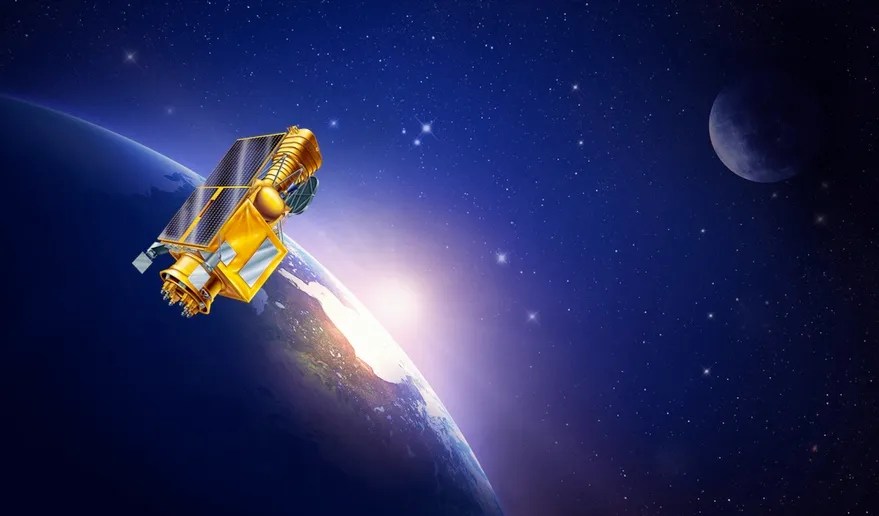
Image (Credit): Artist’s rendering of Israel’s ULTRASAT space telescope. (Weizmann Institute of Science)

Here are some recent stories of interest.

Reuters News: “SpaceX Ready to Retry Launching NASA’s Next Space Station Crew

Elon Musk’s rocket company SpaceX was ready to try again at sending NASA’s next long-duration crew of the International Space Station to orbit on Thursday, about 72 hours after a first attempt was scrubbed due to a clogged filter in the launch system. Two NASA astronauts will be joined by a Russian cosmonaut and an astronaut from the United Arab Emirates for a six-month science mission made up of experiments ranging from human cell growth in space to controlling combustible materials in microgravity.

NASA: “NASA to Launch Israel’s First Space Telescope

NASA will launch Israel’s first space telescope mission, the Ultraviolet Transient Astronomy Satellite (ULTRASAT). ULTRASAT, an ultraviolet observatory with a large field of view, will investigate the secrets of short-duration events in the universe, such as supernova explosions and mergers of neutron stars. Led by the Israel Space Agency and Weizmann Institute of Science, ULTRASAT is planned for launch into geostationary orbit around Earth in early 2026. In addition to providing the launch service, NASA will also participate in the mission’s science program.

Carnegie Science: “Organic Molecules Found on First Primitive Asteroid Sample Returned to Earth

Approximately 20,000 organic molecules composed of carbon, hydrogen, nitrogen, oxygen, or sulfur were found in samples returned to Earth from the asteroid Ryugu by the Japan Aerospace Exploration Agency’s Hayabusa2 mission, according to  new work published in two Science papers from an international team that included Carnegie’s George Cody, Jens Barosch, and Larry Nittler. Named after a Japanese folktale, Ryugu is a near-Earth object, half a mile across, shaped kind of like a spinning top that orbits the Sun every 16 months. Hayabusa2 was the first mission to bring material back to Earth from a primitive asteroid, offering unique insight into the building blocks from which our Solar System was formed and the possible origin of organic material that contributed to Earth’s habitability.