Space Stories: Mystery on Saturn, an Interstellar Visitor, and Hunting a Rogue Planet

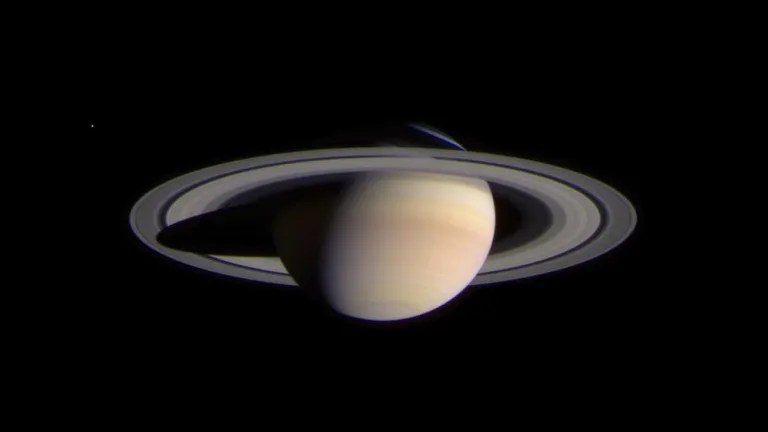
Image (Credit): Saturn as captured by NASA’s Cassini spacecraft on February 9, 2004 (NASA/JPL/Space Science Institute)

Here are some recent space-related stories of interest.

New Scientist: Did Something Just Hit Saturn? Astronomers Are Racing to Find Out

Something may have just hit Saturn – and, if so, an amateur astronomer could hold the key to confirming the event, which would be the first ever recorded on the gas giant. About seven asteroids or comets are estimated to impact Saturn every year, but no such event has ever been caught on camera. Now, NASA employee and amateur astronomer Mario Rana has recorded images that appear to show just that.

Astronomy.com: Astronomers Race to Learn More About Third Interstellar Visitor

Astronomers have spotted an object from outside our solar system bolting toward the Sun at around 150,000 mph (240,000 km/h). The big, frozen ball of ice and dust presents a rare chance to study an object that formed around an alien solar system, and potentially much earlier in the Milky Way’s history. The object named 3I/ATLAS — “3I” because it’s the third interstellar object detected so far, and “ATLAS” in honor of the system of telescopes that revealed it, the Asteroid Terrestrial-impact Last Alert System. Because the object is also showing tentative signs of cometary activity, it has also been designated C/2025 N1 (ATLAS).

Universe Today: Old Hubble Space Telescope Photos Unlock the Secret of a Rogue Planet

Astronomers have achieved a first in exoplanet hunting by using the Hubble Space Telescope images to investigate a mysterious event that could reveal the existence of a “rogue planet” drifting through space without a host star. The discovery centers on a brief astronomical phenomenon with the catchy name OGLE-2023-BLG-0524, detected in May 2023 by ground-based telescopes. The event lasted just eight hours and was caused by gravitational microlensing, an effect predicted by Einstein where a massive object acts like a magnifying glass in space, briefly brightening the light from a more distant object as it passes in front.
Space Stories: New Stars in the Heavens, Moon Budget Passes Senate, and Lunar Trailblazer Needs to Call Home

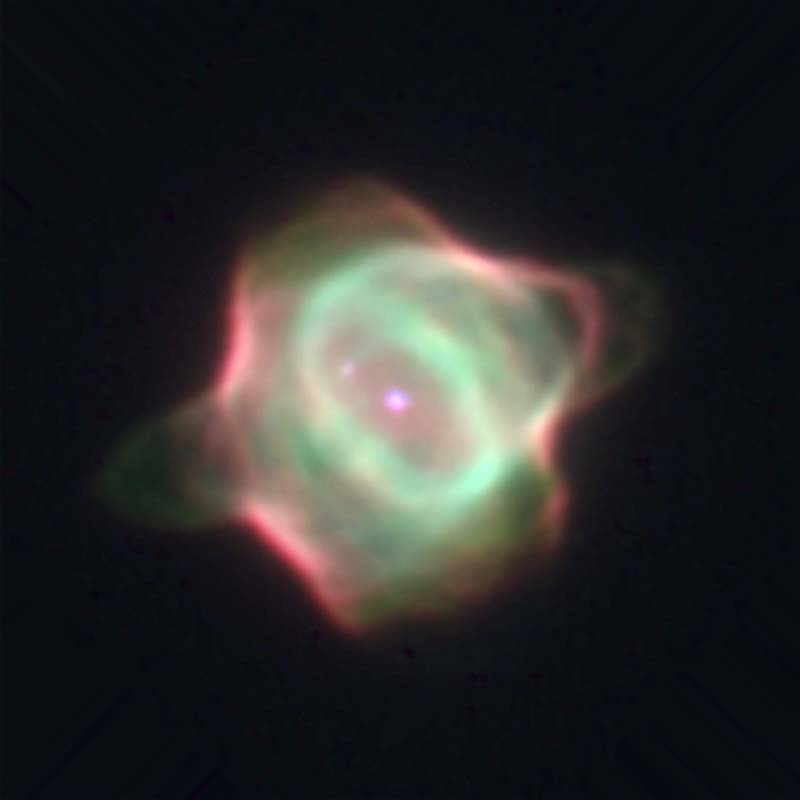
Image (Credit): The Stingray nebula (Hen-1357), the youngest known planetary nebula. (Matt Bobrowsky, Orbital Sciences Corporation and NASA)

Here are some recent space-related stories of interest.

Live Science: 2 ‘New Stars’ Have Exploded into the Night Sky in Recent Weeks — and Both are Visible to the Naked Eye

A second “new star” has unexpectedly appeared in the night sky, less than two weeks after a near-identical point of light first burst into view without warning. The first nova, dubbed V462 Lupi, was initially spotted June 12 shining in the Lupus constellation, after its progenitor star suddenly became more than 3 million times brighter than normal. Then, on June 25, multiple astronomers detected another nova, dubbed V572 Velorum, within the Vela constellation, according to EarthSky.org. Astronomers normally expect to see a classical nova once a year at most, and more than one of these explosions shining simultaneously is almost unheard of.

TechCrunch: Congress Just Greenlit a NASA Moon Plan Opposed by Musk and Isaacman

Legacy aerospace giants scored a win Tuesday when the U.S. Senate passed President Trump’s budget reconciliation bill that earmarks billions more for NASA’s flagship Artemis program. The $10 billion addition to the Artemis architecture, which includes funding for additional Space Launch System rockets and an orbiting station around the moon called Gateway, is a rebuke to critics who wished to see alternative technologies used instead. Among those critics are SpaceX CEO Elon Musk and billionaire entrepreneur Jared Isaacman, who Musk proposed as the next NASA administrator.

The Register: NASA Gives Lunar Trailblazer a Few More Weeks to Pick Up the Phone

NASA has extended recovery efforts for its stricken Lunar Trailblazer spacecraft to mid-July, but is warning that if the probe remains silent, the mission could end. Contact with the small satellite was lost the day after its launch on February 26. Controllers were initially able to receive engineering data from the vehicle, but the telemetry indicated power system issues, and the spacecraft eventually fell silent.

Space Stories: Mysterious Signal Solved, Trusting AI in Astronomy, and a New Particle Detected on the Moon

Credit: Image by Anjana Daksh from Pixabay.

Here are some recent space-related stories of interest.

Phys.org: Mysterious Fast Radio Burst Turns Out to be From Long-dead NASA Satellite

A team of astronomers and astrophysicists affiliated with several institutions in Australia has found that a mysterious fast radio burst (FRB) detected last year originated not from a distant source, but from one circling the planet—a long-dead satellite. The team has posted a paper outlining their findings on the arXiv preprint server…The findings could lead to the development of new tools for studying signals coming from space, whether near or far, and possibly new ways to monitor the movement of dead satellites.

Futurism: Nobel Prize Winner Warns About Astronomers Using AI to Make Discoveries

A team of astronomers say they’ve gleaned the mysterious traits of our galaxy’s black hole by probing it with an AI model. But a pretty big name on the field is throwing a little bit of cold water on their work. Just a little bit. Reinhard Genzel, a Nobel laureate and an astrophysicist at the Max Planck Institute, expressed some skepticism regarding the team’s use of AI, and the quality of the data they fed into the model. “I’m very sympathetic and interested in what they’re doing,” Genzel told Live Science. “But artificial intelligence is not a miracle cure.”

Swedish Institute of Space Physics: Swedish-built Instrument Discovers New Type of Particle on the Lunar Surface

A space instrument, built by the Swedish Institute of Space Physics (IRF), has for the first time detected negative hydrogen ions on the surface of the Moon – a type of particle never seen there before. The discovery was recently published in the scientific journal Nature Communications Earth and Environment.

Space Stories: Newly Discovered Volcano on Mars, Universe’s Missing Matter Found, and Congress Expects a NASA Nominee

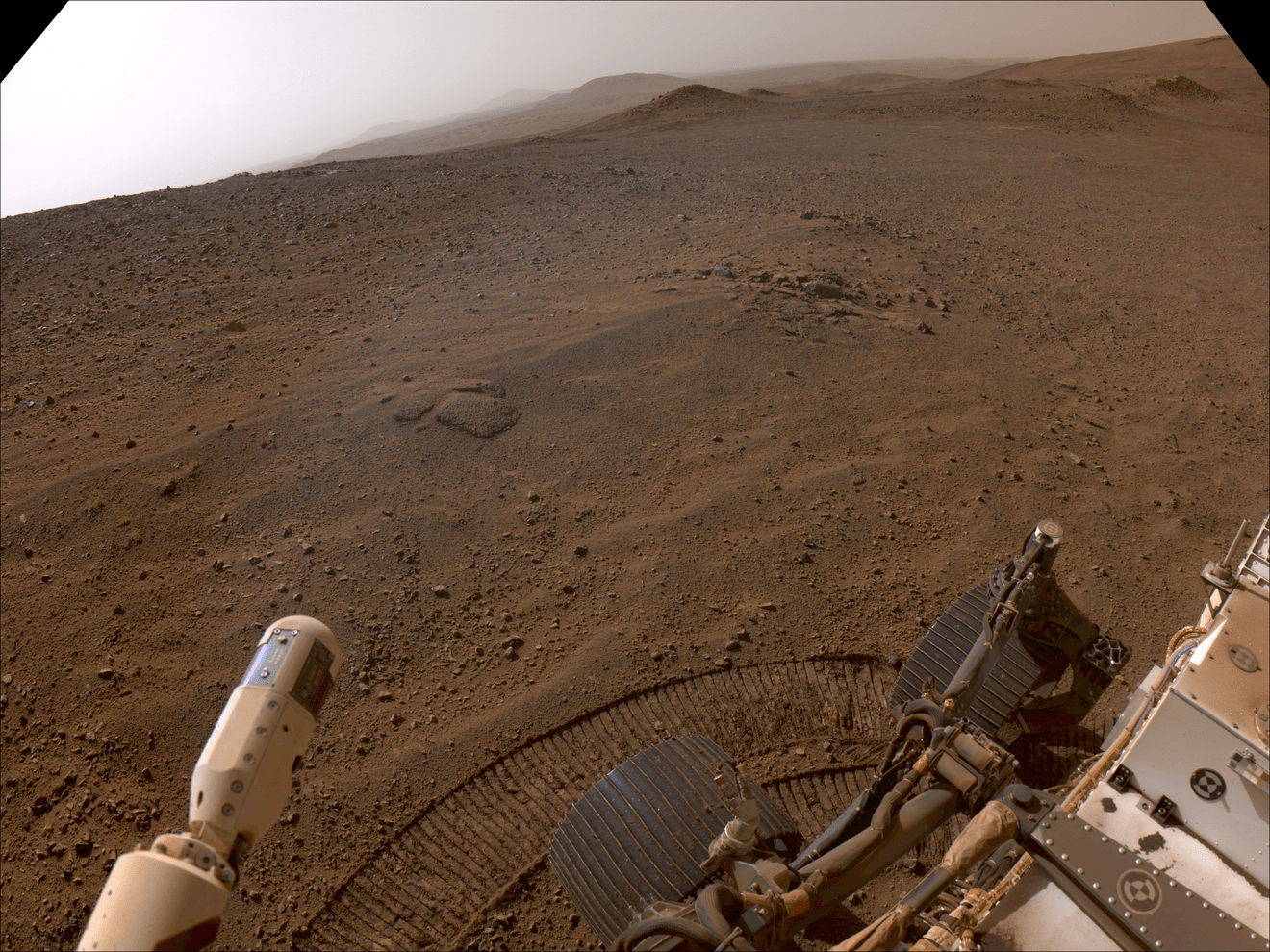
Image (Credit): View of the rim of Jezero Crater from NASA’s Perseverance Mars rover on December 10, 2024. (NASA/JPL-Caltech)

Here are some recent space-related stories of interest.

Georgia Tech: Volcano ‘Hidden in Plain Sight’ Could Help Date Mars — and its Habitability

Georgia Tech scientists have uncovered evidence that a mountain on the rim of Jezero Crater — where NASA’s Perseverance Rover is currently collecting samples for possible return to Earth — is likely a volcano. Called Jezero Mons, it is nearly half the size of the crater itself and could add critical clues to the habitability and volcanism of Mars, transforming how we understand Mars’ geologic history. The study, “Evidence for a composite volcano on the rim Jezero crater on Mars,” was published this May in the Nature-family journal Communications Earth & Environment, and underscores how much we have left to learn about one of the most well-studied regions of Mars.

Caltech: Missing Matter in Universe Found

Due to its diffuse nature, roughly half of ordinary matter in the universe went unaccounted for and had been considered “missing”—until now. In a new study in Nature Astronomy, a team of astronomers at Caltech and the Center for Astrophysics | Harvard & Smithsonian (CfA) has, for the first time, directly detected and accounted for all the missing matter. To do this, the team used brief, bright radio flashes in the distant cosmos, called fast radio bursts (FRBs), to illuminate the matter lying between the FRBs and us. “The FRBs shine through the fog of the intergalactic medium, and by precisely measuring how the light slows down, we can weigh that fog, even when it’s too faint to see,” says Liam Connor, assistant professor at Harvard and lead author of the study, who performed much of the work while a Caltech research assistant professor working with Vikram Ravi, assistant professor of astronomy at Caltech.

Space News: Members of Congress Want White House to Quickly Nominate New NASA Administrator

Members of the House and Senate called in the White House to promptly offer a new candidate for NASA administrator after the surprise withdrawal of Jared Isaacman’s nomination. In briefings organized by the Aerospace Industries Association June16, representatives of House and Senate delegations to the Paris Air Show said it was critical that the agency get permanent leadership as it deals with potential significant cuts to its budget in the coming fiscal year.

Space Stories: Spirals in the Oort Cloud, Killer Asteroid Heading Towards Moon, and Starlink Messes Up Astronomy

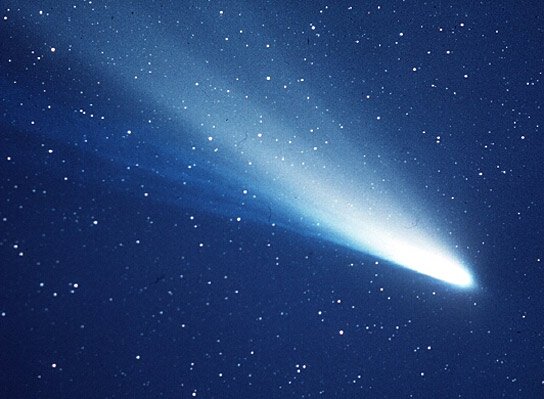
Image (Credit): Halley’s Comet. (NASA Jet Propulsion Laboratory, California Institute of Technology)

Here are some recent space-related stories of interest.

NDTV: Visual Glitch Leads To Accidental Discovery Of Spiral In Mysterious Oort Cloud

Scientists have long assumed the Oort Cloud, one of the most mysterious structures in our solar system, to be spherical. But during the pre-production of their new space show, “Encounters in the Milky Way,” they noticed a strange spiral pattern in the middle of the cloud. The show, which premiered on Monday at New York City’s Hayden Planetarium, featured a computer-generated visualisation of the Oort Cloud on the dome. The team was reviewing the animation when they noticed what appeared to be a spiral structure inside the typically spherical cloud shape.

Daily Mail: NASA Issues Urgent Update on ‘City Killer’ Asteroid Heading Towards the Moon in 2032

The ‘city killer’ asteroid 2024 YR4 may not be on a collision course with Earth anymore. But NASA has raised the odds of it hitting the moon in just seven years’ time. According to the space agency, there’s now a 4.3 per cent chance that 2024 YR4 will smash into the moon on December 22, 2032…The impact event would be the first time scientists could watch a known asteroid create a lunar crater in real-time.

New Scientist: Starlink Satellites are Leaking Radio Signals that May Ruin Astronomy

SpaceX’s Starlink satellites are leaking radio waves to such an extent that it could threaten our ability to study and understand the early universe, say astronomers. Interference from the thousands of Starlink satellites in orbit, where they provide a global internet service, has been a continuing concern for astronomers, who say that the radio emissions from the craft could affect sensitive telescopes that observe distant, and faint, radio sources. SpaceX has worked with astronomers to try to prevent this interference, by switching off their internet-transmitting beams when they fly over key telescopes, but it turns out that this isn’t enough.