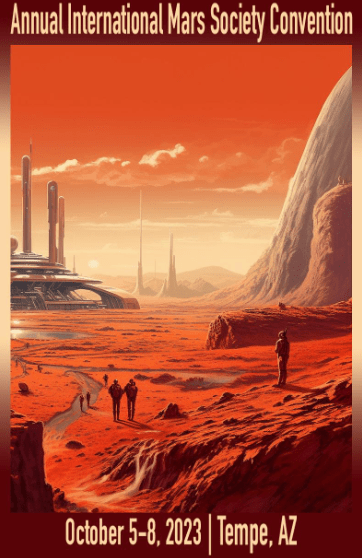
If you missed the Annual International Mars Society Convention last weekend in Arizona, you will soon be able to catch up on all of the presentations.
First, you can find abstracts on all of the convention presentations here, which includes many topics, such as:
Investigating the Effects of Time-Delayed Communications on the Crew Mission Support;
Terraform Earth, then Mars;
Methods for Choosing Government Officials in the Mars Context;
Space and Ocean exploration as the Alternative to World War III;
Agriculture on Mars; and
Advancements in Sustainable Materials for Revolutionizing Mars Exploration.
Next, you can find the recordings of many of the presentations from past conventions on the Society’s YouTube page. I expect you will soon see recordings from the latest convention on this same Youtube page as well.
It’s a great service for interested parties who could not make it to the conventions. I recommend you check it out.
Fashion house Prada has teamed up with commercial space company Axiom Space to create lunar spacesuits for NASA’s Artemis III mission, which will be the first crewed moon landing since 1972.Called Axiom Extravehicular Mobility Unit (AxEMU), the suits will be designed to give astronauts “advanced capabilities for space exploration,” Prada said. They are an evolution of NASA’s Exploration Extravehicular Mobility Unit (xEMU) spacesuit design and will use “innovative technologies and design” to be more flexible and provide more protection against the harsh lunar environment, according to the brand.
On some nights, one of the brightest objects in the sky is neither a planet nor a star. It is a telecommunications satellite called BlueWalker 3, and at times it outshines 99% of the stars visible from a dark location on Earth, according to observations reported today in Nature. BlueWalker 3 is the most brilliant recent addition to a sky that is already swarming with satellites. The spaceflight company SpaceX alone has launched more than 5,000 satellites into orbit, and companies around the globe have collectively proposed launching more than half a million satellites in the coming years — a scenario that astronomers fear could hamper scientific observations of the Universe.
The Russian segment of the International Space Station (ISS) has sprung its third coolant leak in under a year, raising new questions about the reliability of the country’s space programme even as officials said crew members were not in danger. Flakes of frozen coolant spraying into space were seen in an official live feed of the orbital lab provided by Nasa on Monday, and confirmed in radio chatter between US mission control and astronauts. “The Nauka module of the Russian segment of the ISS has suffered a coolant leak from the external (backup) radiator circuit, which was delivered to the station in 2012,” Russian space agency Roscosmos said on Telegram, adding temperatures remained normal in the affected unit.
Image (Credit): Launch of the Amazon Project Kuiper prototypes from Cape Canaveral. (Amazon)
If you were worried about satellite traffic and its impact on astronomy, then you have one more thing to worry about. Yesterday, two prototype satellites were launched aboard an Atlas V rocket from the Cape Canaveral Space Force Station. They are part of Amazon’s Project Kuiper, which may lead to 3,200 additional satellites orbiting the Earth.
Project Kuiper is an initiative to increase global broadband access through a constellation of 3,236 satellites in low Earth orbit (LEO). Its mission is to bring fast, affordable broadband to unserved and underserved communities around the world.
Sounds a lot like SpaceX’s Starlink, doesn’t it? And plenty more similar projects are being planned by the Chinese and others.
It does make you wonder whether there is a better way. I understand the nationals security complications with satellites, but thousands upon thousands of satellites circling the Earth to provide similar Internet services to customers sounds wasteful, dangerous, and bothersome to astronomy. I liked it better when the wires were running under the seas or underground. This new approach will be a mess.
The Government Accountability Office issued a report last year highlighting some of the risks and mitigation ideas:
Increase in orbital debris. Debris in space can damage or destroy satellites, affecting commercial services, scientific observation, and national security. Better characterizing debris, increasing adherence to operational guidelines, and removing debris are among the possible mitigations, but achieving these is challenging.
Emissions into the upper atmosphere. Rocket launches and satellite reentries produce particles and gases that can affect atmospheric temperatures and deplete the ozone layer. Limiting use of rocket engines that produce certain harmful emissions could mitigate the effects. However, the size and significance of these effects are poorly understood due to a lack of observational data, and it is not yet clear if mitigation is warranted.
Disruption of astronomy. Satellites can reflect sunlight and transmit radio signals that obstruct observations of natural phenomena. Satellite operators and astronomers are beginning to explore ways of mitigating these effects with technologies to darken satellites, and with tools to help astronomers avoid or filter out light reflections or radio transmissions. However, the efficacy of these techniques remains in question, and astronomers need more data about the satellites to improve mitigations.
The report has a lot of good information, but I am not sure Amazon, SpaceX, or the Chinese will be paying any attention until a world body gets involved. National regulation will not be enough.
More likely than not, as with many of these areas in need of regulation, we are just one major accident away from new rules.
Image (Credit): SpaceX’s Starbase in Boca Chica, Texas. (SpaceX)
“The final mishap investigation report cited a total of sixty-three (63) corrective actions for SpaceX to implement. These included actions to address redesigns of vehicle hardware to prevent leaks and fires, redesign of the launch pad to increase its robustness, incorporation of additional reviews in the design process, additional analysis and testing of safety critical systems and components including the Autonomous Flight Safety System (AFSS), and the application of additional change control practices.”
-Statement in a September 7, 2023 letter from the Federal Aviation Administration to SpaceX regarding its April 20, 2023 Starship launch from Boca Chica, Texas. These correction actions are expected to be implemented before the next launch can proceed. No date for the next Starship launch has been shared to date.
Image (Credit): Earlier SN10 Starship prototype bursting into flames and exploding soon after landing. (NASASpaceflight)
Last week, The Wall Street Journal had a good story on Elon Musk titled “Elon Musk’s Latest Antics Have Some Asking: Is He Out of Touch?” It discuses his frat-like behavior challenging Meta’s Mark Zuckerberg to a fight, his strange behavior at Twitter, and the shrinking set of friends and colleagues able to keep him from going adrift in his own bubble. The story notes:
Such antics are leading some Musk supporters to worry aloud that he has lost touch, saying he is ensconced in a distorted reality that is warping his perspective and threatening his businesses at a time when he is trying to oversee multiple companies in different industries.
Of course, one of those companies is SpaceX, which has become the backbone of NASA and the US satellite industry. SpaceX also runs Starlink, which is now a key part of the battle against Russia as it supplies Internet services to the Ukrainian military.
Musk has styled himself as the Trump of Technology – breaking established rules, failing to pay his bills, attacking critics (in-house, as well), and generally seeing what he can get away with before it all collapses.
Can one distracted man manage all of these companies? Should one distracted man manage all of these companies? And should our government be so reliant on him in the space and defense arenas? Or is SpaceX becoming the next Wagner Group, a government-funded satellite that is starting to think it is smarter than its paymaster? We all know how that ended.
We’re talking about Elon – again – but this time we’re looking at the big picture: the tech titan’s “unprecedented power” over our the federal government and national security, as encapsulated in Pulitzer Prize-winning reporter Ronan Farrow’s latest New Yorker profile. William Cohan, a financial journalist and founding partner of Puck News, also joins to break down the varying fortunes of SpaceX, Tesla and Twitter, and the sustainability of those companies under a leader that is ambitious, but capricious. Stay til the end to hear Kara tell Nayeema why, despite his shenanigans, she still has empathy for Elon Musk.
You should also check out Ronan Farrow’s The New Yorker article, “Elon Musk’s Shadow Rule.” While acknowledging that some industrialists have had inordinate influence over US politics in the past, the piece notes:
But Musk’s influence is more brazen and expansive. There is little precedent for a civilian’s becoming the arbiter of a war between nations in such a granular way, or for the degree of dependency that the U.S. now has on Musk in a variety of fields, from the future of energy and transportation to the exploration of space.
This really doesn’t sound all that sustainable, or wise. I hope Uncle Sam has a Plan B should Musk run it all into the ground or walks away with all of his marbles (assuming has has any left).



 Our Awesome Universe