Image (Credit): Launch of Russia’s Soyuz M-23 mission to the ISS. (NASA)
Yesterday, Russia launched the uncrewed Soyuz M-23 mission from the Baikonur Cosmodrome in Kazakhstan (it was actually “today” in Russian time). The spacecraft will replace the damaged M-22 capsule attached to the International Space Station (ISS). As a result, the earlier M-22 crew of Russian cosmonauts Sergey Prokopyev and Dmitri Petelin, and NASA astronaut Frank Rubio, will return in this replacement capsule.
NASA noted that the M-22 capsule will be studied by the Russian upon its return in March:
The damaged Soyuz MS-22 is scheduled to undock from the station in late March and return to Earth for an uncrewed parachute-assisted landing in Kazakhstan, and post-flight analysis by Roscosmos.
Given recent leaks on two Russian spacecraft, let’s hope the M-23 mission goes without a hitch. Fingers crossed.
SpaceX will also be shipping a new crew up to the ISS next week, so the space traffic continues even with these hiccups.
Image (Credit): The Tesla Roadster leaving Earth’s orbit. (SpaceX)
It’s time to check in again with ChatGTP to discuss another Elon Musk issue – the Tesla vehicle he launched into space using a SpaceX rocket. I recently asked ChatGPT, which was funded in part by Elon Musk, to provide a three paragraph summary discussing the launch of the Tesla Roadster into space as well as the current location of that Roadster. Here is the response:
In February 2018, Elon Musk’s SpaceX launched its Falcon Heavy rocket into space, making it the most powerful operational rocket in the world. The rocket was carrying a special payload: a Tesla Roadster, driven by a mannequin named Starman wearing a SpaceX suit, was put into orbit around the sun. The Roadster, which was live-streamed as it traveled through space, was meant to be a whimsical demonstration of the Falcon Heavy’s capabilities, but it also became a symbol of Musk’s audacity and his willingness to take risks.
The Tesla Roadster is still orbiting the sun, travelling as far out as the orbit of Mars and as close to the sun as the orbit of Earth. Its precise location can be tracked using the website whereisroadster.com, which provides real-time updates on the car’s location based on data from the JPL Horizons system. The Roadster’s journey through space is expected to continue for millions of years, making it one of the longest-lasting man-made objects in space.
Although the Roadster was not intended to be a scientific mission, it has provided valuable data for astronomers and space enthusiasts. For example, it has been used to test the accuracy of simulations of the solar system, and to study the effects of space radiation on electric vehicle batteries. In addition, the Roadster’s journey has inspired a new generation of space enthusiasts and has sparked interest in the possibilities of space travel and exploration. It is a testament to the power of innovation, creativity, and the human spirit, and it serves as a reminder of the incredible things that can be achieved when people are willing to take risks and pursue their passions.
The summary amusingly states that this floating Roadster has provided “valuable data” and “…sparked interest in the possibilities of space travel and exploration.” It appears Mr. Musk still has his fingers in the program code. I believe NASA can get the data it needs without the use of a wandering automobile. Besides, you only need to know the impact of radiation on an EV battery if you plant to drive to Mars. And while I would agree that his “audacious” claims about a trip to Mars on the SpaceX Starship may have stimulated a few souls, creating a new form of space junk was seen for what it was – a dumb stunt.
All stunts aside, I look forward to seeing Mr. Musk focus again on Mars rather than areas outside of his expertise, such as Twitter. We need less space junk and more space missions with a destination in mind.
Image (Credit): Former NASA astronauts Robert Behnken, left, and Douglas Hurley, right, and are seen after being awarded the Congressional Space Medal of Honor by Vice President Kamala Harris during a ceremony in the Eisenhower Executive Office Building. (NASA/Joel Kowsky)
On behalf of President Joe Biden, Vice President Kamala Harris awarded former NASA astronauts Douglas Hurley and Robert Behnken the Congressional Space Medal of Honor Tuesday for their bravery in NASA’s SpaceX Demonstration Mission-2 (Demo-2) to the International Space Station in 2020. Hurley and Behnken are the first recipients of the honor since 2006 and accepted the awards during a televised event in Washington.
Scientists using NASA’s new James Webb Space Telescope say they’ve been able to get a closer look at an asteroid that also hosts just the fifth ring system to be discovered in our solar system (the others circle Saturn, Jupiter, Uranus and Neptune). Astronomers initially discovered the rings in 2013 while watching Chariklo occult, or pass in front of, a distant star. To their surprise, two other smaller objects also appeared to pass in front of the background star for an instant. These turned out to be two thin rings around Chariklo.
In 2008, HR8799 was the first extrasolar planetary system ever directly imaged. Now, the famed system stars in its very own video. Using observations collected over the past 12 years, Northwestern University astrophysicist Jason Wang has assembled a stunning time lapse video of the family of four planets — each more massive than Jupiter — orbiting their star. The video gives viewers an unprecedented glimpse into planetary motion.
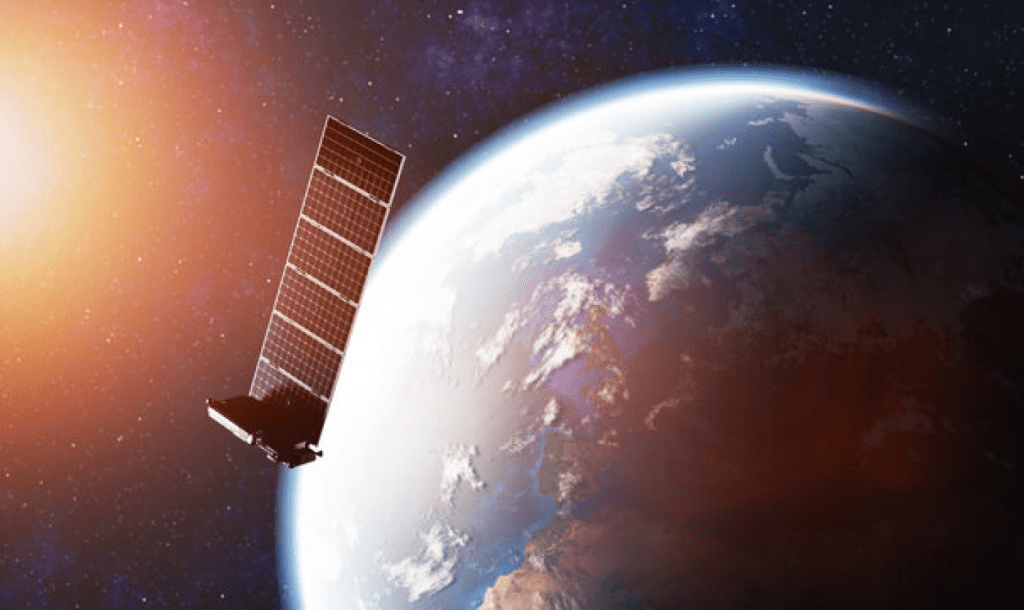
Image (Credit): Artist’s rendering of a Starlink satellite in orbit. (SpaceX)
Earlier this month, the National Science Foundation (NSF) and SpaceX came to an agreement to “mitigate potential interference” from its Starlink satellites. These satellites have been impacting ground-based radio, optical, and infrared astronomy facilities.
Basically, SpaceX agreed to continue working on recommendations and best practices from the scientific community, ensure the second generation of Starlink satellites are darker and less intrusive in the night sky, continue to assist with studies on the satellites impact on astronomy facilities, and improve overall coordination with these scientific facilities.
It is a tall order, but any company pumping thousands of satellites into the night sky should have some responsibilities to others using that same sky. SpaceX is just the first of many companies with big plans for the night sky, so maybe this will set a precedent for the satellites that follow, or at least the U.S. satellites. I am note sure we can do anything about the Chinese and others, but the United Nations cans certainly create similar standards at the international level.
In the agreement, the NSF stated:
NSF and SpaceX have collaborated from the beginning on how best to meet the goals of protecting astronomy while also providing maximum internet access for communities across the United States. The mitigation steps taken can and should serve as a model for coordination among satellite operators and the astronomy community within the United States and beyond.
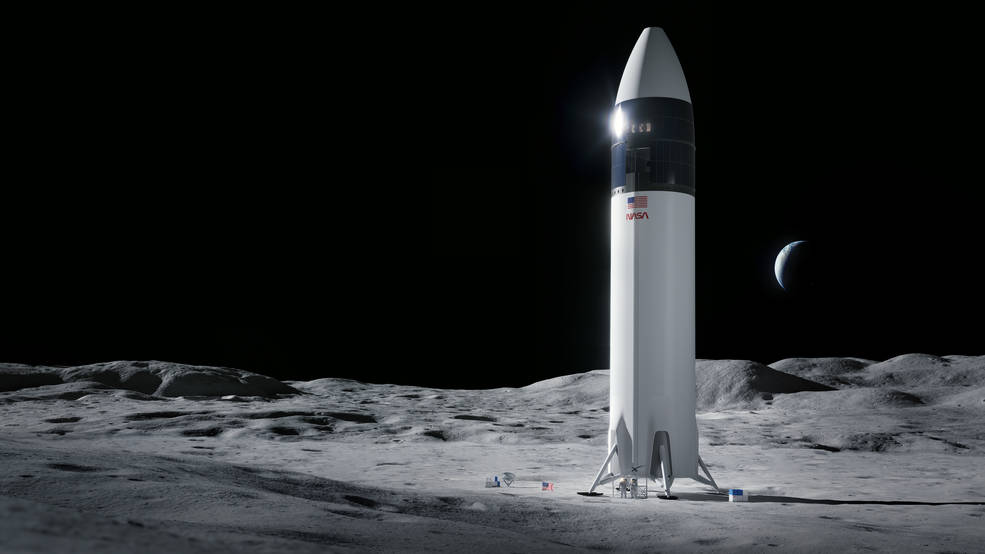
Image (Credit): Arstist’s rendering of SpaceX Starship human landing system design. (SpaceX)
The other week, NASA revealed an update on the Artemis III mission to the Moon in 2025. Now that Artemis I was a success and Artemis II is being readied, Artemis III is becoming much clearer on the horizon. The plan focuses on the first crew to land on the surface, noting that future missions will be involved in building the Gateway lunar space station.
While the Space Launch System (SLS) will get the crew into orbit on Orion, SpaceX has been chosen to bring this first crew to the moon. However, SpaceX will first need to test this human landing system on the Moon without a crew.
The landing site is likely to be on the Moon’s South Pole involving two astronauts who will take the SpaceX human landing system to the surface. They will conduct their research work in Axiom space suits.
It all may have become routine back in the 1970s, but NASA is demoing everything all over again to ensure new systems and new parties are up to par for this return to the Moon. The world is watching again, particularly China. We need to be perfect in this overdue first step back into human space travel.
You can view all of the parts of the mission in the graphic below.



 Our Awesome Universe