I have written about satellite pollution a few times on this site, and now I need to address it one more time by citing even more bad news. As noted in the news, the Federal Communications Commission (FCC) is allowing SpaceX to place another 7,500 satellites into orbit. SpaceX wanted permission for about 30,000 new satellites, so stay tuned for whining and more pressure on the FCC.
In making its decision, the FCC acknowledged and addressed concerns related to orbital debris and space safety, and required SpaceX to report back on mitigation efforts. You can read the full FCC decision here.
Given that Mr. Musk does not seem to believe in limitations on Twitter or satellite activities, we will need to rely on the regulators to keep an eye on him.
The Hungarian government plans to spend $100 million to send an astronaut to the International Space Station in two years through a deal with Axiom Space. In a presentation at the European Space Agency’s ministerial council meeting Nov. 22, Péter Szijjártó, Hungarian foreign minister, said the country was in the middle of a process to select an astronaut to fly on a month-long mission to the ISS in late 2024 or early 2025. Axiom Space announced in July it signed a memorandum of understanding with the government of Hungary regarding that country’s Hungarian to Orbit (HUNOR) program, which would fly a Hungarian astronaut to space on a future Axiom Space mission. That announcement, though, provided few details about when that person would fly.
Three Chinese astronauts docked early Wednesday with their country’s space station, where they will overlap for several days with the three-member crew already onboard and expand the facility to its maximum size. Docking with the Tiangong station came at 5:42 a.m. Wednesday, about 6 1/2 hours after the Shenzhou-15 spaceship blasted off atop a Long March-2F carrier rocket from the Jiuquan Satellite Launch Center...The station’s third and final module docked earlier this month, one of the last steps in China’s effort to maintain a constant crewed presence in orbit.
A tiny spacecraft is ready to head out for a big job: shining a light on water ice at the Moon’s south pole. Lunar Flashlight is a cubesat about the size of a briefcase, set to launch on December 1 on a SpaceX Falcon 9 rocket, sharing a ride with the Hakuto-R Mission to the Moon. The tiny 14 kg (30 lb) spacecraft will use near-infrared lasers and an onboard spectrometer to map the permanently shadowed regions near the Moon’s south pole, where there could be reservoirs of water ice.
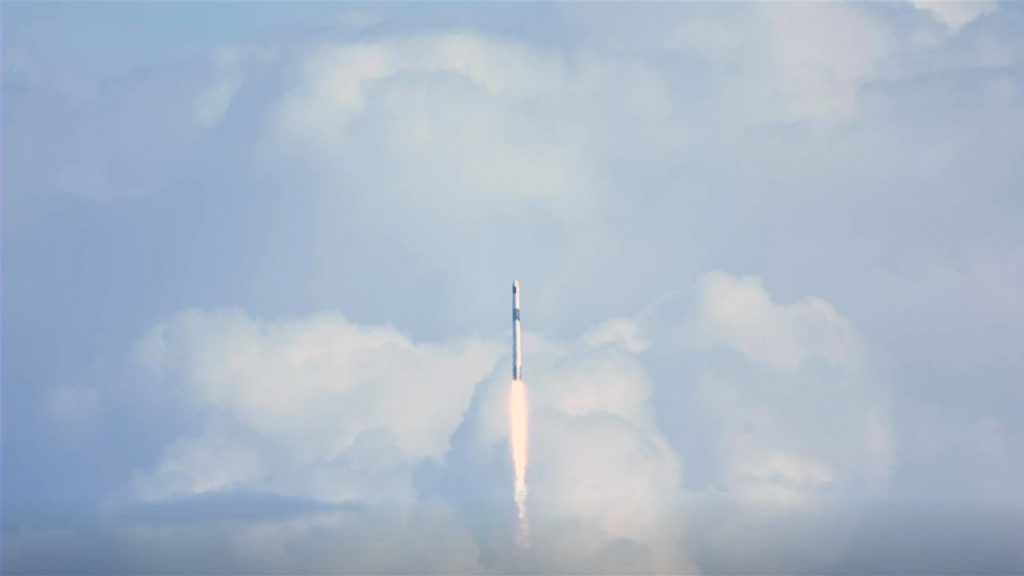
Image (Credit): SpaceX’s Falcon 9 rocket leaving NASA’s Kennedy Space Center in Florida at 2:20 p.m. EST November 26, 2022. (NASA)
Earlier today, a SpaceX rocket sent more supplies towards the International Space Station (ISS). The Falcon 9 rocket successfully sent the Dragon capsule on its way towards a rendezvous with the ISS tomorrow morning. You can read about some of the cargo here.
For example, part of the cargo will assist with the growing of dwarf tomatoes in space. Gioia Massa, NASA Life Sciences project scientist and VEG-05 principal investigator, stated:
We are testing tomatoes, looking at the impacts of light spectrum on how well the crop grows, how delicious and nutritious the tomatoes are, and the microbial activity on the fruit and plants…We also are examining the overall effect of growing, tending, and eating crops on crew behavioral health. All of this will provide valuable data for future space exploration.
Even with all of the excitement targeted at the Moon and Artemis these days, the everyday work on the ISS continues.
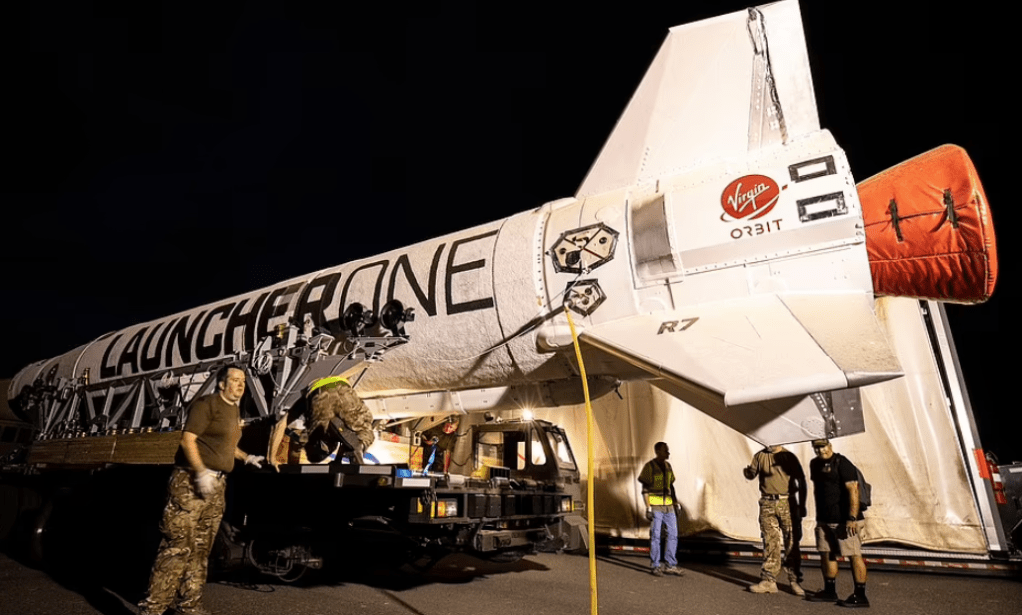
Image (Credit): LauncherOne rocket after arriving in Cornwall, England. (UK Space Command)
Later this year, the United Kingdom (UK) is getting into the commercial space business with Virgin Orbit’s launch of the LauncherOne rocket. The 70-foot long rocket stuffed with a satellites will be loaded onto Virgin Orbit’s Boeing 747 (called the “Cosmic Girl”) for a mid-air launch. It will be the first satellite launch from the UK.
While the launch was planned for earlier this year, Virgin Orbit is still dealing with some bureaucratic delays. Nonetheless, the use of Space Cornwall is an achievement for the UK and Europe as they plan more space missions from the continent.
Late last year, the Guardian wrote about planned space missions from the UK. The article, “The Great British Race to Space,” highlights plans for rocket launches from England, Wales, and Scotland. For instance, B2Space in Wales has plans to launch rockets from a helium balloon floating 20 miles up. The balloon could save about 70 percent of fuel and other costs related to a typical satellite launch.
It seems reusable rockets are just one of many innovations for lowering the cost of satellite launches. Watch out, SpaceX.
Image (Credit): A test flight for the B2Space balloon. Picture: (B2Space)
Image (Credit): Nighttime photograph of Riyadh, Saudi Arabia, taken in November 2012 by one of the Expedition 33 crew members aboard the ISS. (NASA)
While the Biden Administration appears to have its issues with Saudi Arabia, this is not stopping the visit of two Saudi Arabian private astronauts to the International Space Station (ISS). Space Newsreports that NASA has confirmed that a male and female astronaut from Saudi Arabia will travel to the ISS next spring aboard a SpaceX rocket as part of the privately-run Axiom Space. Plans for this mission were reported back in September.
This will be the second Axiom Space mission to the ISS. Other missions are being planned involving additional countries, including astronauts from Turkey, Hungary, Canada, and the United Arab Emirates. Mission participants need to be approved by a NASA-chaired panel that includes the countries involved with the ISS program.
Axiom Space will send four crew members to the ISS for 12 days. Here is the pitch for the second mission, or Ax-2:
The Axiom Mission 2 (Ax-2) astronauts are part of the latest class of space explorers and Axiom’s next crew to advance a new method of access to the International Space Station (ISS) and low-Earth orbit. Aboard the orbiting laboratory, the four-person, multinational crew will conduct extensive research, investigate novel technologies, and engage with audiences around the world as champions of science, technology, engineering, mathematics, and the arts. Their efforts will continue to lay the groundwork and establish key capabilities for the future Axiom Station, the world’s first commercial space station.
You may recall that Saudi Arabia also signed onto the Artemis Accords over the summer. The Accords were established in 2020 to affirm each signatory’s commitment to sustainable space exploration “guided by a common set of principles that promote the beneficial use of space for all of humanity.”
All of this shows that space still remains a realm that does not need to be militarized or abused even if we have yet to figure out to resolve these issues here on Earth. Whatever problems with have with our neighbors, it’s good to see we are building some things together.
As noted earlier, even if the press on this Ax-2 mission demonstrates some unity, let’s just hope these “astronauts” are there for more than a joy ride. I am not convinced that space tourism is what we need. But given that Axiom Space is considering its own commercial space station, maybe there is some interest in real work in space by these parties.




 Our Awesome Universe