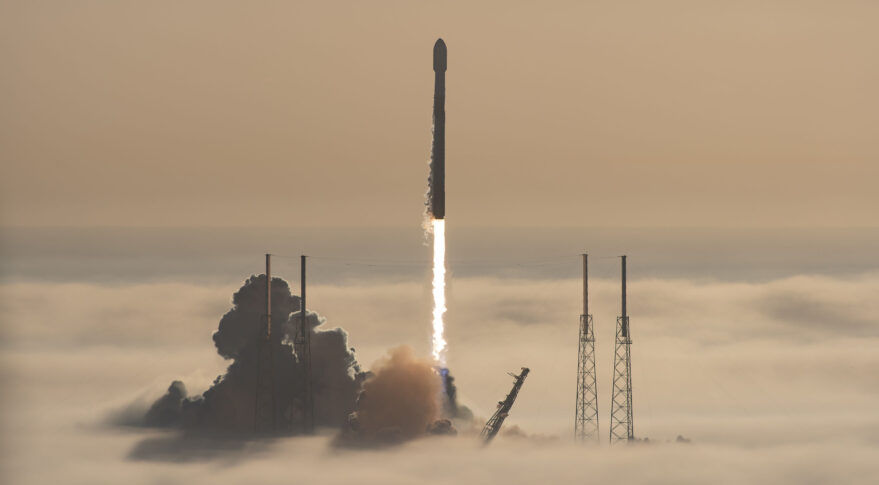
Image (Credit): November 13, 2021 SpaceX launch of 53 Starlink satellites. (SpaceX)
“Quasi-civilian infrastructure may be a legitimate target for a retaliatory strike.”
-Statement to the United Nations by Russian senior foreign ministry official Konstantin Vorontsov in reference to attacking SpaceX’s Starlink satellites being used by the Ukrainian military as it pushes back the Russian invasion. In a Reuters article, “Russia’s Anti-satellite Threat Tests Laws of War in Space,” Iridium chief executive Matt Desch stated, “If somebody starts shooting satellites in space, I’d imagine it would quickly make space unusable.”
Image (Credit): Test of the one-third scale prototype aerobot designed to withstand the corrosive chemicals in Venus’ atmosphere. (Near Space Corporation)
A scaled-down version of the aerobot that could one day take to the Venusian skies successfully completed two Nevada test flights, marking a milestone for the project…The shimmering silver balloon ascended more than 4,000 feet (1 kilometer) over Nevada’s Black Rock Desert to a region of Earth’s atmosphere that approximates the temperature and density the aerobot would experience about 180,000 feet (55 kilometers) above Venus. Coordinated by Near Space, these tests represent a milestone in proving the concept’s suitability for accessing a region of Venus’ atmosphere too low for orbiters to reach, but where a balloon mission could operate for weeks or even months.
China has launched a solar observatory to study solar flares and eruptions, and their connection with the Sun’s magnetic field…[the Advanced Space-based Solar Observatory (ASO-S)] is planned to operate at 720 kilometers (447 miles) above Earth’s surface in a Sun-synchronous orbit that will allow it to observe the Sun at all times. Its primary, four-year mission is timed to make the most of the 2024–2025 solar maximum, when the Sun is at its most active during its 11-year cycle.
SpaceX’s newly announced tourist mission to the moon could help humanity extend its footprint far beyond Earth, company representatives say. That mission, which was revealed today (Oct. 12), will send wealthy entrepreneur Dennis Tito, his wife Akiko and 10 other people on a weeklong journey around the moon aboard SpaceX’s huge Starship vehicle, which is still in development. Who those 10 other passengers will be is unknown; only the Titos have reserved seats at the moment.
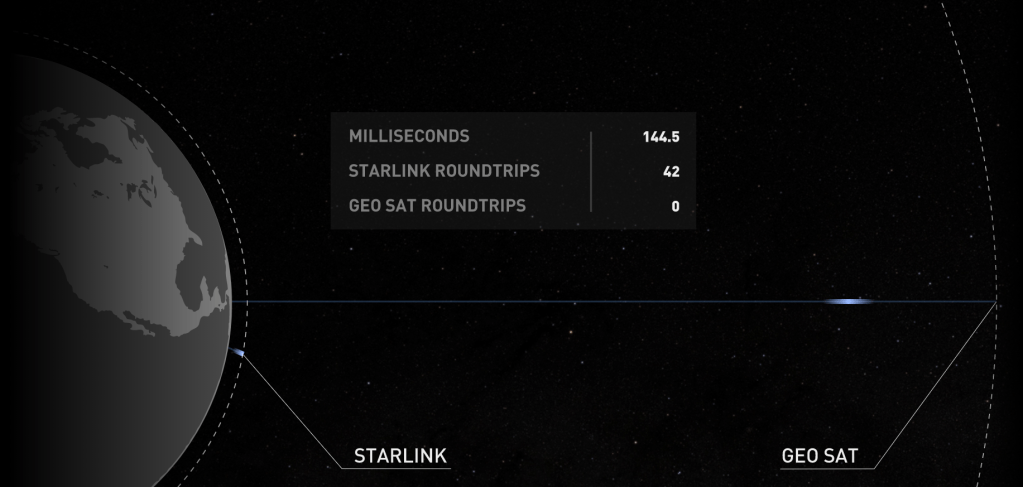
Image (Credit): Starlink page explaining why Starlink satellites are better then geostationary satellites. (SpaceX)
As if Elon Musk doesn’t have enough problems with his Twitter purchase and declining shares at Tesla, now the Ukranians are reporting that SpaceX’s Starlink internet service failed to work during a critical point in their battle to push the Russians out of Ukranian territory. This problem has been going on for weeks, but we are hearing about it now.
SpaceX was silent when these reports came out, but some suggested this may have been a feature rather than a bug in the Starlink system to prevent it from being used by Russians.
Mr. Musk later tweeted on this matter, stating:
Bad reporting by [The Financial Times]. This article falsely claims that Starlink terminals & service were paid for, when only a small percentage have been. This operation has cost SpaceX $80M & will exceed $100M by end of year. As for what’s happening on the battlefield, that’s classified.
Sadly, Mr. Musk did not clear the air but rather boasted about his company and attacked the media. But another media story from The Eurasian Times shed more light on the issue. The newspaper reports that Russia may be using its Tirada-2S satellite communications electronic jamming system to interrupt Starlink signals.
I would rather SpaceX is the cause of the problem rather than the Russians, but whatever it is we can only hope the Ukrainians, SpaceX, and Ukraine’s allies have a quick fix. Mr. Musk should received accolades for adding a novel asset to this war, yet his entire Starlink enterprise, and not just his donated equipment, is now at risk.
Update: Elon Musk is now asking the Pentagon to assume the costs of the Ukrainian Starlink program, expected to cost SpaceX about $100 million by the end of the year. Given the ongoing Twitter battle between Elon Musk and the Ukrainians related to Mr. Musk’s proposed peace plan for the region, the Ukrainians should probably be looking for another funding partner rather than continuing to count on the generosity of Mr. Musk.
Further Update: Elon Musk is now backing off on his attempts to seek more funding for Starlink, but as usual he is not very graceful about it. Here is his recent tweet:
The hell with it … even though Starlink is still losing money & other companies are getting billions of taxpayer $, we’ll just keep funding Ukraine govt for free.
“We are going to keep flying [to the] International Space Station as long as our new infrastructure [is being] buil[t]. We don’t know yet how it’s going to be built and what kind of modules we will have, but I’m sure that we will stay in international partnership when we fly [to the] ISS and [the] future station and future infrastructure is also going to be with international partnership.”
–Statement by Sergei Krikalev, executive director of human space flight programs at Roscosmos, during an October 5th briefing following the successful SpaceX launch of the latest crew to the International Space Station (ISS), which included Russian cosmonaut Anna Kikina. His comments were seen as part of a continuing Russian clarification of earlier comments about the Russians leaving the ISS in 2024. It appears the Russian will be staying with the station even longer, even if this support does not last until 2030.
Image (Credit): October 5, 2022 departure of a SpaceX Falcon 9 rocket from the Kennedy Space Center in Florida carrying NASA’s SpaceX Crew-5 mission to the ISS. (NASA/Joel Kowsky)
Earlier today, SpaceX Crew-5 successfully departed from NASA’s Kennedy Space Center in Florida on their way to the International Space Station (ISS). The four members on this flight are NASA astronauts Nicole Mann and Josh Cassada, Japan Aerospace Exploration Agency astronaut Koichi Wakata, and Roscosmos cosmonaut Anna Kikina. The population of the ISS will increase to 11 until 3 astronauts return to Earth a few days later.
Here is NASA’s bio on the new crew members:
As commander, Mann is responsible for all phases of flight, from launch to re-entry, and will serve as an Expedition 68 flight engineer. This will be her first spaceflight since becoming an astronaut in 2013. Mann was born in Petaluma, California, and will be the first indigenous woman from NASA in space. She is a colonel in the U.S. Marine Corps, and she served as a test pilot in the F/A-18 Hornet and Super Hornet.
Cassada is the spacecraft pilot and second in command for the mission. He is responsible for spacecraft systems and performance. Aboard the station, he will serve as an Expedition 68 flight engineer. This will be his first flight since his selection as an astronaut in 2013. Cassada grew up in White Bear Lake, Minnesota, and is a physicist and U.S. Navy test pilot.
Wakata will be making his fifth trip to space and as a mission specialist he will work closely with the commander and pilot to monitor the spacecraft during the dynamic launch and re-entry phases of flight. Once aboard the station, he will serve as a flight engineer for Expedition 68. With Crew-5’s launch, Dragon will be the third different type of spacecraft Wakata has flown to space.
Kikina will be making her first trip to space, and will serve as a mission specialist, working to monitor the spacecraft during the dynamic launch and re-entry phases of flight. She will be a flight engineer for Expedition 68.