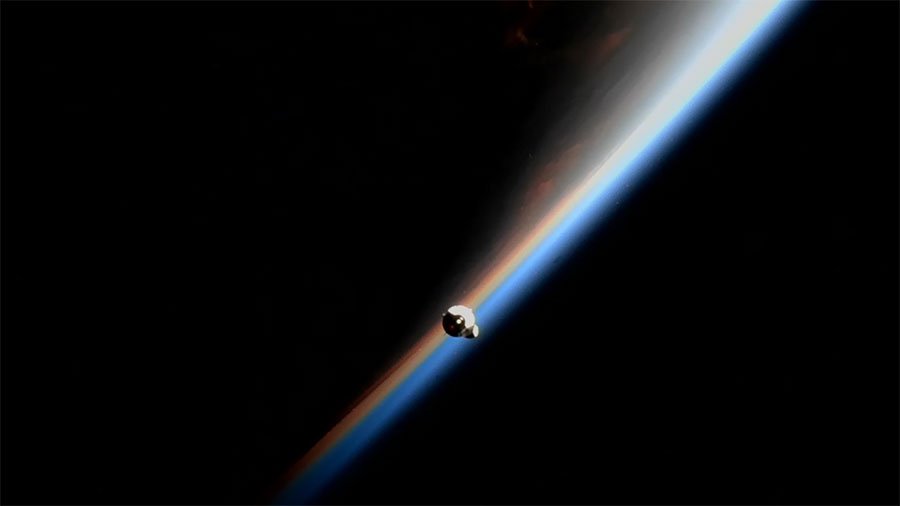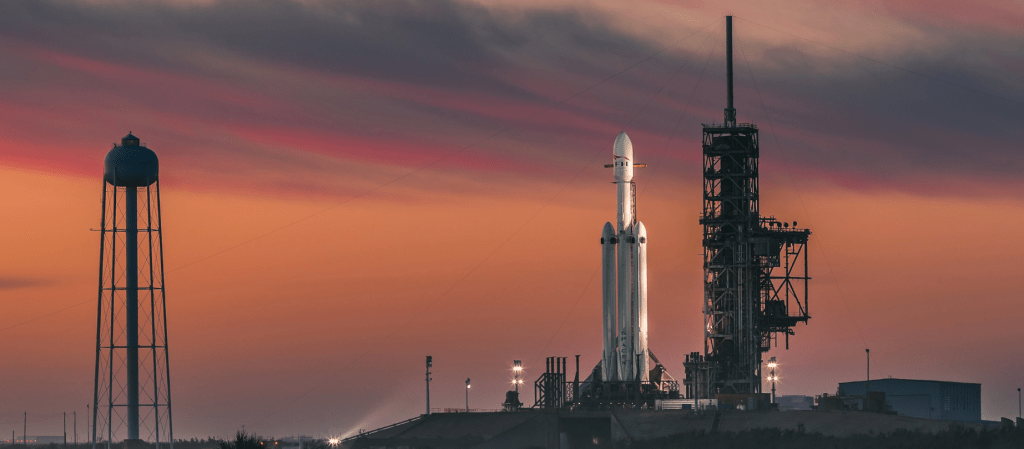
Image (Credit): SpaceX Dragon capsule approaching the ISS. (NASA)
This week’s image is from the International Space Station (ISS) as it awaits incoming cargo from an uncrewed SpaceX Dragon capsule approaching the station on July 16th. NASA noted that what we are seeing is an orbital sunrise above the Pacific Ocean.
NASA also highlighted the various experiments aboard the Dragon that will be added to the station, including one on extraterrestrial concrete:
Biopolymer Research for In-Situ Capabilities looks at how microgravity affects the process of creating a concrete alternative made with an organic material and on-site materials, such as lunar or Martian dust, known as a biopolymer soil composite. Using resources available where construction takes place makes it possible to increase the amount of shielding.
“It would be nice to have a bit more free time on my hands, as opposed to just working day and night from when I wake up till when I go to sleep seven days a week. It’s pretty intense.”
-Statement by Elon Musk from last year, as quoted in yesterday’s Wall Street Journal story, “Twitter Suit Tests Musk as He Faces Tesla, SpaceX Hurdles.” The newspaper cites Tesla’s struggles with new car plants in Germany and Texas, which he calls “gigantic money furnaces,” as well as the billions in losses at SpaceX related to the Starship and Starlink programs. Musk can only blame himself for distracting himself and investors with the Twitter deal. He needs to decide what he wants to spend his time on. If it is not SpaceX, maybe he should sell the firm to others who believe in space. That way he has more money in his pocket for his other distracting hobbies.
Image (Credit): Artist’s image of the Boeing Starliner space capsule. (Boeing)
It wasn’t that long ago U.S. astronauts were completely dependent on Russian rockets to get to the International Space Station (ISS). NASA was paying about $60 million per seat on the Soyuz spacecraft. Well, times have certainly changed with SpaceX now ferrying astronauts, Boeing working on its own crewed Starliner capsule, and Northrop Grumman already helping with cargo.
Now NASA is mixing it up. NASA and Russia’s Roscosmos agreed this weak to place astronauts on the Soyuz again and cosmonauts on the SpaceX Dragon spacecraft. Bloombergreports NASA stated that such mixed crews “ensures there are appropriately trained crew members on board the station for essential maintenance and spacewalks.” In other words, with two launches to the ISS planned in September, a mixing of the crews will ensure some stability in space if only one makes it to the station. Not a bad idea.
Even with all the rhetoric and stunts taking place, it’s nice to see a little bit of common sense prevailing.
Image (Credit): Test run of the Starship Booster on May 5, 2022. (SpaceX)
Earlier this week, SpaceX conducted another test of its Starship. However, the booster was damaged by an explosion during a pre-launch test and will now need to be inspected to determine whether it can be used in the inaugural launch of the Starship later this summer.
For more on the Starship, check out the Cool Worlds video titled “Why Starship Could Transform Astronomy.” It argues that reduced launch costs, reduced complexity, and heavier payloads would allow NASA to launch a fleet of telescopes within current budgets. For instance, the larger Starship payload would have allowed NASA to avoid all of the contortions necessary to fold the James Webb Space Telescope into a smaller rocket. The video also argues that SpaceX’s willingness to take risks is something NASA may want to emulate.
These are interesting times with NASA and SpaceX testing new rockets to place astronauts on distant objects. Even if Russia wants to sit this one out, we have a full blown space race underway domestically.
On this week’s podcast program Sway, you can re-listen to a September 2020 interview between host Kara Swisher and Elon Musk. This was long before all the Twitter nonsense, when Mr. Musk was still focused on cars and space (mostly). The discussion covers plenty of topics, including the need to settle Mars (Mr. Musk disagress with Jeff Bezos who he said believes a space station will be enough to save humanity from an existential crisis), neural implants, and a return to the Moon.
You can tell the program is dated because Mr. Musk complains that NASA cannot find a way to return to the Moon, whereas today we have the Artemis lunar program that includes SpaceX as one of its contractors. Nonetheless, it is good to hear from the old Musk when he was a little more focused.
Then again, the neural implants still seem odd. Neuralink, a company he co-founded, is focusing on those with disabilities at the moment, but the application is expected to be more widespread:
Neuralink is currently focused on making medical devices. These devices have the potential to help people with a wide range of injuries and neurological disorders, and we hope to develop treatments for many of these conditions in the coming years. We expect that as our devices continue scale, and as we learn to communicate with more areas of the brain, we will discover new, non-medical applications for our [brain-machine interface] BMIs. Neuralink’s long-term vision is to create BCIs that are sufficiently safe and powerful that the general population would want to have them.
Helping paraplegics walk and curing brain disorders are certainly noble goals. And, hey, ordering a pizza just by thinking about it sounds cool. But many experts are concerned that Musk is seriously overhyping what Neuralink’s implants will be able to accomplish.
Elon Musk overhyping an idea? Never!
Check it out. You can download the podcast at the New York Times, the Apple Store, and elsewhere.