Image (Credit): USSR’s Luna 2 spacecraft. (Worldhistoryproject.org)
So who owned the rocket stage that hit the Moon earlier this month? I had earlier noted the speculation pertaining to both SpaceX and then the Chinese rockets. Surprisingly, it is still is not clear who owned that rocket stage and maybe we will never know. That is not a good answer for the European Space Agency’s Space Safety Programme, which stated:
The upcoming lunar impact illustrates well the need for a comprehensive regulatory regime in space, not only for the economically crucial orbits around Earth but also applying to the Moon.
While that case has yet to be solved, we are pretty certain about the first Earth-launched rocked to hit the Moon. We can blame the Soviets for that strike back in 1959 with its Luna 2 (nicknamed the Lunik 2). At least the goal in that case was to hit the Moon.
Launched on September 12, 1959, it took 35 hours to travel the distance between the Earth and Moon. Luna 1, launched by the Soviets earlier that year, was supposed to hit the Moon but it missed by about 3,700 miles. You can see more about Luna 2 via this dated news clip.
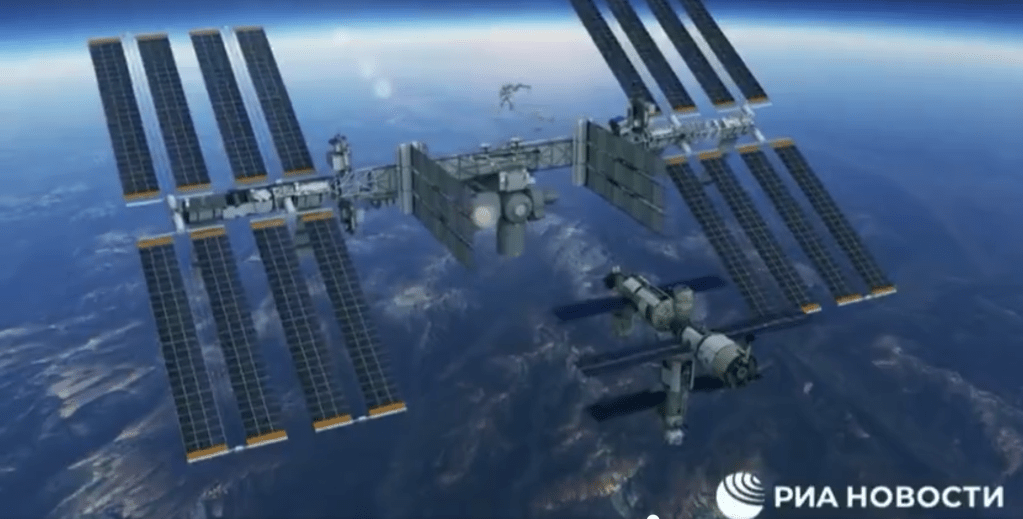
Source/Credit: Image of Russian section breaking away from the ISS from NASA Watch.
You may have already seen this ridiculous Russian video that NASA Watch shared with the world. It is very disturbing. Presumably created by the Russian space program Roscosmos, it shows the Russian portion of the International Space Station (ISS) breaking away as a result of the worldwide sanctions against the Russians for invading Ukraine. Here is the NASA Watch tweet and related video (an image of which is shown above):
Russian gov’t-controlled RIA Novosti @rianru posted a video on Telegram made by @Roscosmos where cosmonauts say goodbye to Mark Vande Hei on #ISS, depart, and then the Russian segment detaches from the rest of ISS. @Rogozin is clearly threatening the ISS program. #NASA#Ukraine
One person provided some hope among all this foolishness with this reply:
Basically all astro-/ cosmonauts said that after a couple of days in space they only see a fragile planet, and that nation states start to disappear in their minds.
And now we have former US astronaut Scott Kelly and SpaceX’s Elon Musk battling with Dmitry Rogozin, the head of Roscosmos. Scott Kelly was clear in his dislike of Rogozin’s comments about the ISS:
Maybe you could find yourself a job working at McDonalds if McDonalds still exists in Russia.
None of this is helpful when we have lives in space depending on a competent ground team. Let’s hope all these egos do not get in the way of the professionalism we expect from the US, Russia, and others with regards to the safe operation of the ISS.
Source/Credit: Starlink terminals posted in a Ukrainian tweet.
Three cheers for SpaceX’s assistance to Ukraine during this difficult time. After Ukrainian Vice Prime Minister Mykhailo Fedorov made a plea to SpaceX for assistance with its Internet, Mr. Must approved the shipment of Starlink terminals to Ukraine to allow the country to use the company’s satellites for its communications.
@elonmusk, while you try to colonize Mars — Russia try to occupy Ukraine! While your rockets successfullyland from space — Russian rockets attack Ukrainian civil people! We ask you to provide Ukraine with Starlink stations and to address sane Russians to stand.
We can haggle about the number of Starlink satellites in orbit another time. Fortunately, such satellites are there when the beleaguered Ukrainians need them.
I guess once was not enough. Billionaire Jared Isaacman wants to spend even more money sending private citizens into space aboard SpaceX spacecraft. He funded his first private flight last September, called Inspiration 4, and now wants to do three more of these flights. The first one raised funds for St. Jude Children’s Research Hospital, whereas it is not clear whether these other voyages also relate to charitable causes.
Space tourism is all the rage these days, with Captain Kirk going up on Blue Origin’s capsule and Virgin Galactic sending Sir Richard Branson into space in preparation of paying customers in the near future. SpaceX always seemed to have more serious goals, but I suppose a buck is a buck.
The first of these three new flights is planned for later this year and will include a spacewalk and science experiments. The second will involve SpaceX’s Dragon, which is currently used for trips to the International Space Station (ISS). The third will involve SpaceX’s Starship created for lunar missions under NASA’s Artemis program.
Apparently, these new missions are expected to “…serve a bigger purpose of opening up space for everyone and making humankind a multiplanetary species, and ideally, have a benefit for the things we’re trying to accomplish back here on Earth.” Once might ask whether this bigger purpose, such as space walks and science experiments, can already be performed by professional astronauts aboard the ISS. It is hard to believe these new vanity missions are critical. And maybe dangerous stunts on such missions should only be performed by a professional team, but Mr. Isaacman wants to command the mission. I cannot see how having an accident on one of these flights will benefit SpaceX. I can still remember the blow-back after sending (and losing) the first teacher to space.
Space is still a dangerous place. Maybe money should not trump everything, including common sense. This seems more like a bored corporate executive spending $500,000 on a new fire truck, setting a few old buildings on fire, and then going in with an inexperienced crew to have fun putting out the blaze while claiming he is advancing the science of firefighting. I am not convinced.
With all the previous posts about NASA’s Artemis mission, I should have outlined the three stages ahead as we return to the Moon:
Artemis I: This stage involves an uncrewed flight test around the Moon. The new Space Launch System carrying the empty Orion spacecraft will launch from NASA’s Kennedy Space Center in Florida. The mission will last from four to six weeks. The European Space Agency has supplied a key piece for this mission – a service module, which will supply the spacecraft’s main propulsion system and power (and also house air and water for astronauts on future missions).
Artemis II: This next stage will confirm all of the Orion spacecraft’s systems operate as designed with crew aboard in the actual environment of deep space as the spacecraft circles the Moon. The mission is expected to last just over 10 days
Artemis III: This third and final stage will land a crew on the surface of the Moon. NASA has awarded Human Landing System contracts to Blue Origin, Dynetics, and SpaceX. This final stage will be followed by annual crewed missions to the Moon.
The ultimate goal of Artemis is to establish a presence on the Moon as well as build an orbiting Gateway that can serve as a multi-purpose outpost providing essential support for long-term human return to the lunar surface. The Gateway will also serve as a staging points for deep space exploration, such as travel to Mars.
This is a broad and hopeful mission. The only thing that seems a bit odd is the website mission statement for Artemis:
With Artemis missions, NASA will land the first woman and first person of color on the Moon, using innovative technologies to explore more of the lunar surface than ever before. We will collaborate with commercial and international partners and establish the first long-term presence on the Moon. Then, we will use what we learn on and around the Moon to take the next giant leap: sending the first astronauts to Mars.
I think the first focus of this multi-billion dollar lunar mission should be space exploration, which should also include a diverse crew. Maybe it is better to stick to the more universal statement in the earlier Artemis Plan:
Under the Artemis program, humanity will explore regions of the Moon never visited before, uniting people around the unknown, the never seen, and the once impossible. We will return to the Moonrobotically beginning next year, send astronauts to the surface within four years, and build a longterm presence on the Moon by the end of the decade…we will use the Moon as the stepping stone for our next greatest leap—human exploration of Mars.
You say potato and I say spuds.
Source/Credit: Artemis I mission map from NASA.
Note: NASA’s Artemis page was somewhat out of date when I posted this summary. For instance, in April 2021, SpaceX was chosen to provide the lunar lander.
Update: On March 31st, NASA announced it was looking for “…other U.S. companies to provide new lander development and demonstration missions from lunar orbit to the surface of the Moon.”







 Our Awesome Universe