Image (Credit): The Telsa Diner in Hollywood, CA. (Tesla)
So, what is the next step for Elon Musk now that he decimated NASA and the federal government in general? A trip to the Moon? A trip to Mars?
No, his next goal is serving burgers and fries. That’s right, Mr. Musk is now proudly selling diner food at his Tesla Diner in Hollywood where you can charge your Tesla (if you have not given it away), talk with a robot (because employees are expensive), and get your food served to you by someone on roller skates (most likely these employees will also replaced with robots to eliminate any lawsuits).
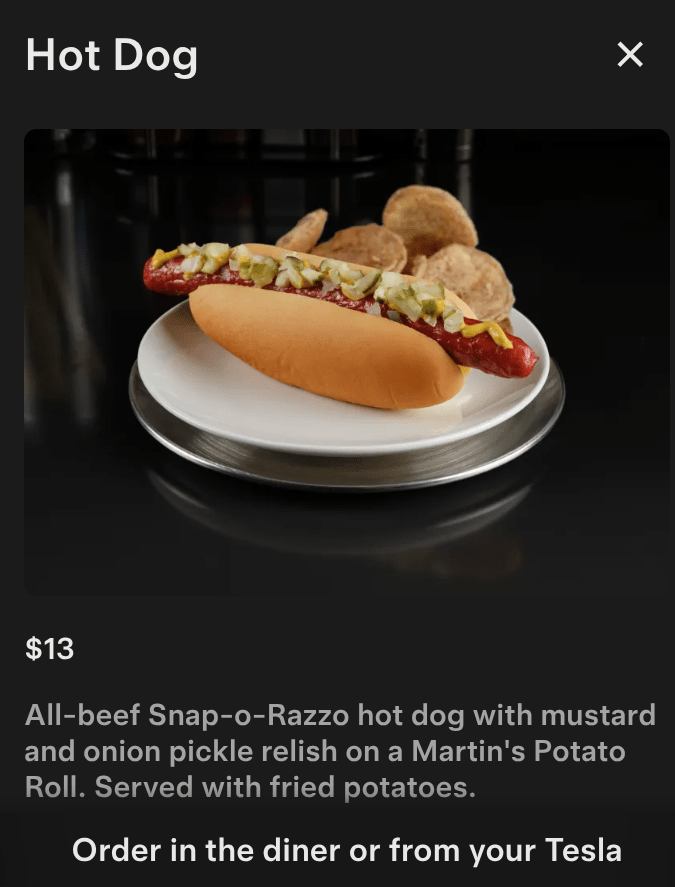
For $13 you can get an All-beef Snap-o-Razzo hot dog and fries. None of that freeze-dried food they would be serving on a trip to Moon should that ever happen.
I just hope that Mr. Musk is still working on his space-related projects in addition to all of his other companies, his new political party, and now his restaurant chain. Otherwise one might start to think this guy is starting to loose his focus.
Now hand me one of those fried chicken and waffle thingies, please.
Image (Credit): Menu item from the Tesla Diner. (Tesla)
Image (Credit): The Starliner capsule outside the ISS in July 2024. (Boeing)
The good news is that Boeing’s CST-100 Starliner spacecraft will be returning to the International Space Station (ISS). However, the not so good news is that NASA may not trust it enough to carry humans – what it was designed to do – so it will probably be carrying cargo on its next mission instead.
Overall, this is good news in that Boeing is not throwing in the towel. We need a backup to SpaceX’s Dragon, and Boeing’s spacecraft is the best bet at the moment.
The Starliner is designed to carry seven crew members or a mix of crew and cargo. That means it can carry quite a bit of cargo if that is all it is doing on its next trip.
NASA is still sorting things out, but this cargo mission, if it occurs, is expected to take place next year.
The press is all abuzz about Elon Musk’s latest statements regarding his establishment a new political party called the America Party. Some of the stories also relate to his continued inattention to his companies, particularly Tesla. Fortune magazine quoted one security tech analyst who stated:
Very simply Musk diving deeper into politics and now trying to take on the Beltway establishment is exactly the opposite direction that Tesla investors/shareholders want him to take during this crucial period for the Tesla story.
The same concerns exist with SpaceX, even it if is a private company. Elon Musk has been distracted by politics for too long as his companies take a back seat. His budget-cutting work for President Trump tanked Tesla sales around the world while his recent divorce with the White House caused President Trump to ask whether the government needed to cut off contracts to SpaceX. Throughout, it has been a roller coaster for his customers and investors.
I imagine that those boards of directors did not like this announcement yesterday (Saturday) and will be encouraging him to focus on his business activities, not his political activities.
Musk’s political pivot is a gamble with no clear playbook. While his companies’ technological prowess and market dominance provide a cushion, the interplay of regulatory risks, political spending, and third-party uncertainty demands vigilance.
It also doesn’t help that some of President Trump’s friends are now calling for the nationalization of SpaceX. For example, Trump advisor Steve Bannon has already suggested the White House should consider using the Defense Production Act to take control SpaceX. That would be an extremely serious step.
Mr. Musk does seem to have trouble keeping focus on his businesses, so maybe it makes sense for him to hand over more control to other managers while he goes off and plays with politics. He is a man who is no longer driven by Mars the planet but instead by Mars the god or war, in this case political wars.
His many distractions are not good for NASA, the space industry, or SpaceX investors.
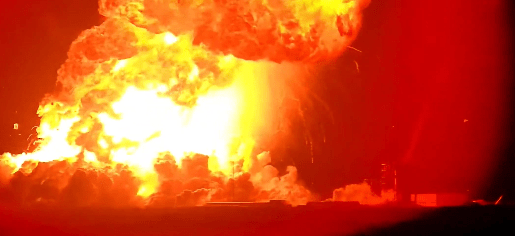
Image (Credit): The explosion of a Starship rocket during testing at the Brownsville, Texas Starbase on June 18, 2025. (LabPadre Space)
As shown in the image above, SpaceX lost one of its Starships yesterday in a massive explosion at the Brownsville, Texas Starbase, making the Moon and Mars seem even farther away. Fortunately, no one was injured during this failed test firing of the Starship 36 rocket engines.
We should expect some problems along the way, but the trend is going backwards for Mr. Musk.
Engineering teams are actively investigating the incident and will follow established procedures to determine root cause. Initial analysis indicates the potential failure of a pressurized tank known as a COPV, or composite overwrapped pressure vessel, containing gaseous nitrogen in Starship’s nosecone area, but the full data review is ongoing. There is no commonality between the COPVs used on Starship and SpaceX’s Falcon rockets.
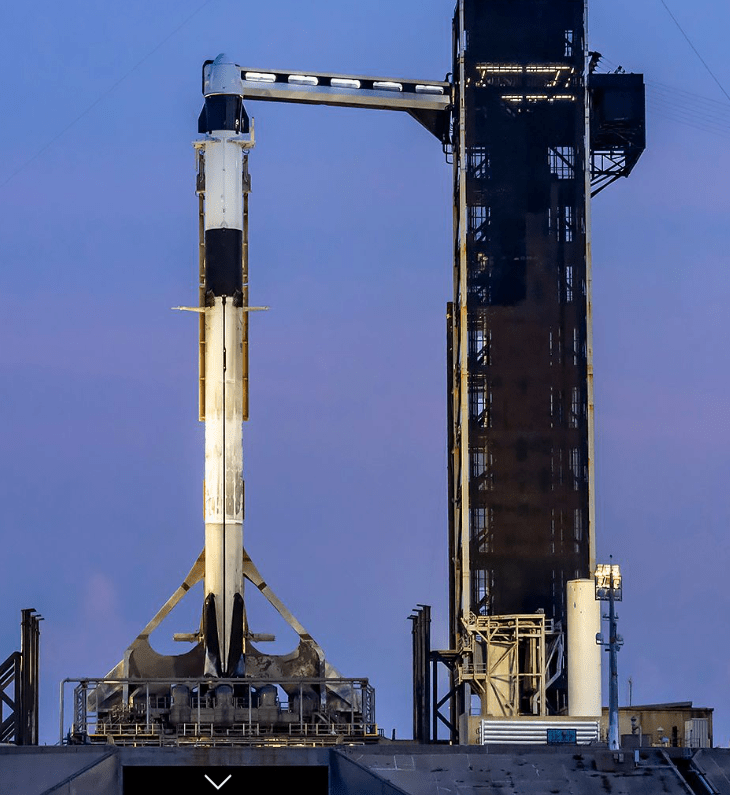
Image (Credit): Falcon 9 rocket on the lauch pad with Axiom Space’s Axiom Mission 4. (SpaceX)
“NASA and Axiom Space are postponing the launch of Axiom Mission 4 to the International Space Station. As part of an ongoing investigation, NASA is working with Roscosmos to understand a new pressure signature, after the recent post-repair effort in the aft most segment of the International Space Station’s Zvezda service module.”
–Statement by NASA regarding an leak in the Russian section of the International Space Station (ISS) that has yet to be resolved. This may slow down some of the space tourism to the site, such as the already delayed Axiom Mission, but it is more important to get this right rather than risk additional lives on the station. Axiom Space stated that the launch of the mission will be no earlier than June 19.




 Our Awesome Universe