Trump Administration Proposes 25 Percent Cut to NASA’s Budget

It should come as no surprise at this point that NASA will fall victim to massive budget cuts like so many other civilian agencies. While it will not disappear like the US Agency for International Development, it will be severely wounded as the result of a proposed 25 percent cut to its budget.

The White House’s proposed 2026 budget is setting aside $7 billion for the Moon missions and $1 billion for Mars missions, but it seems just about everything else is up for grabs. For instance, we would see the show shutdown of the Space Launch System rocket and the Orion spacecraft so they could become fully commercial. In addition, the orbiting lunar Gateway will be cut completely.

Specifically, the budget summary states:

The Budget phases out the grossly expensive and delayed Space Launch System (SLS) rocket and Orion capsule after three flights. SLS alone costs $4 billion per launch and is 140 percent over budget. The Budget funds a program to replace SLS and Orion flights to the Moon with more cost-effective commercial systems that would support more ambitious subsequent lunar missions. The Budget also proposes to terminate the Gateway, a small lunar space station in development with international partners, which would have been used to support future SLS and Orion missions.

Moreover, the Mars funding would not cover the sample return mission. Hence, SpaceX might get a boost to head towards Mars while we are stranding samples that help us to understand why we might want to go to Mars. We will also see the end of the Nancy Grace Roman Space Telescope, pruning back the accomplishments we have made since the Hubble Space Telescope to make the universe more available to scientists and the public.

If we ignore the future of the Artemis mission for a moment, a NASA press release boasted about all the events over the past 100 days to prepare for the Artemis mission. This is a hopeful sign that the Moon mission is still vital and viable at the moment, even with the defunding efforts underway. However, given some of the recent failures of the private sector efforts to reach the Moon, and the continual delays in SpaceX’s Starship, the future for Moon missions after the SLS does not look too promising at the moment.

The future also looks somewhat bleak when you look at proposed cuts to NASA’s funding for space science, space technology, and STEM programs. The endless faith in the private sector forgets the benefits of a government supporting and nudging these efforts.

As Casey Dreier, Chief of Space Policy for The Planetary Society, clearly stated:

These cuts would cause irreparable losses, throwing away billions of dollars invested by the U.S. taxpayers in productive space hardware and infrastructure. Space science is a critical national investment that engages our cutting edge economic, scientific, and educational abilities across the country.

Musk Gives Up His Day Job

Credit: Image by OpenClipart-Vectors from Pixabay.

Elon Musk has decided to step away from the Department of Government Efficiency (DOGE) after watching his reputation crater, his car company falter, and his rockets litter the Caribbean. Plus he damaged NASA, the space agency that funds his company SpaceX. Maybe he finally realized that a plumber has no business pretending to be brain surgeon.

The most disturbing part of Musk’s short time with the government is his lies about fraud, attacks on government employees, and horrible math regarding savings. For example, regarding the US Agency for International Development, he called it a “criminal organization” and then said it is “Time for it to die.” He never took the time to even understand the organization or verify his “findings”, most of which were wrong. I cannot believe a single Fortune 500 company would want this guy anywhere near its operations. So why would you trust any organization headed by this man?

We can only hope this means he will start to take the development of Starship seriously, since his company is still contracted to assist NASA with its Artemis mission to the Moon. So far in 2025, SpaceX has lost both of its Starship rockets (#7 and #8) over the Caribbean, though it was scheduled to conduct 25 tests in 2025, or twice a month.

Mr. Musk may know nothing about government programs, but he is supposed to know something about rockets. He cannot bully or lie his way out of this one. As with Tesla, performance and promises is everything, and he seems to be struggling.

And now before he can come close to meeting his NASA commitments, he is promising to send Starship to Mars next year, tweeting ““Starship will hopefully depart for Mars at the end of next year with Optimus explorer robots!”.

Maybe it is time to stop listening to this man.

Space Stories: Safe Return of Astronaut & Cosmonauts from ISS, Resupply of ISS Successful, and Continuing Concerns About ISS Risks

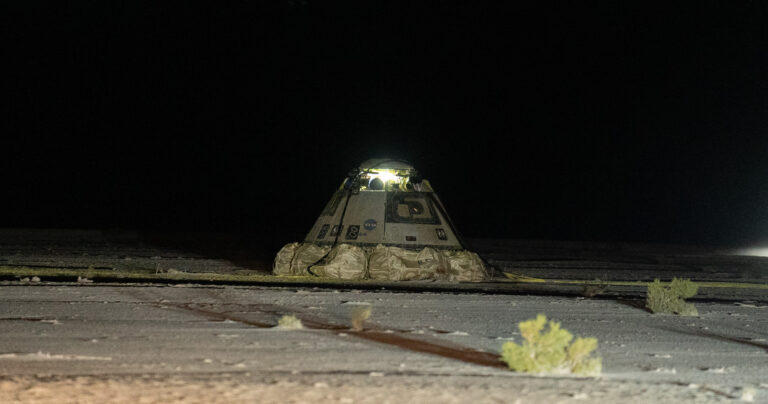
Image (Credit): The Soyuz MS-26 spacecraft carrying Expedition 72 NASA astronaut Don Pettit, and Roscosmos cosmonauts Alexey Ovchinin and Ivan Vagner back to Earth from the ISS on April 19, 2025 (April 20, 2025, Kazakhstan time). (NASA/Bill Ingalls)

Here are some recent stories of interest related to the International Space Station (ISS).

ABC News: Capsule with 1 American, 2 Russians returns to Earth from International Space Station

A Soyuz capsule carrying two Russians and one American from the International Space Station landed Sunday in Kazakhstan, ending their seven-month research assignment. According to Russian space agency Roscosmos, the capsule carrying Roscosmos cosmonauts Alexey Ovchinin and Ivan Vagner and astronaut Don Pettit of U.S. space agency NASA landed on the Kazakh steppe near the city of Zhezkazgan at 6:20 a.m. (0120 GMT). Roscosmos said the parachute-assisted landing was a trouble-free descent.

Space.com: SpaceX CRS-32 Dragon Cargo Capsule Arrives at the ISS with 6,700 Pounds of Supplies

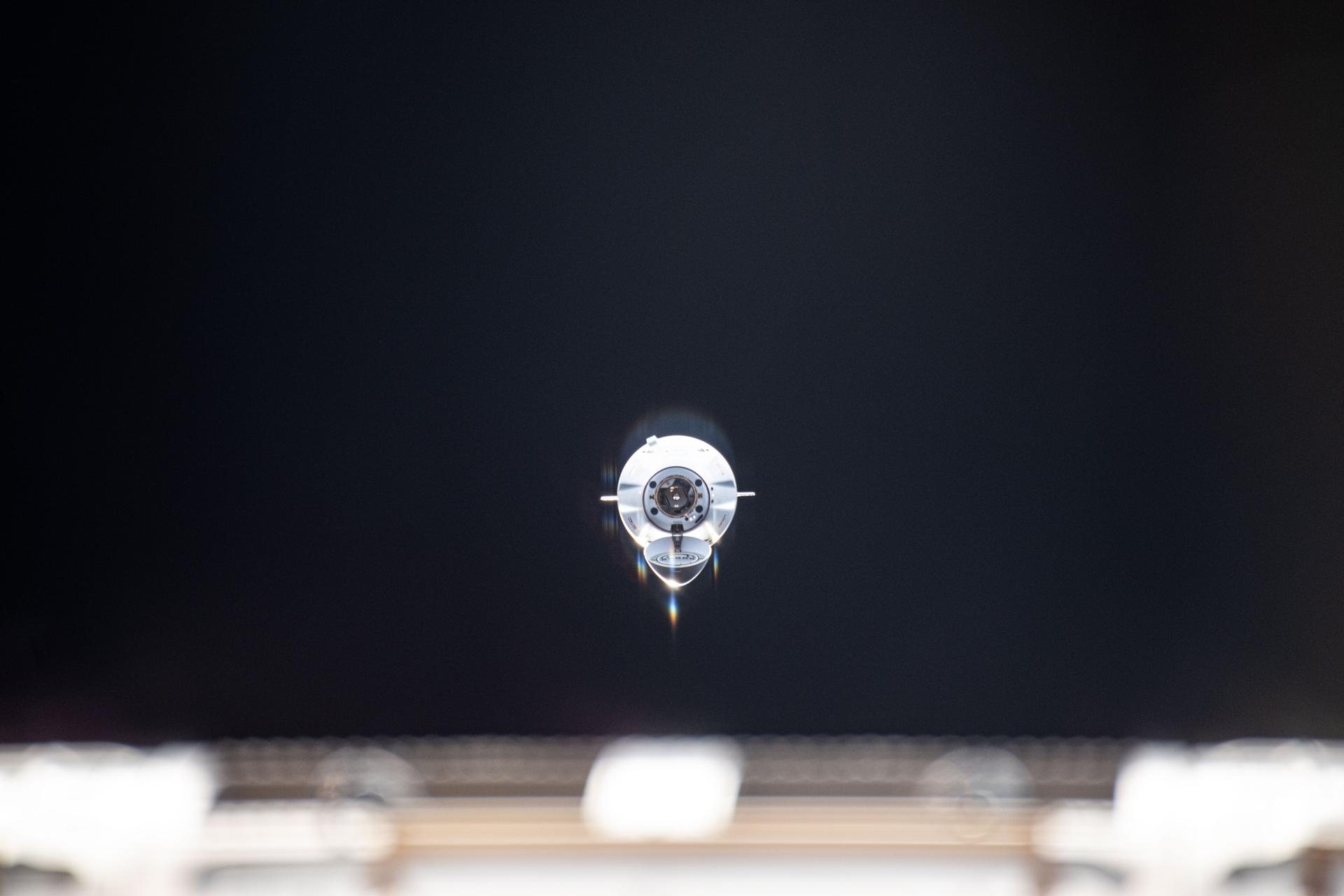
A SpaceX Dragon cargo capsule has arrived at the International Space Station (ISS) this morning (April 22), wrapping up about 28 hours traveling on orbit to close the gap between them. Elon Musk’s company launched its 32nd robotic resupply mission to the ISS for NASA early Monday morning (April 21), sending a Dragon freighter aloft from Florida’s Space Coast.

Gizmodo: The ISS Is in the ‘Riskiest Period of Its Existence,’ NASA Safety Panel Warns

During a meeting of the Aerospace Safety Advisory Panel (ASAP) held on Thursday, members of a NASA safety panel stated that there are growing risks threatening the space station as it nears the end of its use, SpaceNews reported. “The ISS has entered the riskiest period of its existence,” Rich Williams, a member of the panel, said during the meeting. At the top of the list of growing risks is a leak where air has been escaping at an increasing rate from a tunnel that connects a docking port to a Russian module.

The Internet Satellite Race Continues, Almost

Amazon hopes to challenge SpaceX’s Starlink system, but not just yet.

The launch planned for earlier this week place 27 internet satellites into orbit as part of Amazon’s Project Kuiper was scrubbed at the last minute. The United Launch Alliance (ULA) launch, scheduled for last Wednesday, was delayed due to bad weather.

If all goes according to plan, Project Kuiper will have about 1,600 satellites in orbit by the middle of next year. That would mean about 80 launches over that period, which seems somewhat unlikely given ongoing delays. In addition to ULA launches, Amazon is booking launches with Arianespace, Blue Origin, and SpaceX. When the project is complete, about 3,200 Kuiper internet satellites will be in orbit.

The Kuiper satellites will compete head-to-head with SpaceX’s Starlink (with its goal of 42,000 satellites) and China’s SpaceSail (with its goal of 15,000 satellites).

A new launch date for the first launch of the Kuiper internet satellites has not been announced yet.

Update: I forgot to mention another competitor – Eutelsat’s Oneweb in the European Union, which already has about 650 Internet satellites in Low Earth Orbit.

Second Update: This story, “Telecommunications Satellites and Space Exploration,” has a nice summary about how we arrived at the current moment with our satellite technology as well as what the future may hold.

Democrats Question Musk on NASA Ties

Timing is everything, and the Democrats opening an investigation into Elon Musk’s role at NASA the same week that the Senate grills the nominee for NASA Administrator smacks as bad timing for all the parties involved.

The ranking members of the House Committee on Oversight and Reform are concerned about Mr. Musk having a role in the deconstruction of NASA via the Department of Government Efficiency (DOGE). In a letter to NASA’s Chief Legal Officer, the ranking members state:

As of February 2025, Mr. Musk and his companies have received a combined total of at least $38 billion in contracts, loans, subsidies, and tax credits from the federal government and state governments…Mr. Musk continues to profit from taxpayer dollars and now finds himself in charge of determining which federal contracts the government will keep and which will be cut—an arrangement that runs afoul of the law.

The letter also discusses Mr. Musk’s financial relationship with Jared Isaacman (wrongly spelled in the letter cited below), the nominee for NASA Administrator, providing examples such as this one:

Mr. Isaacson’s fortune is tied to Shift4, the payments processing company he controls. In 2021, Shift4 entered into a partnership with Starlink, a wholly owned subsidiary of Mr. Musk’s SpaceX. Shift4 estimated that its partnership with SpaceX will generate $100 billion in Starlink subscription payments.

The letter is worth reviewing even if you believe the Democrats have an ax to grind. Would this type of activity, business relationship, and lack of transparency been allowed under the Biden administration? I don’t believe it would have been tolerated then, nor should it be tolerated now.

The standards in today’s government have fallen through the floor, but it doesn’t have to remain that way. NASA and the American public deserve better.

Note: The same Committee is also launching an investigation into the use of Starlink at federal facilities. A letter from the Committee ranking members to the White House states:

We write to express our deep concerns and request clarification regarding the recent installation of Starlink’s satellite internet service at the White House complex, the General Services Administration (GSA), and potentially other federal government agencies. Given Elon Musk’s dual role as the owner of Starlink and the apparent leader of the Department of Government Efficiency (DOGE) in the Trump Administration, the expanded use of Starlink across the federal government raises significant ethical, security, and regulatory implications that warrant immediate attention.