Space Stories: Safe Return of Astronaut & Cosmonauts from ISS, Resupply of ISS Successful, and Continuing Concerns About ISS Risks

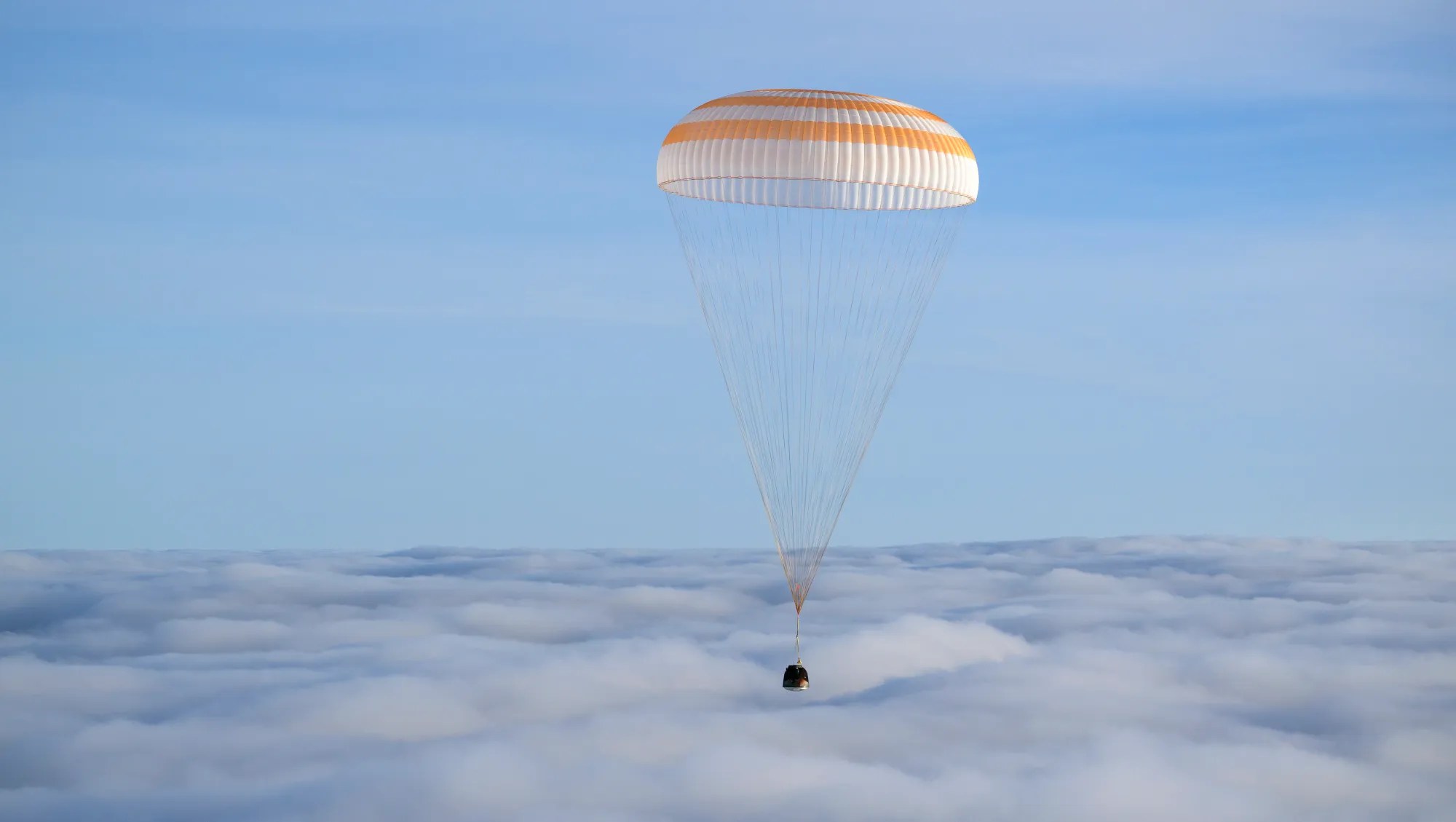
Image (Credit): The Soyuz MS-26 spacecraft carrying Expedition 72 NASA astronaut Don Pettit, and Roscosmos cosmonauts Alexey Ovchinin and Ivan Vagner back to Earth from the ISS on April 19, 2025 (April 20, 2025, Kazakhstan time). (NASA/Bill Ingalls)

Here are some recent stories of interest related to the International Space Station (ISS).

ABC News: Capsule with 1 American, 2 Russians returns to Earth from International Space Station

A Soyuz capsule carrying two Russians and one American from the International Space Station landed Sunday in Kazakhstan, ending their seven-month research assignment. According to Russian space agency Roscosmos, the capsule carrying Roscosmos cosmonauts Alexey Ovchinin and Ivan Vagner and astronaut Don Pettit of U.S. space agency NASA landed on the Kazakh steppe near the city of Zhezkazgan at 6:20 a.m. (0120 GMT). Roscosmos said the parachute-assisted landing was a trouble-free descent.

Space.com: SpaceX CRS-32 Dragon Cargo Capsule Arrives at the ISS with 6,700 Pounds of Supplies

A SpaceX Dragon cargo capsule has arrived at the International Space Station (ISS) this morning (April 22), wrapping up about 28 hours traveling on orbit to close the gap between them. Elon Musk’s company launched its 32nd robotic resupply mission to the ISS for NASA early Monday morning (April 21), sending a Dragon freighter aloft from Florida’s Space Coast.

Gizmodo: The ISS Is in the ‘Riskiest Period of Its Existence,’ NASA Safety Panel Warns

During a meeting of the Aerospace Safety Advisory Panel (ASAP) held on Thursday, members of a NASA safety panel stated that there are growing risks threatening the space station as it nears the end of its use, SpaceNews reported. “The ISS has entered the riskiest period of its existence,” Rich Williams, a member of the panel, said during the meeting. At the top of the list of growing risks is a leak where air has been escaping at an increasing rate from a tunnel that connects a docking port to a Russian module.


The Internet Satellite Race Continues, Almost

Amazon hopes to challenge SpaceX’s Starlink system, but not just yet.

The launch planned for earlier this week place 27 internet satellites into orbit as part of Amazon’s Project Kuiper was scrubbed at the last minute. The United Launch Alliance (ULA) launch, scheduled for last Wednesday, was delayed due to bad weather.

If all goes according to plan, Project Kuiper will have about 1,600 satellites in orbit by the middle of next year. That would mean about 80 launches over that period, which seems somewhat unlikely given ongoing delays. In addition to ULA launches, Amazon is booking launches with Arianespace, Blue Origin, and SpaceX. When the project is complete, about 3,200 Kuiper internet satellites will be in orbit.

The Kuiper satellites will compete head-to-head with SpaceX’s Starlink (with its goal of 42,000 satellites) and China’s SpaceSail (with its goal of 15,000 satellites).

A new launch date for the first launch of the Kuiper internet satellites has not been announced yet.

Update: I forgot to mention another competitor – Eutelsat’s Oneweb in the European Union, which already has about 650 Internet satellites in Low Earth Orbit.

Second Update: This story, “Telecommunications Satellites and Space Exploration,” has a nice summary about how we arrived at the current moment with our satellite technology as well as what the future may hold.

Democrats Question Musk on NASA Ties

Timing is everything, and the Democrats opening an investigation into Elon Musk’s role at NASA the same week that the Senate grills the nominee for NASA Administrator smacks as bad timing for all the parties involved.

The ranking members of the House Committee on Oversight and Reform are concerned about Mr. Musk having a role in the deconstruction of NASA via the Department of Government Efficiency (DOGE). In a letter to NASA’s Chief Legal Officer, the ranking members state:

As of February 2025, Mr. Musk and his companies have received a combined total of at least $38 billion in contracts, loans, subsidies, and tax credits from the federal government and state governments…Mr. Musk continues to profit from taxpayer dollars and now finds himself in charge of determining which federal contracts the government will keep and which will be cut—an arrangement that runs afoul of the law.

The letter also discusses Mr. Musk’s financial relationship with Jared Isaacman (wrongly spelled in the letter cited below), the nominee for NASA Administrator, providing examples such as this one:

Mr. Isaacson’s fortune is tied to Shift4, the payments processing company he controls. In 2021, Shift4 entered into a partnership with Starlink, a wholly owned subsidiary of Mr. Musk’s SpaceX. Shift4 estimated that its partnership with SpaceX will generate $100 billion in Starlink subscription payments.

The letter is worth reviewing even if you believe the Democrats have an ax to grind. Would this type of activity, business relationship, and lack of transparency been allowed under the Biden administration? I don’t believe it would have been tolerated then, nor should it be tolerated now.

The standards in today’s government have fallen through the floor, but it doesn’t have to remain that way. NASA and the American public deserve better.

Note: The same Committee is also launching an investigation into the use of Starlink at federal facilities. A letter from the Committee ranking members to the White House states:

We write to express our deep concerns and request clarification regarding the recent installation of Starlink’s satellite internet service at the White House complex, the General Services Administration (GSA), and potentially other federal government agencies. Given Elon Musk’s dual role as the owner of Starlink and the apparent leader of the Department of Government Efficiency (DOGE) in the Trump Administration, the expanded use of Starlink across the federal government raises significant ethical, security, and regulatory implications that warrant immediate attention.

Upcoming Hearing on NASA Nominee

The process continues to bring on a new NASA Administrator, even as Elon Musk and his DOGE team do all they can to cripple the agency.

The nomination hearing for Jared Isaacman, announced earlier today by the Senate Committee on Commerce, Science, and Transportation, will take place next Wednesday, April 9, at 10am. The hearing will be streamed live via the Committee’s website as well as YouTube.

The same hearing will also discuss the nomination of Olivia Trusty to be a Member of the Federal Communications Commission, so it is not clear how much time will be dedicated to the NASA piece. Generally, the nominee reads from a prepared statement and the Senators who show up that day pepper the nominee with a few questions.

These hearings are usually pretty tame, but that may not be the case if Mr. Isaacman’s ties with Elon Musk become a topic. A recent Wall Street Journal story stated that Mr. Isaacman was hand-picked by Mr. Musk, which followed Mr. Isaacman paying SpaceX an undisclosed amount to go into orbit last year.

It has also been reported that Mr. Isaacman’s own companies may come under scrutiny because of their DEI initiatives, a big no-no with the White House and the ever-destructive DOGE.

Maybe it will be an interesting hearing.

Space Stories: More Space Tourists, Chinese Maglev Rocket Launches, and New Hubble Findings on Uranus

Image (Credit): Launch of the Fram2 mission earlier this week. (SpaceX)

Here are some recent stories of interest.

South China Morning Post: SpaceX Launches Fram2: 4 Astronauts Seek to Make Historic Flight Over Earth’s Poles

A SpaceX spacecraft carrying four international astronauts is on a pioneering journey circling Earth over its poles after launching Monday night from Florida…Fram2 follows in the footsteps of other commercial spaceflight ventures, including Inspiration4 and Polaris Dawn – two missions also bankrolled and led by billionaire Jared Isaacman. In fact, the Fram2 crew is now traveling on the same Dragon spacecraft that the Polaris Dawn crew rode to orbit in September for a five-day mission in which they completed a historic spacewalk.

South China Morning Post: China in Bid to Challenge SpaceX by Deploying Maglev Rocket Launch Pad by 2028

In a bid to disrupt the United States’ long-held dominance in space exploration, China is quietly advancing a radical new rocket launch system – powered not by roaring engines but by electromagnetic force – that could propel satellites into orbit with unprecedented speed and efficiency. At the heart of the ambitious project is Galactic Energy, a private aerospace company that plans to debut the world’s first electromagnetic rocket launch pad by 2028, a project that could redraw the competitive lines of the global space industry.

Space Telescope Science Institute: 20-Year Hubble Study of Uranus Yields New Atmospheric Insights

Halfway through its fourth decade, Hubble’s long life has proven invaluable for studying the atmosphere of the mysterious ice giant Uranus. By repeatedly training Hubble on the distant cyan planet over the course of 20 years, researchers chronicled a two-decade story of seasonal changes. These astronomers have gained new understanding of the atmospheric dynamics of Uranus, which can serve as a proxy for studying exoplanets of similar size and composition.