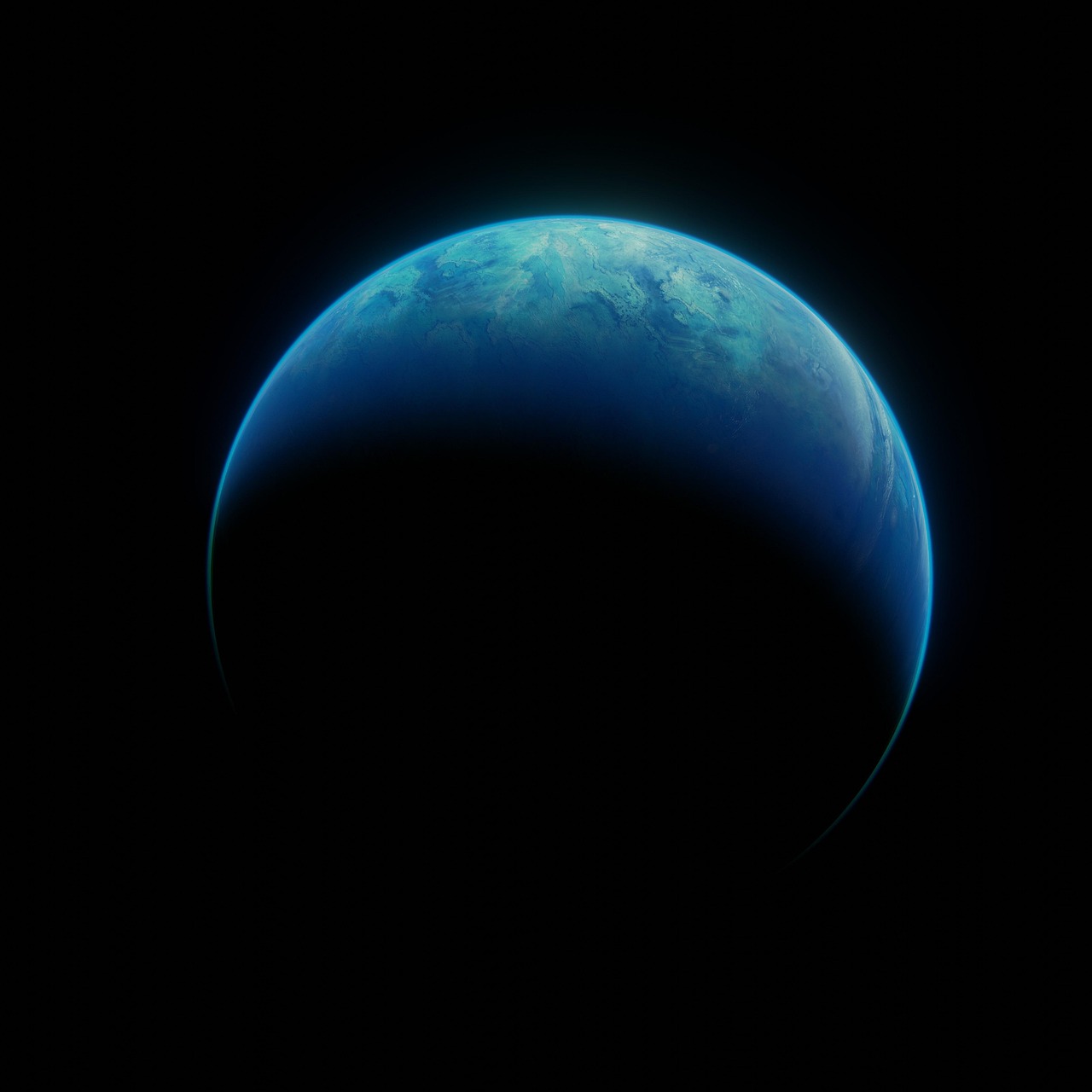
Study Findings: A Carbon-rich Atmosphere on a Windy Pulsar Planet

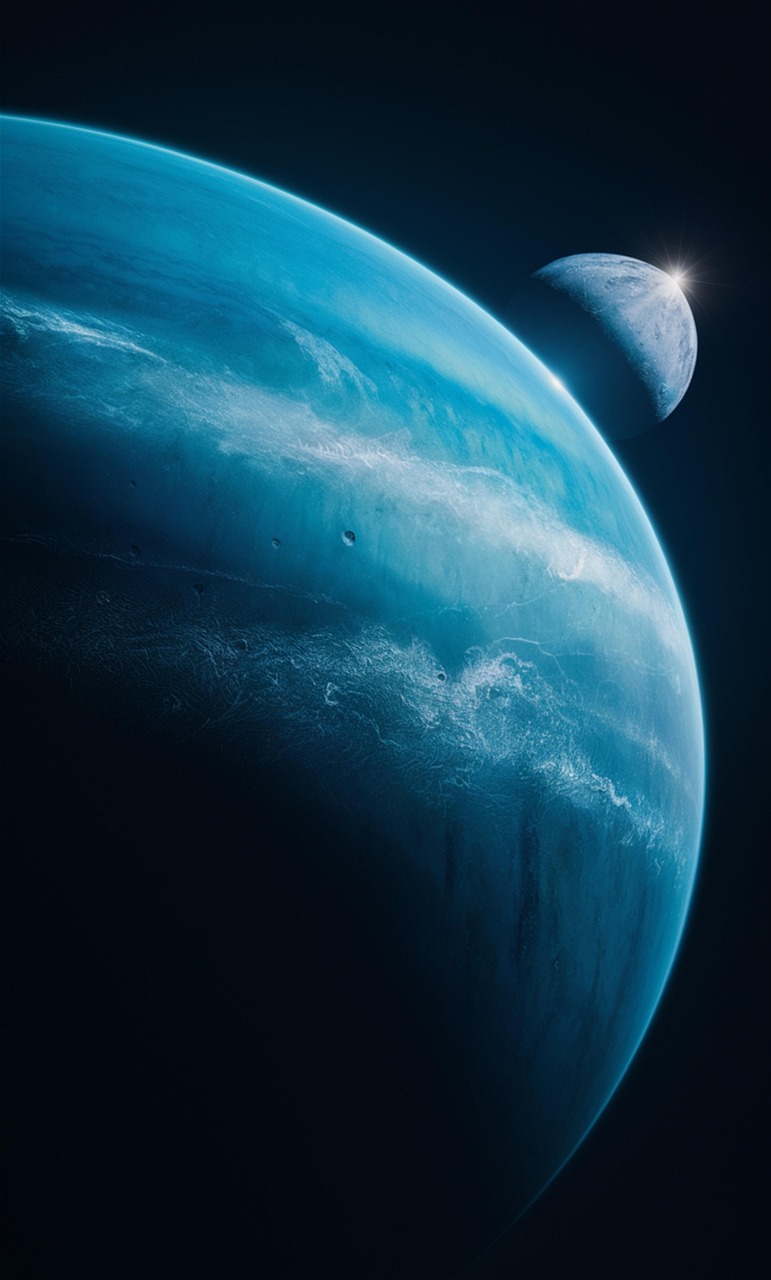
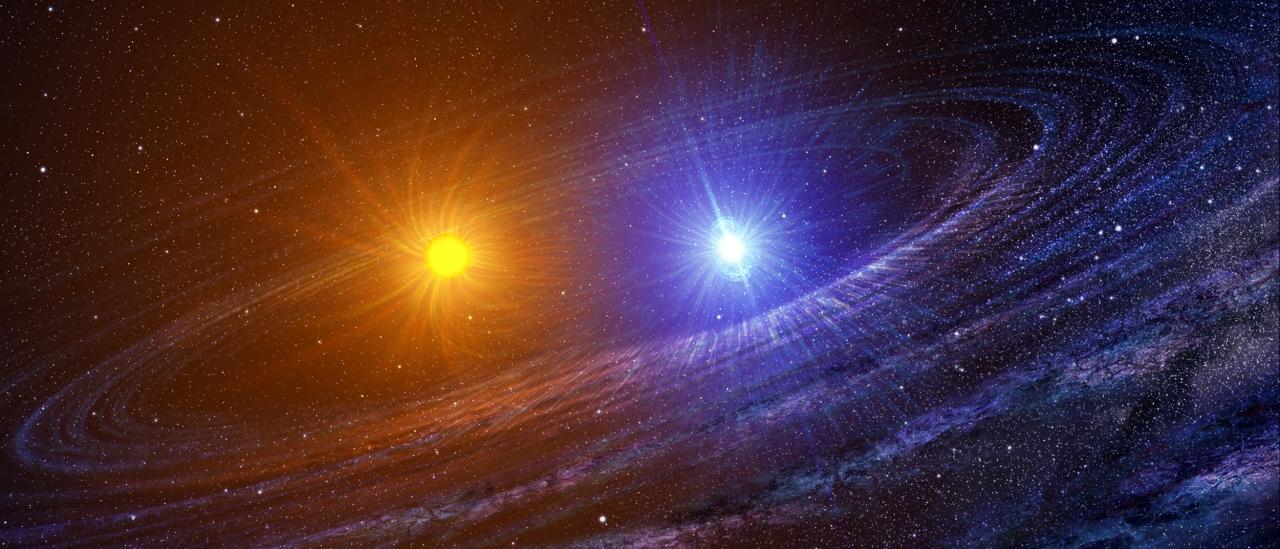
Image (Credit): Artist’s rendering of of an exoplanet orbiting a rapidly spinning neutron star called a pulsar. (NASA, ESA, CSA, Ralf Crawford (STScI))

Abstract of pre-publication study findings:

A handful of enigmatic Jupiter-mass objects have been discovered orbiting pulsars. One such object, PSR\,J2322-2650b, uniquely resembles a hot Jupiter exoplanet due to its minimum density of 1.8 g/cm^3 and its ~1900 K equilibrium temperature. We use JWST to observe PSR J2322-2650b’s emission spectrum across an entire orbit. In stark contrast to every known exoplanet orbiting a main-sequence star, we find an atmosphere rich in molecular carbon (C3, C2) with strong westward winds. Our observations open up new exoplanetary chemical (ultra-high C/O and C/N ratios of >100 and >10,000, respectively) and dynamical regimes (ultra-fast rotation with external irradiation) to observational study. The extreme carbon enrichment poses a severe challenge to the current understanding of “black widow” companions, which were expected to consist of a wider range of elements due to their origins as stripped stellar cores.

Citation: Michael Zhang et al. A carbon-rich atmosphere on a windy pulsar planet. ApJL (2025).

https://doi.org/10.48550/arXiv.2509.04558

Study-related stories:

University of Chicago – “NASA’s Webb Telescope Finds Bizarre Atmosphere on a Lemon-shaped Exoplanet”

Scientific American – “This Planet Is the Shape of a Lemon. That May Be the Least Weird Thing about It”

Space Daily – “Webb Maps Carbon Rich Atmosphere on Distorted Pulsar Planet”

Study Findings: Satellite Megaconstellations will Threaten Space-based Astronomy

Image (Credit): The Hubble Space Telescope. (NASA)

Nature abstract of the study findings:

Rapidly growing satellite constellations have raised strong concerns among the scientific community. Reflections from satellites can be visible to the unaided eye and extremely bright for professional telescopes. These trails already affect astronomical images across the complete electromagnetic spectrum, with a noticeable cost for operations and mitigation efforts. Contrary to popular perception, satellite trails affect not only ground-based observatories but also space observatories such as the Hubble Space Telescope. However, the current number of satellites is only a fraction (less than 3%) of those to be launched in the next decade. Here we show a forecast of the satellite trail contamination levels for a series of international low-Earth-orbit telescopes on the basis of the proposed telecommunication industry constellations. Our results show that if these constellations are completed, one-third of the images of the Hubble Space Telescope will be contaminated, while the SPHEREx (Spectro-Photometer for the History of the Universe, Epoch of Reionization and Ices Explorer), ARRAKIHS (Analysis of Resolved Remnants of Accreted galaxies as a Key Instrument for Halo Surveys) and Xuntian space telescopes will have more than 96% of their exposures affected, with 5.6,  69 and 92 trails per exposure, respectively, with an average surface brightness of μ = 19 ± 2 mag arcsec−2. Our results demonstrate that light contamination is a growing threat for space telescope operations. We propose a series of actions to minimize the impact of satellite constellations, allowing researchers to predict, model and correct unwanted satellite light pollution from science observations.

Citation: Borlaff, A.S., Marcum, P.M. & Howell, S.B. Satellite megaconstellations will threaten space-based astronomy. Nature 648, 51–57 (2025).

https://doi.org/10.1038/s41586-025-09759-5

Study-related stories:

Scientific American – “Satellites Swarming Low-Earth Orbit Threaten Space Telescopes”

News Scientist – “Planned Satellite Launches Could Ruin Hubble Space Telescope Images”

Orbital Today – “Satellite Boom Set To Disrupt Space Telescopes As Researchers Warn Of ‘Growing Threat’”

Study Findings: Not All Sub-Neptune Exoplanets Have Magma Oceans

Credit: Image by Enrique from Pixabay

The Astrophysical Journal Letters abstract of the study findings:

The evolution and structure of sub-Neptunes may be strongly influenced by interactions between the outer gaseous envelope of the planet and a surface magma ocean. However, given the wide variety of permissible interior structures of these planets, it is unclear whether conditions at the envelope–mantle boundary will always permit a molten silicate layer or whether some sub-Neptunes might instead host a solid silicate surface. In this work, we use internal structure modeling to perform an extensive exploration of surface conditions within the sub-Neptune population across a range of bulk and atmospheric parameters. We find that a significant portion of the population may lack present-day magma oceans. In particular, planets with a high atmospheric mean molecular weight and large envelope mass fraction are likely to instead have a solid silicate surface, since the pressure at the envelope–mantle boundary is high enough that the silicates will be in solid postperovskite phase. This result is particularly relevant given recent inferences of high-mean molecular weight atmospheres from JWST observations of several sub-Neptunes. We apply this approach to a number of sub-Neptunes with existing or upcoming JWST observations and find that in almost all cases, a range of solutions exist that do not possess a present-day magma ocean. Our analysis provides critical context for interpreting sub-Neptunes and their atmospheres.

Citation: Bodie Breza et al. Not all sub-Neptune exoplanets have magma oceans. ApJL 993 L46 (2025).

https://doi.org/10.3847/2041-8213/ae0c07

Study-related stories:

Universe Today – “It Looks Like All Mini-Neptunes Aren’t Magma Oceans After All”

University of Chicago – “New Study Revises Our Picture of the Most Common Planets in the Galaxy”

Space.com – “Is Our Dream of Finding Ocean-Covered Exoplanets Drying Up?”

Study Findings: A Less Terrifying Universe? Mundanity as an Explanation for the Fermi Paradox

Credit: Image by Angela from Pixabay.

Abstract of the pre-publication study findings:

Applying a principle of “radical mundanity”, this paper examines explanations for the lack of strong evidence for the presence of technology-using extraterrestrial civilizations (ETCs) in the Galaxy – the Fermi paradox. With this principle, the prospect that the Galaxy contains a modest number of civilizations is preferred, where none have achieved technology levels sufficient to accomplish large-scale astro-engineering or lack the desire to do so. This consideration also leads to the expectation that no ETC will colonize a large fraction of the Galaxy, even using robotic probes, and that there are no long-duration high-power beacons. However, there is a reasonable chance that we may make contact on a short, by historical standards, timescale. This event would be momentous, but could still leave us slightly disappointed. Such a Universe would be less terrifying than either of the two possibilities in the quote generally attributed to Arthur C. Clarke on whether we are alone or not. Also, if there is a modest number of ETCs in the Galaxy, that would suggest that there is a large number of planets with some form of life.

Citation: Robin H.D. Corbet. A less terrifying universe? Mundanity as an explanation for the Fermi Paradox. arXiv.org (2025).

https://doi.org/10.48550/arXiv.2509.22878

Study-related stories:

Times of India – “Aliens Got Bored: NASA Scientist Gives Bizarre Reason Why Aliens Have Stopped Contacting Us”

The Guardian – “‘Bored Aliens’: Has Intelligent Life Stopped Bothering Trying to Contact Earth?”

Futurism – “NASA Scientist Proposes Theory of Alien Civilizations Throughout Milky Way”

Space Quote: Surmising Planetary-mass Bodies in the Outer Solar System

Image (Credit): Illustrations of the Kuiper Belt and the Oort Cloud. (European Space Agency)

“One explanation is the presence of an unseen planet, probably smaller than the Earth and probably bigger than Mercury, orbiting in the deep outer solar system…This paper is not a discovery of a planet, but it’s certainly the discovery of a puzzle for which a planet is a likely solution.”

-Statement by lead author Amir Siraj, an astrophysicist and a doctoral candidate in the department of astrophysical sciences at Princeton University, as quoted by CNN News. The presence of a new, distant planet attempts to address the tilted orbits of some distant objects in the Kuiper Belt. The issue is discussed in a recent paper by Siraj and his fellow authors titled Measuring the Mean Plane of the Distant Kuiper Belt and found in the journal Monthly Notices of the Royal Astronomical Society: Letters.