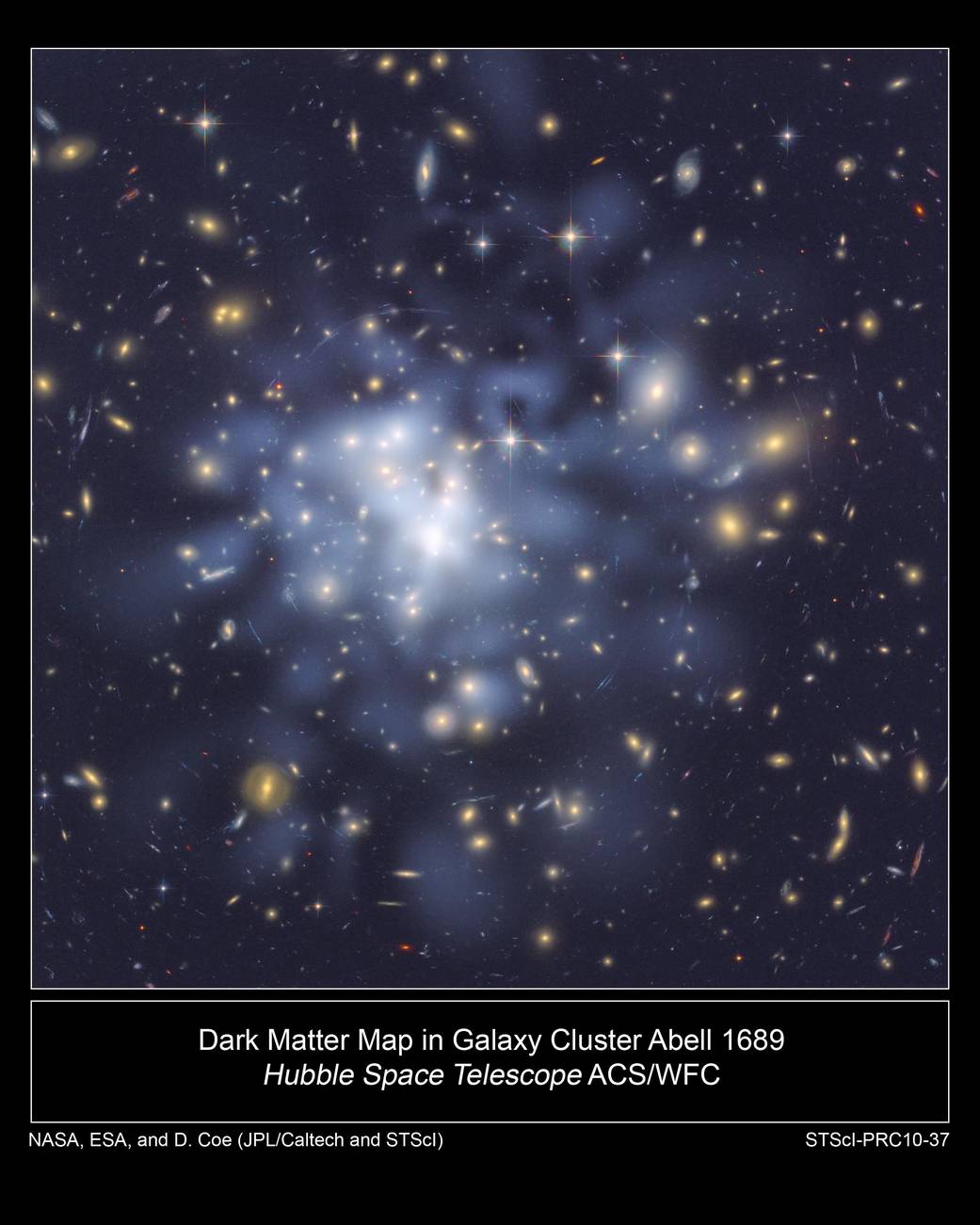
Study Findings: Constraining Cosmological Parameters Using the Cluster Mass–Richness Relation

If you don’t understand the research title, you are not alone. The abstract is even worse:

The cluster mass–richness relation (MRR) is an observationally efficient and potentially powerful cosmological tool for constraining the matter density Ωm and the amplitude of fluctuations σ8 using the cluster abundance technique. We derive the MRR relation using GalWCat19, a publicly available galaxy cluster catalog we created from the Sloan Digital Sky Survey-DR13 spectroscopic data set. In the MRR, cluster mass scales with richness as $\mathrm{log}{M}_{200}=\alpha +\beta \mathrm{log}{N}_{200}$. We find that the MRR we derive is consistent with both the IllustrisTNG and mini-Uchuu cosmological numerical simulations, with a slope of β ≈ 1. We use the MRR we derived to estimate cluster masses from the GalWCat19 catalog, which we then use to set constraints on Ωm and σ8. Utilizing the all-member MRR, we obtain constraints of Ωm = ${0.31}_{-0.03}^{+0.04}$ and σ8 = ${0.82}_{-0.04}^{+0.05}$, and utilizing the red member MRR only, we obtain Ωm = ${0.31}_{-0.03}^{+0.04}$ and σ8 = ${0.81}_{-0.04}^{+0.05}$. Our constraints on Ωm and σ8 are consistent and very competitive with the Planck 2018 results.

Where is Carl Sagan when you need him? I know these are scientific journals, but plain language abstracts should be possible.

Luckily, the university released a press release on the study findings. Here is the bottom line:

A UC Merced researcher and her teammates around the world have succeeded in measuring the total amount of matter in the universe for the second time. A new paper in the Astrophysical Journal, titled “Constraining Cosmological Parameters using the Cluster Mass-Richness Relation,” shows that matter makes up 31% of the universe, with the remainder consisting of dark energy — answering one of the most interesting and important questions in cosmology.

Now that wasn’t too hard. If you want to read the paper itself, you can find the details here.

Good luck.

Study Findings: Diverse Organic-mineral Associations in Jezero Crater, Mars

Image (Credit): NASA’s Mars Perseverance rover selfie with its Ingenuity helicopter in the background. (NASA/JPL-Caltech/MSSS)

Nature abstract of the study findings:

The presence and distribution of preserved organic matter on the surface of Mars can provide key information about the Martian carbon cycle and the potential of the planet to host life throughout its history. Several types of organic molecules have been previously detected in Martian meteorites and at Gale crater, Mars. Evaluating the diversity and detectability of organic matter elsewhere on Mars is important for understanding the extent and diversity of Martian surface processes and the potential availability of carbon sources. Here we report the detection of Raman and fluorescence spectra consistent with several species of aromatic organic molecules in the Máaz and Séítah formations within the Crater Floor sequences of Jezero crater, Mars. We report specific fluorescence-mineral associations consistent with many classes of organic molecules occurring in different spatial patterns within these compositionally distinct formations, potentially indicating different fates of carbon across environments. Our findings suggest there may be a diversity of aromatic molecules prevalent on the Martian surface, and these materials persist despite exposure to surface conditions. These potential organic molecules are largely found within minerals linked to aqueous processes, indicating that these processes may have had a key role in organic synthesis, transport or preservation.

Citation: Sharma, S., Roppel, R.D., Murphy, A.E. et al. Diverse organic-mineral associations in Jezero crater, Mars. Nature (2023).
https://doi.org/10.1038/s41586-023-06143-z

Study-related stories:

Study Findings: Drift of Earth’s Pole Confirms Groundwater Depletion as a Significant Contributor to Global Sea Level Rise 1993–2010

Credit: Reto Stöckli, Nazmi El Saleous, and Marit Jentoft-Nilsen, NASA GSFC

Geophysical Research Letters (plain language) abstract:

Melting of polar ice sheets and mountain glaciers has been understood as a main cause of sea level rise associated with contemporary climate warming. It has been proposed that an important anthropogenic contribution is sea level rise due to groundwater depletion resulting from irrigation. A climate model estimate for the period 1993–2010 gives total groundwater depletion of 2,150 GTon, equivalent to global sea level rise of 6.24 mm. However, direct observational evidence supporting this estimate has been lacking. In this study, we show that the model estimate of water redistribution from aquifers to the oceans would result in a drift of Earth’s rotational pole, about 78.48 cm toward 64.16°E. In combination with other well-understood sources of water redistribution, such as melting of polar ice sheets and mountain glaciers, good agreement with PM observations serves as an independent confirmation of the groundwater depletion model estimate.

Citation: Ki-Weon Seo, Dongryeol Ryu, Jooyoung Eom, Taewhan Jeon, Jae-Seung Kim, Kookhyoun Youm, Jianli Chen, Clark R. Wilson. Drift of Earth’s Pole Confirms Groundwater Depletion as a Significant Contributor to Global Sea Level Rise 1993–2010. Geophysical Research Letters  (2023).
https://doi.org/10.1126/science.abo6192

Study-related stories:

Note: We have been unintentionally terra-forming the Earth while looking at Mars and elsewhere to find candidates for intentional terra-forming. I believe we are learning that it is much easier to break a working system than create a new system from scratch.

Study Findings: Direct Imaging and Astrometric Detection of a Gas Giant Planet Orbiting an Accelerating Star

Image (Credit): Artist’s rendering of Gaia mapping the stars of the Milky Way. (European Space Agency)

Science abstract:

Direct imaging of gas giant exoplanets provides information on their atmospheres and the architectures of planetary systems. However, few planets have been detected in blind surveys with direct imaging. Using astrometry from the Gaia and Hipparcos spacecraft, we identified dynamical evidence for a gas giant planet around the nearby star HIP 99770. We confirmed the detection of this planet with direct imaging using the Subaru Coronagraphic Extreme Adaptive Optics instrument. The planet, HIP 99770 b, orbits 17 astronomical units from its host star, receiving an amount of light similar to that reaching Jupiter. Its dynamical mass is 13.9 to 16.1 Jupiter masses. The planet-to-star mass ratio [(7 to 8) × 10−3] is similar to that of other directly imaged planets. The planet’s atmospheric spectrum indicates an older, less cloudy analog of the previously imaged exoplanets around HR 8799.

Citation: Thayne Currie, G. Mirek Brandt, Timothy D. Brandt, Brianna Lacy, Adam Burrows, Olivier Guyon, Motohide Tamura, Ranger Y. Liu, Sabina Sagynbayeva, Taylor Tobin, Jeffrey Chilcote, Tyler Groff, Christian Marois, William Thompson, Simon J. Murphy, Masayuki Kuzuhara, Kellen Lawson, Julien Lozi, Vincent Deo, Sebastien Vievard, Nour Skaf, Taichi Uyama, Nemanja Jovanovic, Frantz Martinache, N. Jeremy Kasdin, Tomoyuki Kudo, Michael McElwain, Markus Janson, John Wisniewski, Klaus Hodapp, Jun Nishikawa, Krzysztof Hełminiak, Jungmi Kwon, Masahiko Hayashi. Direct imaging and astrometric detection of a gas giant planet orbiting an accelerating star. Science (2023).
https://doi.org/10.1126/science.abo6192

Study-related stories:

Study Findings: Acceleration of 1I/‘Oumuamua from Radiolytically Produced H2 in H2O Ice

Image (Credit): Artist’s concept of interstellar object1I/2017 U1 (‘Oumuamua) as it passed through the solar system after its discovery in October 2017. (European Southern Observatory / M. Kornmesser)

Nature abstract:

In 2017, 1I/‘Oumuamua was identified as the first known interstellar object in the Solar System. Although typical cometary activity tracers were not detected, ‘Oumuamua showed a notable non-gravitational acceleration. So far, there has been no explanation that can reconcile these constraints. Owing to energetic considerations, outgassing of hyper-volatile molecules is favoured over heavier volatiles such as H2O and CO2. However, there are theoretical and/or observational inconsistencies with existing models invoking the sublimation of pure H2, N2 and CO. Non-outgassing explanations require fine-tuned formation mechanisms and/or unrealistic progenitor production rates. Here we report that the acceleration of ‘Oumuamua is due to the release of entrapped molecular hydrogen that formed through energetic processing of an H2O-rich icy body. In this model, ‘Oumuamua began as an icy planetesimal that was irradiated at low temperatures by cosmic rays during its interstellar journey, and experienced warming during its passage through the Solar System. This explanation is supported by a large body of experimental work showing that H2 is efficiently and generically produced from H2O ice processing, and that the entrapped H2 is released over a broad range of temperatures during annealing of the amorphous water matrix. We show that this mechanism can explain many of ‘Oumuamua’s peculiar properties without fine-tuning. This provides further support that ‘Oumuamua originated as a planetesimal relic broadly similar to Solar System comets.

Citation: Bergner, J.B., Seligman, D.Z. Acceleration of 1I/‘Oumuamua from radiolytically produced H2 in H2O ice. Nature 615, 610–613 (2023).
https://doi.org/10.1038/s41586-022-05687-w

Study-related stories:

Note: Harvard astronomer Avi Loeb, who has written a book about Oumuamua, raised some concerns the about new study in this EarthSky article.