Study Results: A Long-period Transient With a Sun-like Companion

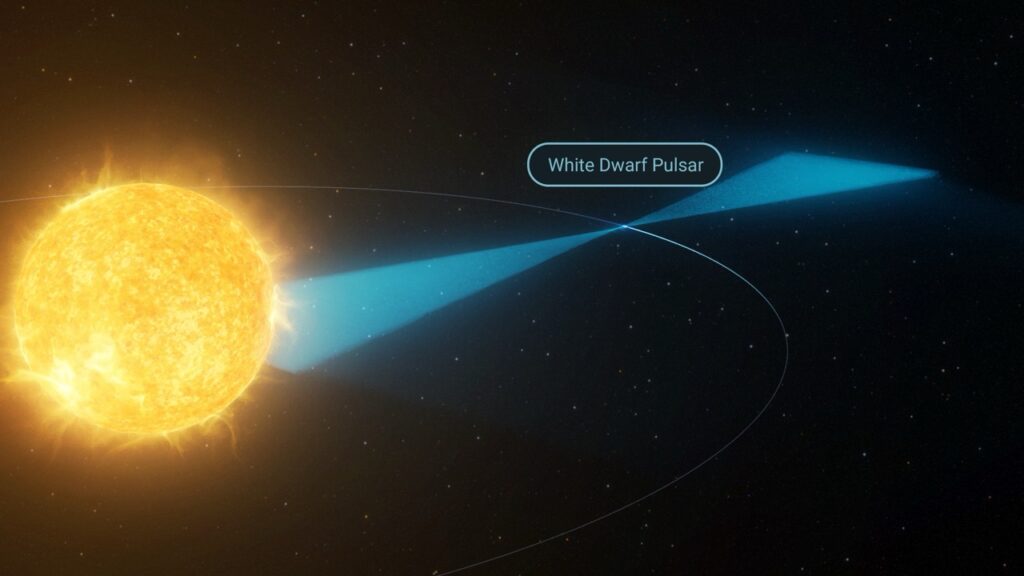
Image (Credit): A small and highly energetic white dwarf pulsar is orbiting a much larger star similar to our Sun. (ICRAR/N Hurley-Walker)

Nature Astronomy abstract of study findings:

Long-period transients are an emerging class of repeating radio transients characterized by periodicities of minutes to hours, small duty cycles, highly polarized radio emission and brightness temperatures indicative of a coherent emission mechanism. An optical follow-up confirmed that at least 4 (out of 12) long-period transients are binary systems comprising a white dwarf and an M dwarf. Here we have discovered a new radio-emitting long-period transient, GPM J071507−114153, with a period of 7.9 min. It is a binary system comprising a low-mass white dwarf and a G-type star identified via optical spectroscopy. Its radio pulses are modulated by a longer period of about 1.3 days, interpreted as the orbital period of the binary system. A timing analysis constrains the orbital configuration, suggesting that the G-type star does not fill its Roche lobe. Rapid changes of the rotation measure near superior conjunction of the white dwarf are consistent with Faraday rotation induced by the corona of the companion. We conclude that in long-period transients powered by white dwarf binaries, the coherent radio pulsed emission crucially depends on its interaction with the companion star, which we show can be G-type stars in day-long orbits.

Citation: McSweeney, S.J., Hurley-Walker, N., Bahramian, A. et al. A long-period transient with a Sun-like companion. Nat Astron (2026).

DOI: https://doi.org/10.1038/s41550-026-03016-z

Study-related stories:

EarthSky – “Mysterious Radio Signals Traced to Rare Binary Star System”

International Centre for Radio Astronomy Research – “Researchers Discover Rare Star System That Emits Radio Signals Every Eight Minutes”

SciTechDaily – “Mysterious Radio Signals From 5,000 Light-Years Away Lead Scientists to a Surprising Discovery”

AI in the News: Solving Astronomy Problems

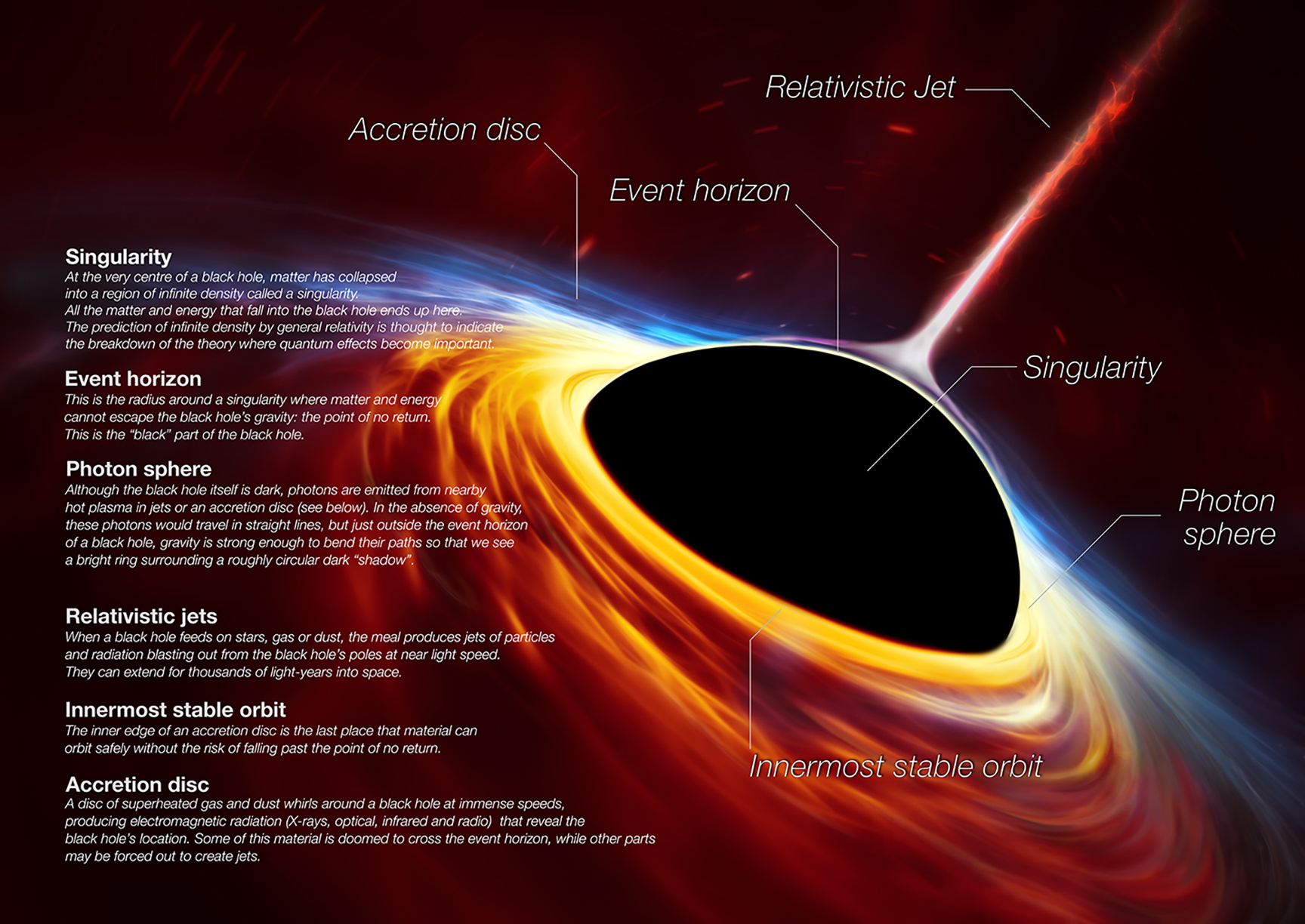
Image (Credit): Diagram of a black hole. (NASA)

You probably heard that artificial intelligence (AI) has been solving math problems. However, that is not all. AI is also being used to solve astronomy problems as well.

For example, Anthropic’s Claude has recently solved two questions in theoretical physics related to black holes.

In reporting on this, Anthrophic noted:

In the first, it completed a calculation that physicists set up more than 20 years ago, but which had never been solved. Claude’s result showed that a sudden transition associated with the formation of black holes persists even where spacetime no longer has a definite shape. In the second, Claude found the exact limit of the simplest version of a technique used to test candidate theories of quantum gravity.

The underlying paper for the black hole phase transition paper here, and the quantum gravity paper here.

As with the AI work related to mathematics, this is just the start for astronomy. AI should be able to assist astronomers in many way, including solving such questions, reviewing massive amounts of data, automating telescopes, assisting astronauts, and more.

Cecilia Garraffo with the Center for Astrophysics, Harvard & Smithsonian, believes AI has a clear role in the future of astronomy. She noted the slow integration of AI into astronomy in a Sky & Telescope article, stating:

We’re missing out on a lot of improvements, developments, and very powerful techniques that we’re not using…Not having access to these methods is similar to not having had access to a computer when computers started.

Space Quote: Twinkle, Twinkle, Little Satellite

Credit: Image by Chil Vera from Pixabay.

“Those on low-earth orbits can be especially bright. Companies plan to launch tens of thousands of such satellites, and our view of the night sky, constellations and the Milky Way may be entirely lost.”

-Statement by Gáspár Bakos, a professor at the Department of Astrophysical Sciences at Princeton University, in an Independent news story discussing satellite pollution. The article also cites a new study finding that resident in small UK towns are more likely to see a satellite in the night sky than observable stars. About 700 satellites are passing in the night sky at any one time, outnumbering visible stars. Moreover, a typical English town could see as many as 13,000 different satellites pass overhead on an average night.

Pic of the Week: Tribute to Voyager 1

Image (Credit): NYC’s Empire State Building aglow in tribute to Voyager 1. (NASA/Bill Ingalls)

This week’s image comes directly from New York City where the Empire State Building has been illuminated in gold to mark Voyager 1 reaching a distance of one light-day from Earth this week. It is one of many structures from around the world lit in this way to celebrate the occasion.

In reference to the golden color, NASA noted:

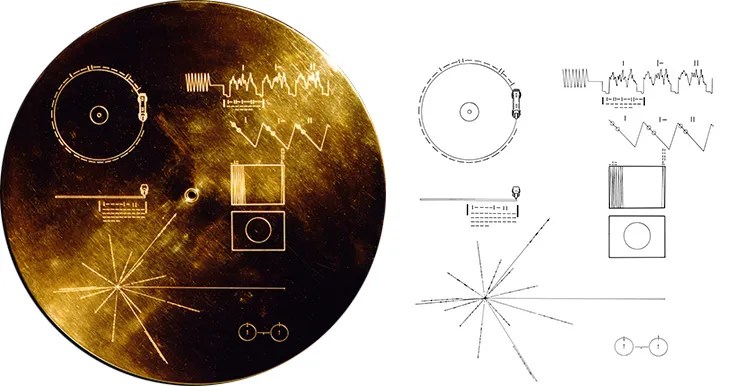
The color gold is emblematic of the gold-plated copper phonograph record that is flying on Voyager. The record contains sounds and images selected to portray the diversity of life and culture on Earth.

Image (Credit): The Golden Record cover shown with its extraterrestrial instructions. (NASA)

Good News for Blue Origin, But Not ULA or Amazon

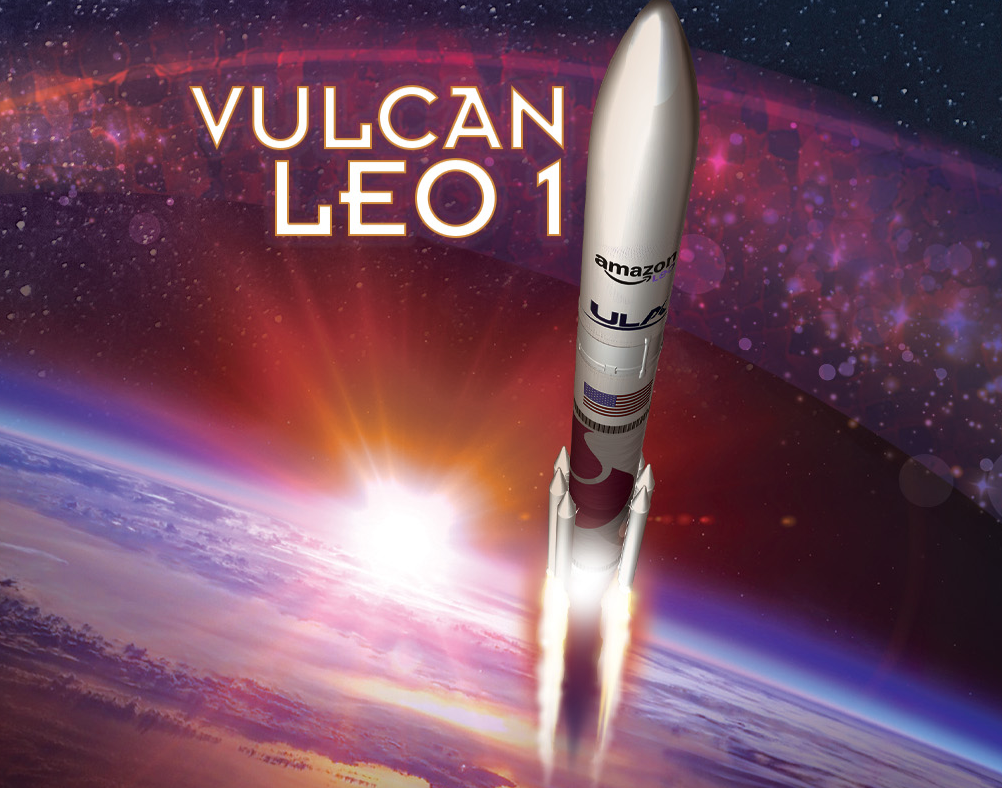
Credit: ULA

The recent failure of the United Launch Alliance’s (ULA) Vulcan rocket was unfortunate for ULA and Amazon, but not Blue Origin, the company that supplied the rocket engines. Sunday’s failed launch cost Amazon 40 Leo internet satellites. This was the first ULA Vulcan launch of LEO satellites. Amazon hopes to place more than 3,000 satellites into orbit.

The ULA site states:

ULA has completed an initial integrated review of flight data from the Leo 1 launch anomaly that occurred last Sunday. While work remains to determine cause, preliminary indications are that the low booster thrust was the result of inadequate fuel supply from the vehicle to the BE-4 engines, not from the performance of the engines.

As shared previously, the Vulcan second stage appears to have started nominally, and the RL10 engines were operating as planned. The second stage was performing well but was unable to recover from the performance loss resulting in loss of mission.

All indications are that the solid rocket booster performance was nominal, following nozzle improvements implemented for this launch.

As the investigation continues, we will provide updates when there is information to share.

This is good news for Blue Origin and NASA since the BE-4 engines will be key to the New Glenn rocket being used for Artemis III. Any problems with the engine would be seen as another setback for the program.

One has to be quite an optimist to think everything will come together quickly. Blue Origin is using a brand new rocket for its part in Artemis III, while Elon Musk is more interested in playing games with his Starship rockets rather than getting them into the air. Add to that the fact that neither company will have a fully capable lunar lander as part of the Artemis III tests (though Blue Origin is further ahead), and one could even get nervous.

NASA Administrator Jared Isaacman may be citing NASA’s successes of the 1960s, but that was a different time when NASA had full control of the program. While the privatization of space has its advantages, it also involves a lot of egos and issues that did not hamper the program in the past. Administrator Isaacman appears to be herding cats, and I do not envy him.