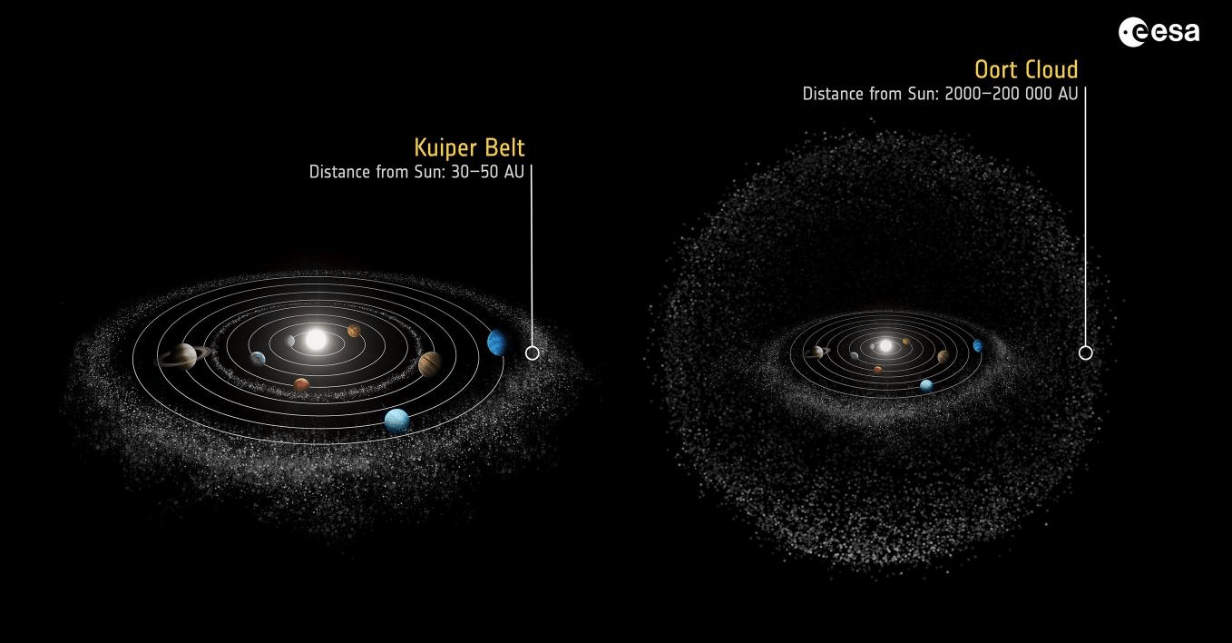
Image (Credit): Illustrations of the Kuiper Belt and the Oort Cloud. (European Space Agency)
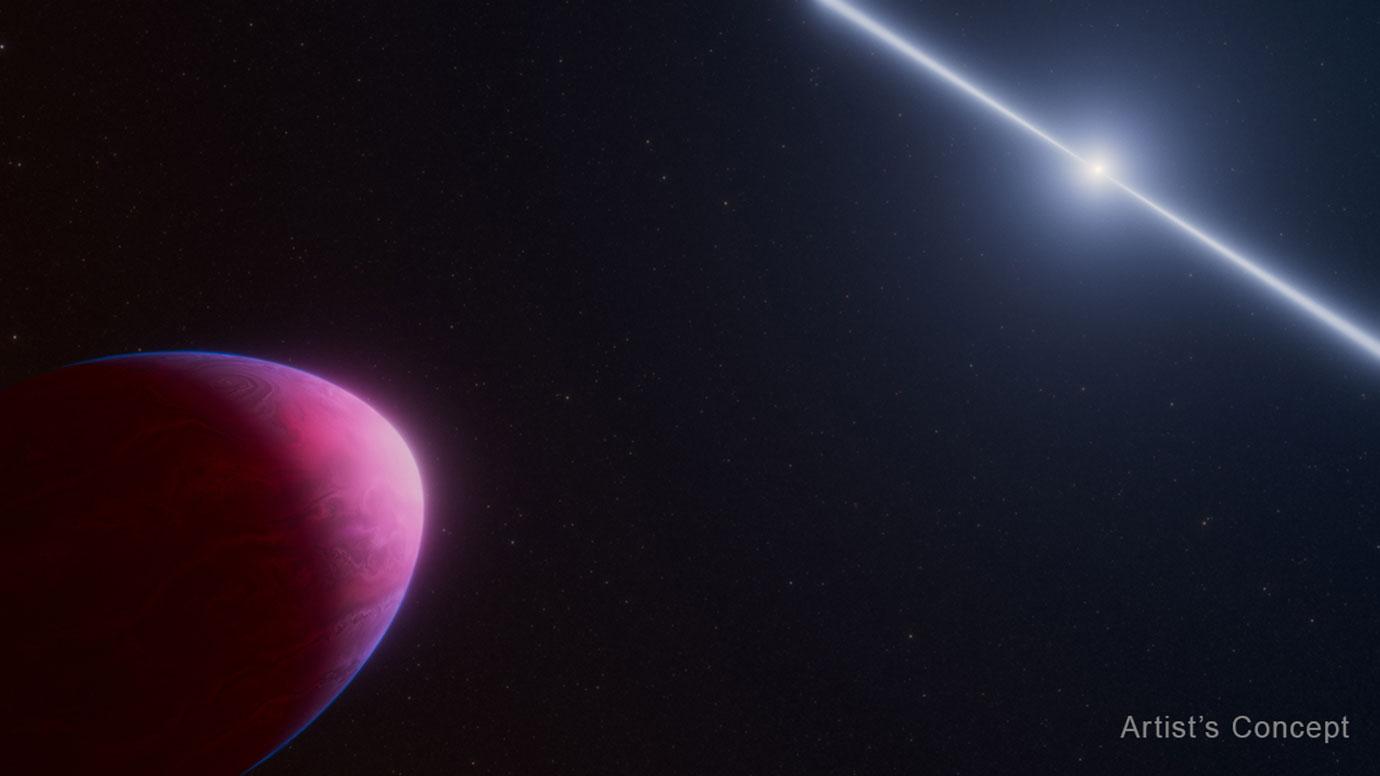
“One explanation is the presence of an unseen planet, probably smaller than the Earth and probably bigger than Mercury, orbiting in the deep outer solar system…This paper is not a discovery of a planet, but it’s certainly the discovery of a puzzle for which a planet is a likely solution.”
-Statement by lead author Amir Siraj, an astrophysicist and a doctoral candidate in the department of astrophysical sciences at Princeton University, as quoted by CNN News. The presence of a new, distant planet attempts to address the tilted orbits of some distant objects in the Kuiper Belt. The issue is discussed in a recent paper by Siraj and his fellow authors titled Measuring the Mean Plane of the Distant Kuiper Belt and found in the journal Monthly Notices of the Royal Astronomical Society: Letters.
The processes driving the formation and distribution of lunar water (OH/H2O), particularly in the subsurface, remain poorly understood. An opportunity to study subsurface water comes from lander plumes, which can displace and expose millimetre- to centimetre-sized regolith during the descent of the lander. Here we analyse data from the Chang’e-6 landing site and find that plume-disturbed areas exhibit distinct temperature and water-content patterns, which are driven by the redistribution of fine regolith. The average water content of the exposed fine regolith of the shallow subsurface is ~76 ppm, which is lower than the surface abundance of ~105 ppm measured at the surface. The Chang’e-6 landing site also contains on average approximately twice the water content than the Chang’e-5 one. Temporal variations of water content are observed at identical locations but different local times, exhibiting a minimum at local noon. We suggest that the differences in water content are correlated with the regolith glass abundance, particle sizes, depths and local times, reinforcing the hypothesis that solar wind implantation and impact gardening govern lunar water formation and distribution.
Citation: Liu, B., Zeng, X., Xu, R. et al. Lunar surface and subsurface water revealed by Chang’e-6. Nat Astron (2025).
The first bodies to form in the Solar System acquired their materials from stars, the presolar molecular cloud and the protoplanetary disk. Asteroids that have not undergone planetary differentiation retain evidence of these primary accreted materials. However, geologic processes such as hydrothermal alteration can dramatically change their bulk mineralogy, isotopic compositions and chemistry. Here we analyse the elemental and isotopic compositions of samples from asteroid Bennu to uncover the sources and types of material accreted by its parent body. We show that some primary accreted materials escaped the extensive aqueous alteration that occurred on the parent asteroid, including presolar grains from ancient stars, organic matter from the outer Solar System or molecular cloud, refractory solids that formed close to the Sun, and dust enriched in neutron-rich Ti isotopes. We find Bennu to be richer in isotopically anomalous organic matter, anhydrous silicates, and light isotopes of K and Zn than its closest compositional counterparts, asteroid Ryugu and Ivuna-type (CI) carbonaceous chondrite meteorites. We propose that the parent bodies of Bennu, Ryugu and CI chondrites formed from a common but spatially and/or temporally heterogeneous reservoir of materials in the outer protoplanetary disk.
Citation: Barnes, J.J., Nguyen, A.N., Abernethy, F.A.J. et al. The variety and origin of materials accreted by Bennu’s parent asteroid. Nat Astron (2025).
Ceres’s surface mineralogy and density structure indicate an aqueous past. Observations from the Dawn mission revealed that Ceres likely hosted a global subsurface ocean in its early history, which was the site of pervasive aqueous alteration of accreted material. Subsurface environmental constraints inferred from Ceres’s surface mineralogy, combined with Ceres’s high abundance of carbon, suggest that the dwarf planet may have been habitable for microbial life. We present a coupled chemical and thermal evolution model tracking Ceres’s interior aqueous environment through time. If the rocky interior reached ≳550 K, then fluids released by rock metamorphism would have promoted conditions favorable for habitability by introducing redox disequilibrium into the ocean, a source of chemical energy for chemotrophs. We find that this period would have been between ~0.5 and 2 billion years after Ceres’s formation. Since then, Ceres’s ocean has likely become a cold, concentrated brine with fewer sources of energy, making it less likely to be habitable at present.
Citation: Samuel W. Courville, S.W., Castillo-Rogez J.C., Daswani, M.M. et al. Core metamorphism controls the dynamic habitability of mid-sized ocean worlds—The case of Ceres, Science Advances, Vol 11, Issue 34 (August 20, 2025).
Image (Credit): NASA infographic highlighting NASA’s twin robot geologists, the Mars Exploration Rovers (MER) Spirit and Opportunity. (NASA/JPL-Caltech)
Terraforming Mars has long captured the imagination but has received surprisingly little rigorous study. Progress in Mars science, climate science, launch capabilities and bioscience motivates a fresh look at Mars terraforming research. Since Sagan’s time, it has been understood that terraforming Mars would involve warming to enable oxygenic photosynthesis by engineered microbes, followed by slow oxygen build-up enabling more complex life. Before we can assess whether warming Mars is worthwhile, relative to the alternative of leaving Mars as a pristine wilderness, we must confront the practical requirements, cost and possible risks. Here we discuss what we know about Mars’s volatile inventories and soil composition, and possible approaches to warm Mars and increase atmospheric O2. New techniques have emerged that could raise Mars’s average global temperature by tens of degrees within a few decades. Research priorities include focusing on understanding fundamental physical, chemical and biological constraints that will shape any future decisions about Mars. Such research would drive advances in Mars exploration, bioscience and climate modelling.
Citation: DeBenedictis, E.A., Kite, E.S., Wordsworth, R.D. et al. The case for Mars terraforming research. Nat Astron9, 634–639 (2025).