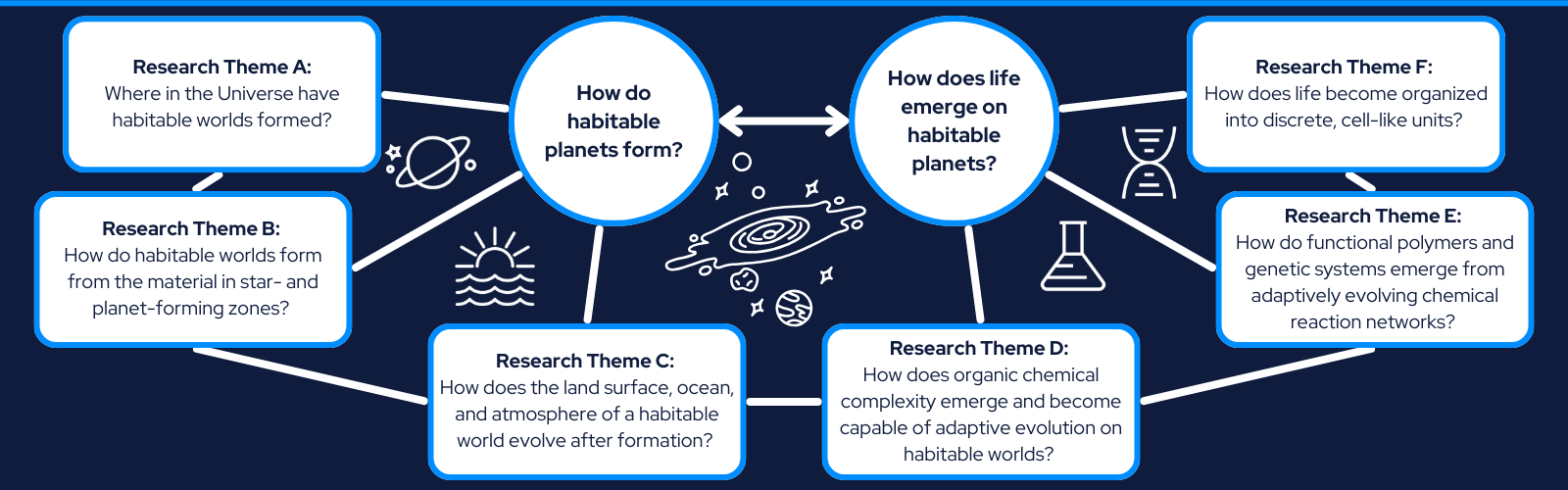
The Wisconsin Center for Origins Research (WiCOR) at the University of Wisconsin has two questions as part of its mission:
How do habitable planets form?
How does life emerge on habitable planets?
And now, the center has discovered its first exoplanet that brings up an unexpected question – Why is the newly discovered exoplanet GJ 523b a Mega-Earth rather than a gas giant like Saturn or Jupiter?
This new exoplanet, located about 87 light-years away, is 2.5 times the size of our Earth and 23 times its mass. To date, it was understood that something this large would become the core of a gas giant and not just a rocky planet like Earth. So what is the story here?
The results will appear shortly in a new paper, which will include some theories as to how this happened. You can read more about the discovery and at least one theory at the WiCOR site now.
Most lunar surface conditions are incredibly harsh for microbial survival. High ultraviolet radiation, temperatures, and energetic particle radiation limit survival over most unprotected lunar surfaces, particularly in equatorial regions where all previous crewed exploration occurred. However, whether these harsh conditions are widespread at lunar poles has not been examined considering topographical effects. Here, we show that recent microorganism survivability data and lunar surface remote sensing reveal likely survivable niches in lunar polar regions. Analysis of topography and latitude-driven surface conditions using remote sensing data and high-resolution illumination models indicates the lunar south pole has substantial regions with persistent low temperatures and ultraviolet flux. Comparing these conditions to survivability data of specific microorganisms, we find that significant lunar polar areas likely have surface conditions amenable to microbial survival. Our findings suggest that lunar polar regions may be less hostile to microbial survival than previously assumed. This does not encompass growth likelihood, but survival in a cryptobiotic state where growth would be possible if habitable conditions were present. Potential microbial survivability at lunar poles is particularly significant given many examined microbes will likely be transported to the Moon during crewed lunar south pole exploration planned in numerous near-term missions. Thoughtfully planning exploration and tracking its impact is key to limiting and understanding potential unintended life transfer to the Moon.
Citation: Saxena, P., Bertone, S., Heather V. Graham, H. et al. Potential survivable niches for microbial life on the lunar south pole. Science Advances, Vol 12, Issue 34 (2026).
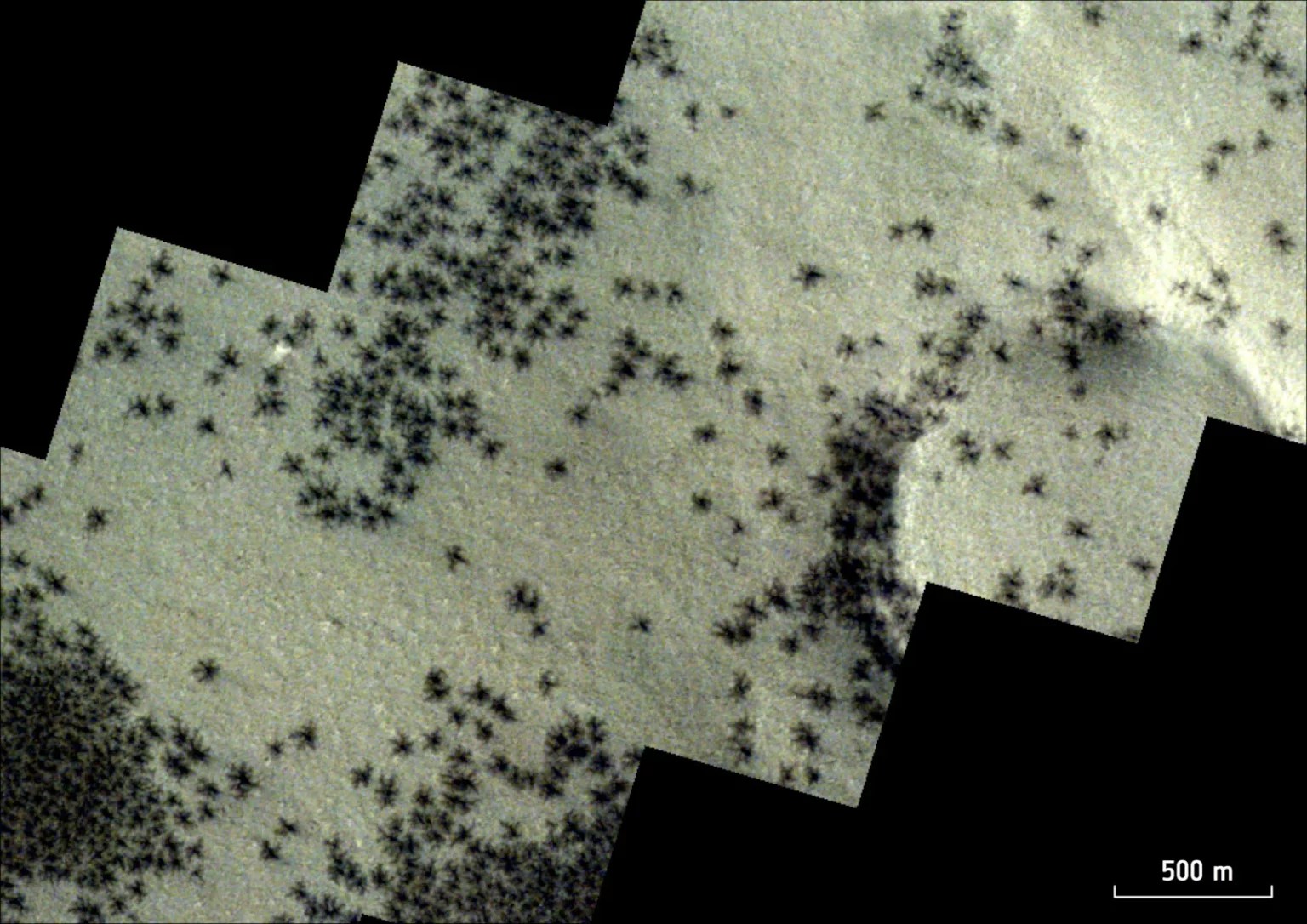
For years, satellites around Mars kept finding mysterious, spider-like geological structures. Mars spiders, scientifically known as araneiform terrain, are unique geological formations predominantly found in the southern hemisphere of Mars. They appear as branching, spider-like channels etched into the Martian surface, sometimes spanning over a kilometer in length. In 2024, NASA-led lab experiments pinned down the likeliest way these “spiders” form: seasonal CO₂ ice. Now, a 2026 follow-up showed that the soil beneath the ice can make or break the process, and that these structures could hold clues to Mars’ wet past.
Astronauts have complained about constipation for as long as people have flown to space. Nobody could say exactly why. Researchers have long suspected that living without gravity changes how quickly food moves through the gut. Blood drawn from crew members on long stays aboard the International Space Station now points to an answer. Giorgia La Barbera, a joint first author of the study and an associate professor at the University of Copenhagen’s Department of Nutrition, Exercise and Sports, led the work with NASA. “We see changes in astronauts’ blood samples that indicate that the gut bacteria begin to ferment protein to a greater extent than usual within weeks after the astronauts arrive in space, and this change continues until they are back on Earth,” La Barbera said.
A Chinese rocket set to launch a satellite into orbit blew-up seconds after liftoff Monday, marking the relatively rare failure for a rocket considered a workhorse of Beijing’s space program. The Long March 7A rocket erupted into a massive fireball just 85 seconds after blasting off from the Wenchang Space Launch Site on the island of Hainan on Monday night, video showed. Unlike other successful launches, the incident appears to have been downplayed on China’s state media with scant mention of the explosion.
The Outer Space Treaty (OST) was opened to signatures in 1967 and, since then, 117 countries, including China, the USA and Russia, have become part of it. Among other stipulations, the treaty bans the placement of nuclear weapons in outer space. Recently, the US government has raised worries that Russia is testing nuclear-armed anti-satellite weapon (ASAT) components, with the possibility that it will place a nuclear weapon in space. Such a device, if detonated, would destroy most of the satellites in the low Earth orbit. This danger is compounded by the lack of a verification mechanism for the OST. No methodologies of verification have been proposed in the open peer-reviewed literature. Here a concept and feasibility study is presented for verifying a satellite’s compliance to the OST by observing the neutrons induced by spallation from the approximately GeV protons in the inner Van Allen radiation belts. The calculations show that a 9U-CubeSat-sized detection platform can identify a thermonuclear weapon from a distance of 4 km in approximately one week of observation. This conceptual study will stimulate and inform future research and development of verification platforms for the OST.
Citation: Danagoulian, A. Verification of the Outer Space Treaty with cosmic protons. Nature, 655, 585–590 (2026).
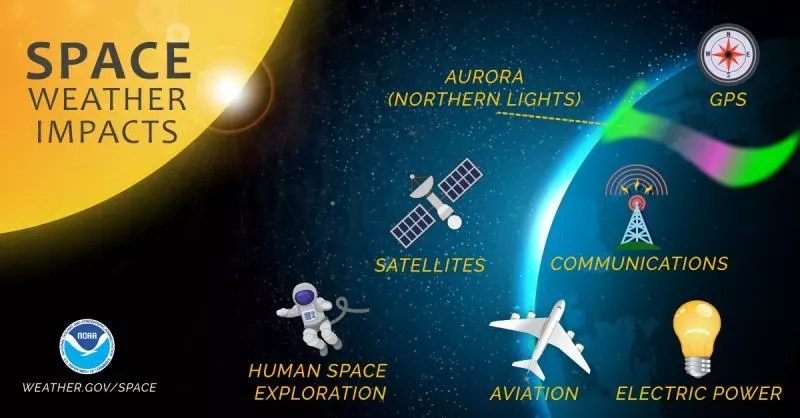
Image (Credit): A graphic showing how space weather can impact eveyday technology. (National Oceanic and Atmospheric Administration)
Now that we know solar flares can be worse than anticipated (per the study cited in the prior post), let me add some good news about another study that may have a solution.
The study presents a new way to protect Earth from harmful space weather caused by storms from the sun that can disrupt technology and power grids. The study shows humans can actively reduce the impact by releasing neutral gas from orbiting satellites. Once released, this gas turns into plasma and drifts to the edge of Earth’s magnetic field where it softens the effects of solar storms. Computer simulations show this method could reduce the strength of a major solar storm by more than half, potentially saving lives and technology. The proposed approach uses existing technology and materials, making it a practical future defense against space weather risks.
What we really have here is a draw, with the first study saying the impact from solar flares may be twice as bad as previously thought and the second study saying the impact can be cut in half. So we are back to where we started assuming we launch a new batch of satellites.
Maybe future studies will bring us closer to even better defense mechanisms, but it is good to know that new solutions are being proposed.