Study Findings: Carbonate Formation and Fluctuating Habitability on Mars

Image (Credit): Mars as captured by NASA Mars Global Surveyor MOC wide angle cameras. (NASA/JPL/MSSS)

Nature abstract of the study findings:

The cause of Mars’s loss of surface habitability is unclear, with isotopic data suggesting a ‘missing sink’ of carbonate. Past climates with surface and shallow-subsurface liquid water are recorded by Mars’s sedimentary rocks, including strata in the approximately 4-km-thick record at Gale Crater. Those waters were intermittent, spatially patchy and discontinuous, and continued remarkably late in Mars’s history—attributes that can be understood if, as on Earth, sedimentary-rock formation sequestered carbon dioxide as abundant carbonate (recently confirmed in situ at Gale). Here we show that a negative feedback among solar luminosity, liquid water and carbonate formation can explain the existence of intermittent Martian oases. In our model, increasing solar luminosity promoted the stability of liquid water, which in turn formed carbonate, reduced the partial pressure of atmospheric carbon dioxide and limited liquid water. Chaotic orbital forcing modulated wet–dry cycles. The negative feedback restricted liquid water to oases and Mars self-regulated as a desert planet. We model snowmelt as the water source, but the feedback can also work with groundwater as the water source. Model output suggests that Gale faithfully records the expected primary episodes of liquid water stability in the surface and near-surface environment. Eventually, atmospheric thickness approaches water’s triple point, curtailing the sustained stability of liquid water and thus habitability in the surface environment. We assume that the carbonate content found at Gale is representative, and as a result we present a testable idea rather than definitive evidence.

Citation: Kite, E.S., Tutolo, B.M., Turner, M.L. et al. Carbonate formation and fluctuating habitability on Mars. Nature 643, 60–66 (2025).

https://doi.org/10.1038/s41586-025-09161-1

Study-related stories:

University of Chicago – “Was Mars Doomed to be a Desert? Study Proposes New Explanation”

Science Alert – “NASA Discovery Could Explain Why We’ve Never Found Life on Mars”

The Register – “Mars Was Once a Desert with Intermittent Oases, Curiosity Data Suggests”

Study Findings: The Influence of Passing Field Stars on the Solar System’s Dynamical Future

Credit: Image by Yol Gezer from Pixabay.

Icarus abstract of the study findings:

The long-term dynamical future of the Sun’s planets has been simulated and statistically analyzed in great detail, but most prior work considers the solar system as completely isolated, neglecting the potential influence of field star passages. To understand the dynamical significance of field star encounters, we simulate several thousand realizations of the modern solar system in the presence of passing field stars for 5 Gyrs. We find that the impulse gradient of the strongest stellar encounter largely determines the net dynamical effect of field stars. Because the expected strength of such an encounter is uncertain by multiple orders of magnitude, the possible significance of field stars can be large. Our simulations indicate that isolated models of the solar system can underestimate the degree of our giant planets’ future secular orbital changes by over an order of magnitude. In addition, our planets and Pluto are significantly less stable than previously thought. Field stars transform Pluto from a completely stable object over 5 Gyrs to one with a ∼5% instability probability. Furthermore, field stars increase the odds of Mercury’s instability by ∼50%–80%. We also find a ∼0.3% chance that Mars will be lost through collision or ejection and a ∼0.2% probability that Earth will be involved in a planetary collision or ejected. Compared to previously studied instabilities in isolated solar systems models, those induced by field stars are much more likely to involve the loss of multiple planets. In addition, they typically happen sooner in our solar system’s future, making field star passages the most likely cause of instability for the next 4–4.5 Gyrs.

Citation: Kaib, Nathan A. and Raymond, Sean N., The influence of passing field stars on the solar system’s dynamical future, Icarus (2005).

https://doi.org/10.1016/j.icarus.2025.116632

Study-related stories:

The New York Times

Science News

Planetary Science Institute

Study Findings: No Certainty of a Milky Way–Andromeda Collision

Image (Credit): The Andromeda galaxy, or M31, spans 260,000 light-years across. (NASA/JPL-Caltech)

Nature Astronomy abstract of the study findings:

It is commonly believed that our own Milky Way is on a collision course with the neighbouring Andromeda galaxy. As a result of their merger, predicted in around 5 billion years, the two large spiral galaxies that define the present Local Group would form a new elliptical galaxy. Here we consider the latest and most accurate observations by the Gaia and Hubble space telescopes, along with recent consensus mass estimates, to derive possible future scenarios and identify the main sources of uncertainty in the evolution of the Local Group over the next 10 billion years. We found that the next most massive Local Group member galaxies—namely, M33 and the Large Magellanic Cloud—distinctly and radically affect the Milky Way–Andromeda orbit. Although including M33 increases the merger probability, the orbit of the Large Magellanic Cloud runs perpendicular to the Milky Way–Andromeda orbit and makes their merger less probable. In the full system, we found that uncertainties in the present positions, motions and masses of all galaxies leave room for drastically different outcomes and a probability of close to 50% that there will be no Milky Way–Andromeda merger during the next 10 billion years. Based on the best available data, the fate of our Galaxy is still completely open.

Citation: Sawala, T., Delhomelle, J., Deason, A.J. et al. No certainty of a Milky Way–Andromeda collision. Nat Astron (2025).
https://doi.org/10.1038/s41550-025-02563-1

Study-related stories:

PBS

National Geographic

Daily Finland

Study Findings: Four Sub-Earth Planets Orbiting Barnard’s Star from MAROON-X and ESPRESSO

Image (Credit): Conceptual art showing Barnard’s Star from the surface of one of its four orbiting planets. (Illustration by International Gemini Observatory/NOIRLab/NSF/AURA/R. Proctor/J. Pollard)

The Astrophysical Journal Letters abstract of the study findings:

Barnard’s Star is an old, single M dwarf star that comprises the second-closest extrasolar system. It has a long history of claimed planet detections from both radial velocities and astrometry. However, none of these claimed detections have so far withstood further scrutiny. Continuing this story, extreme precision radial velocity measurements from the ESPRESSO instrument have recently been used to identify four new sub-Earth-mass planet candidates around Barnard’s Star. We present here 112 radial velocities of Barnard’s Star from the MAROON-X instrument that were obtained independently to search for planets around this compelling object.

Citation: Ritvik Basant et al. Four sub-Earth planets orbiting Barnard’s Star from MAROON-X and ESPRESSO. ApJL 982 L1 (2025).
https://doi.org/10.3847/2041-8213/adb8d5

Study-related stories:

The University of Chicago

SciTechDaily

Astronomy Magazine

Study Findings: An Evaporite Sequence from Ancient Brine Recorded in Bennu Samples

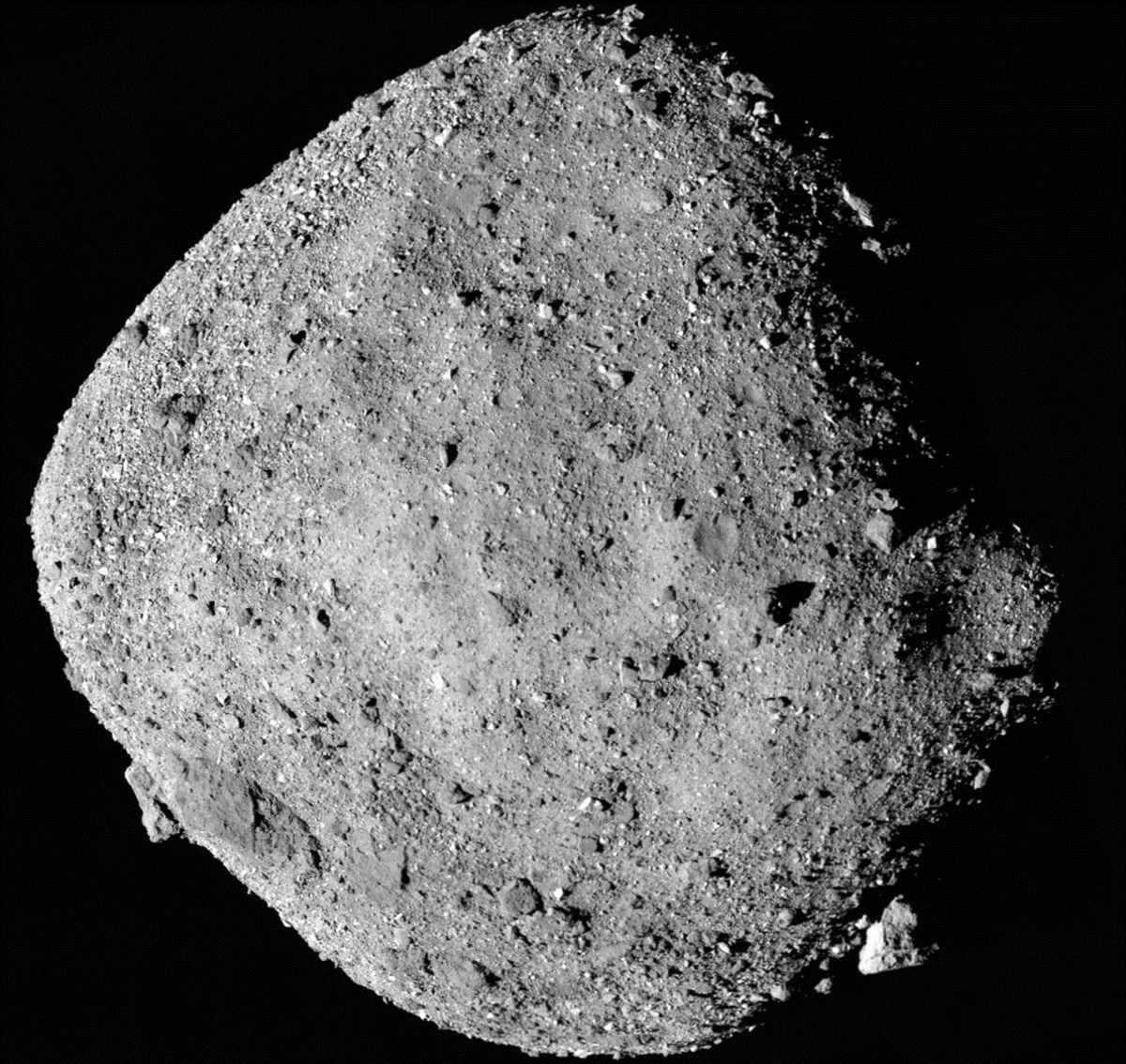
Image (Credit): Up close view of Asteroid Bennu. (NASA)

Nature abstract of the study findings:

Evaporation or freezing of water-rich fluids with dilute concentrations of dissolved salts can produce brines, as observed in closed basins on Earth and detected by remote sensing on icy bodies in the outer Solar System. The mineralogical evolution of these brines is well understood in regard to terrestrial environments, but poorly constrained for extraterrestrial systems owing to a lack of direct sampling. Here we report the occurrence of salt minerals in samples of the asteroid (101955) Bennu returned by the OSIRIS-REx mission. These include sodium-bearing phosphates and sodium-rich carbonates, sulfates, chlorides and fluorides formed during evaporation of a late-stage brine that existed early in the history of Bennu’s parent body. Discovery of diverse salts would not be possible without mission sample return and careful curation and storage, because these decompose with prolonged exposure to Earth’s atmosphere. Similar brines probably still occur in the interior of icy bodies Ceres and Enceladus, as indicated by spectra or measurement of sodium carbonate on the surface or in plumes.

Citation: McCoy, T.J., Russell, S.S., Zega, T.J. et al. An evaporite sequence from ancient brine recorded in Bennu samples. Nature 637, 1072–1077 (2025).
https://doi.org/10.1038/s41586-024-08495-6

Study-related stories:

Smithsonian Magazine

Sci.News

BBC