Study Findings: Archaeology in Space: The Sampling Quadrangle Assemblages Research Experiment (SQuARE) on the International Space Station. Report 1: Squares 03 and 05

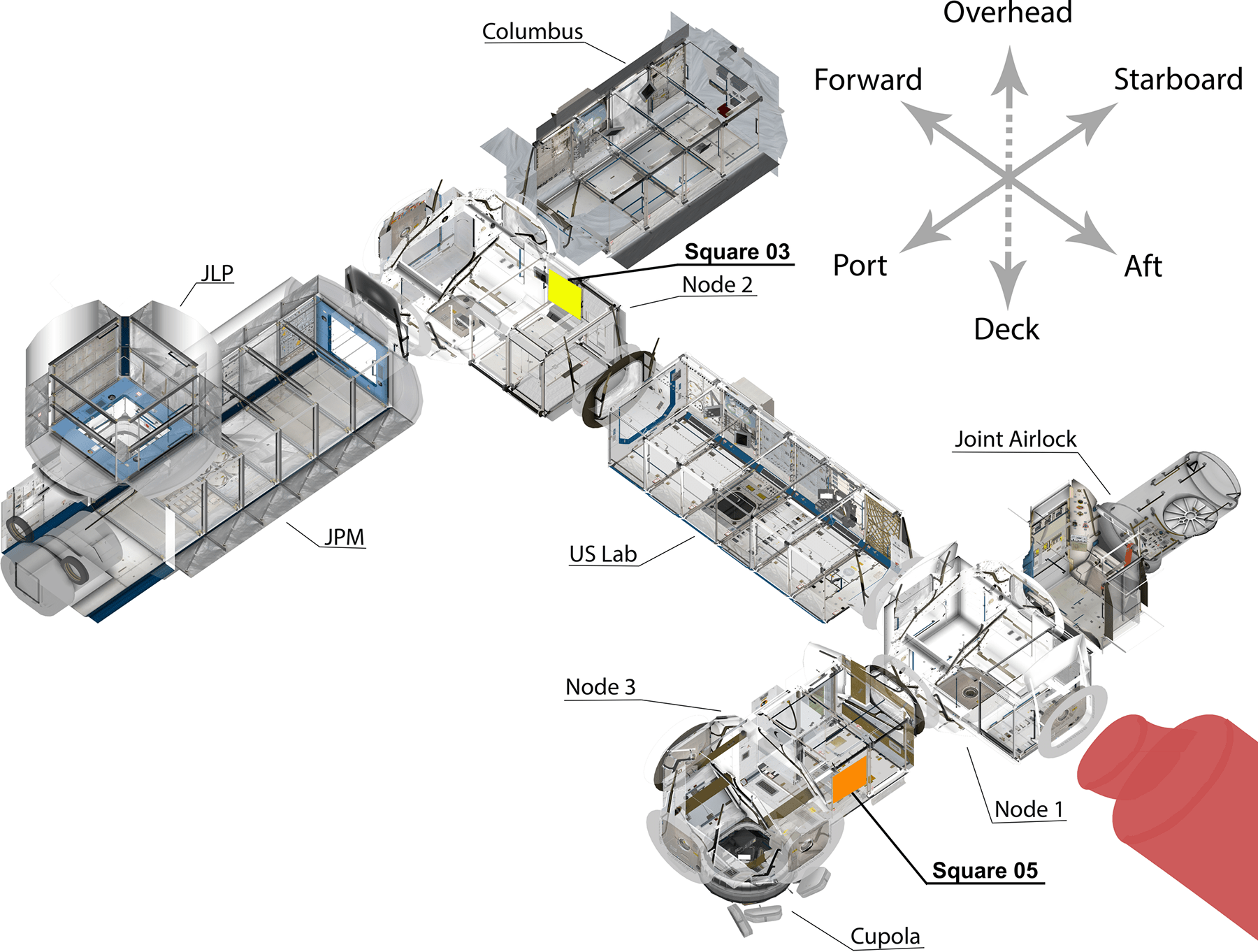
Image (Credit): A cutaway image of the International Space Station’s US Orbital Segment, showing the locations of Square 03 (at upper center, in yellow) and 05 (at lower right, in orange). (Tor Finseth, by permission, modified by Justin Walsh)

PLoS ONE abstract of the study findings:

Between January and March 2022, crew aboard the International Space Station (ISS) performed the first archaeological fieldwork in space, the Sampling Quadrangle Assemblages Research Experiment (SQuARE). The experiment aimed to: (1) develop a new understanding of how humans adapt to life in an environmental context for which we are not evolutionarily adapted, using evidence from the observation of material culture; (2) identify disjunctions between planned and actual usage of facilities on a space station; (3) develop and test techniques that enable archaeological research at a distance; and (4) demonstrate the relevance of social science methods and perspectives for improving life in space. In this article, we describe our methodology, which involves a creative re-imagining of a long-standing sampling practice for the characterization of a site, the shovel test pit. The ISS crew marked out six sample locations (“squares”) around the ISS and documented them through daily photography over a 60-day period. Here we present the results from two of the six squares: an equipment maintenance area, and an area near exercise equipment and the latrine. Using the photographs and an innovative webtool, we identified 5,438 instances of items, labeling them by type and function. We then performed chronological analyses to determine how the documented areas were actually used. Our results show differences between intended and actual use, with storage the most common function of the maintenance area, and personal hygiene activities most common in an undesignated area near locations for exercise and waste.

Citation: Walsh JSP, Graham S, Gorman AC, Brousseau C, Abdullah S, Archaeology in space: The Sampling Quadrangle Assemblages Research Experiment (SQuARE) on the International Space Station. Report 1: Squares 03 and 05. PLoS ONE 19(8): e0304229 (2024).
https://doi.org/10.1371/journal.pone.0304229

Study-related stories:

ScienceAlert

Archaeology Magazine

Popular Science

Study Findings: Radar Evidence of an Accessible Cave Conduit on the Moon Below the Mare Tranquillitatis Pit

Image (Credit): Mare Tranquillitatis Pit on the lunar surface. (http://www.lroc.asu.edu/atlases/pits/3)

Nature Astronomy abstract of the study findings:

Several potential subsurface openings have been observed on the surface of the Moon. These lunar pits are interesting in terms of science and for potential future habitation. However, it remains uncertain whether such pits provide access to cave conduits with extensive underground volumes. Here we analyse radar images of the Mare Tranquillitatis pit (MTP), an elliptical skylight with vertical or overhanging walls and a sloping pit floor that seems to extend further underground. The images were obtained by the Mini-RF instrument onboard the Lunar Reconnaissance Orbiter in 2010. We find that a portion of the radar reflections originating from the MTP can be attributed to a subsurface cave conduit tens of metres long, suggesting that the MTP leads to an accessible cave conduit beneath the Moon’s surface. This discovery suggests that the MTP is a promising site for a lunar base, as it offers shelter from the harsh surface environment and could support long-term human exploration of the Moon.

Citation: Carrer, L., Pozzobon, R., Sauro, F. et al. Radar evidence of an accessible cave conduit on the Moon below the Mare Tranquillitatis pit. Nat Astron (2024).
https://doi.org/10.1038/s41550-024-02302-y

Study-related stories:

Study Findings: Which Caves on Mars are Safe to Live In?

Image (Credit): A region in Chryse Planitia where Tiu, Ares, and Kasei Valles end, which is pockmarked by impact craters large and small. (HiRISE/The University of Arizona)

Here are some highlights from the paper presented at the 55th Lunar and Planetary Science Conference:

For reliable protection against cosmic radiation, living and working spaces for colonists are best built below the surface. These colonies also need to be provided with energy. And solar panels are not the best option because the solar radiation flux is much lower on Mars and the panels will be constantly dusted with dust due to frequent dust storms. A nuclear reactor may be the best option.

Humans also need constant access to water resources. From the point of view of the reliability of the future housing, a lava tube with strong walls best meets these requirements. It is a hollow formation in the crust, formed as a result of the release of volcanic lava. And based on the need to provide settlements with water, a more suitable case should be considered underground caves in glacial cracks with a gentle horizontal entrance. After all, there are already significant deposits of water ice under the surface. But the walls of such settlements will be less strong, and they will require more careful preparatory work.

Publication: 55th Lunar and Planetary Science Conference, held 11-15 March, 2024 at The Woodlands, Texas/Virtual. LPI Contribution No. 3040, id.1028

Contact Info: A. P. Vidmachenko, National University of Life and Environmental Sciences of Ukraine, Str. Heroyiv Oborony, 12, Kyiv, 03041, Ukraine, avidmachenko@gmail.com.

Link to paper: https://www.hou.usra.edu/meetings/lpsc2024/pdf/1028.pdf

Study-related stories:

Study Findings: Genomic, Functional, and Metabolic Enhancements in Multidrug-Resistant Enterobacter Bugandensis Facilitating its Persistence and Succession in the International Space Station

Image (Credit): The International Space Station. (NASA)

PubMed  abstract of the study findings:

Distinct from their Earth counterparts, ISS E. bugandensis strains have exhibited resistance mechanisms that categorise them within the ESKAPE pathogen group, a collection of pathogens recognised for their formidable resistance to antimicrobial treatments. During the 2-year Microbial Tracking 1 mission, 13 strains of multidrug-resistant E. bugandensis were isolated from various locations within the ISS. We have carried out a comprehensive study to understand the genomic intricacies of ISS-derived E. bugandensis in comparison to terrestrial strains, with a keen focus on those associated with clinical infections. We unravel the evolutionary trajectories of pivotal genes, especially those contributing to functional adaptations and potential antimicrobial resistance. A hypothesis central to our study was that the singular nature of the stresses of the space environment, distinct from any on Earth, could be driving these genomic adaptations. Extending our investigation, we meticulously mapped the prevalence and distribution of E. bugandensis across the ISS over time. This temporal analysis provided insights into the persistence, succession, and potential patterns of colonisation of E. bugandensis in space. Furthermore, by leveraging advanced analytical techniques, including metabolic modelling, we delved into the coexisting microbial communities alongside E. bugandensis in the ISS across multiple missions and spatial locations. This exploration revealed intricate microbial interactions, offering a window into the microbial ecosystem dynamics within the ISS.

Citation: Sengupta P, Muthamilselvi Sivabalan SK, Singh NK, et al. Genomic, functional, and metabolic enhancements in multidrug-resistant Enterobacter bugandensis facilitating its persistence and succession in the International Space Station. Microbiome 12(1):62 (2024).
https://doi.org/10.1186/s40168-024-01777-1

Study-related stories:

Study Findings: A Recently Formed Ocean Inside Saturn’s Moon Mimas

Image (Credit): Saturn’s moon Mimas and its large Herschel Crater. The moon is also referred to as the “Death Star” from Star Wars. (NASA/JPL-Caltech/Space Science Institute)

Nature  abstract of the study findings:

Moons potentially harbouring a global ocean are tending to become relatively common objects in the Solar System. The presence of these long-lived global oceans is generally betrayed by surface modification owing to internal dynamics. Hence, Mimas would be the most unlikely place to look for the presence of a global ocean. Here, from detailed analysis of Mimas’s orbital motion based on Cassini data, with a particular focus on Mimas’s periapsis drift, we show that its heavily cratered icy shell hides a global ocean, at a depth of 20–30 kilometres. Eccentricity damping implies that the ocean is likely to be less than 25 million years old and still evolving. Our simulations show that the ocean–ice interface reached a depth of less than 30 kilometres only recently (less than 2–3 million years ago), a time span too short for signs of activity at Mimas’s surface to have appeared.

Citation: Lainey, V., Rambaux, N., Tobie, G. et al. A recently formed ocean inside Saturn’s moon Mimas. Nature 626, 280–282 (2024).
https://doi.org/10.1038/s41586-023-06975-9

Study-related stories: