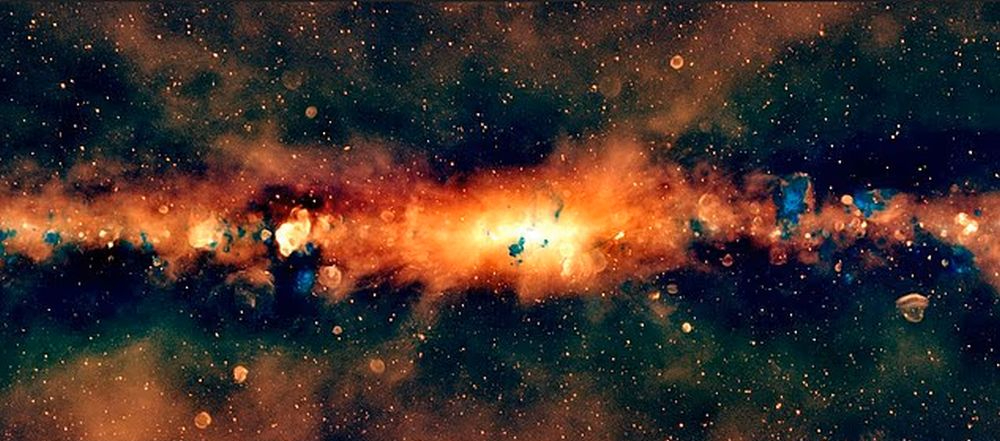
Image (Credit): The Milky Way galaxy in radio waves as seen from the Southern Hemisphere. (Silvia Mantovanini and the GLEAM-X Team)
The image above was released late last year. It shows the Milky Way galaxy in radio-color captured by astronomers from the International Centre of Radio Astronomy Research (ICRAR). All of this was part of the GaLactic and Extragalactic All-sky MWA (GLEAM) and GLEAM-X (GLEAM eXtended) surveys conducted over 28 nights in 2013 and 2014 as well as 113 nights from 2018 to 2020.
In describing the image, Silvia Mantovanini, one of the astronomers analyzing the survey data, noted:
You can clearly identify remnants of exploded stars, represented by large red circles. The smaller blue regions indicate stellar nurseries where new stars are actively forming.
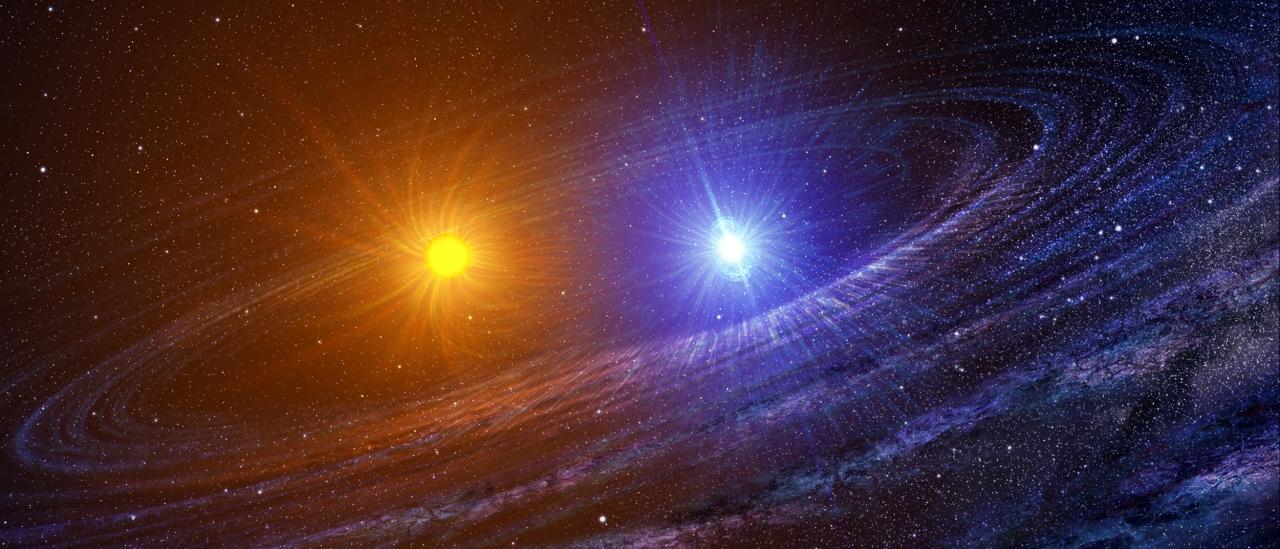
Long-period radio transients (LPTs) represent a recently uncovered class of Galactic radio sources exhibiting minutes to hours periodicities and highly polarized pulses of seconds to minutes duration. Their phenomenology does not fit exactly in any other class, although it might resemble that of radio magnetars or white dwarf (WD) pulsars. Two LPTs with confirmed multi-wavelength counterparts have now been identified as WD – M dwarf binaries. Moreover, WD pulsars (also WD – M dwarf systems), such as AR Scorpii and J1912−44, are known to exhibit short-period pulsations in hour-timescale orbits. Here we investigate the longest-lived LPT known, GPM J1839−10. We use a 36-year timing baseline to infer an ~8.75-h orbital period from radio data alone, and we show that it can be modelled in the same geometric framework as has been proposed for WD pulsars. Radio emission is triggered when the magnetic axis of a rotating WD intersects the wind from its companion, which naturally predicts the peculiar pulse modulation. Applying this to the WD pulsar J1912−44 successfully reproduces the emission profile and geometry as well. Our results indicate analogous emission-site geometries in these related classes of binary system, a possibility we extend to the broader LPT and WD pulsar population.
Citation: Horváth, C., Rea, N., Hurley-Walker, N. et al. A binary model of long-period radio transients and white dwarf pulsars. Nat Astron (2026).
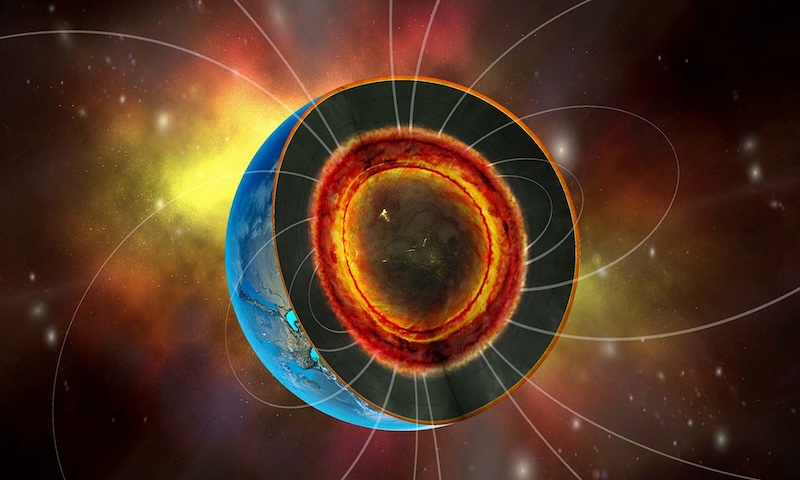
Image (Credit): Artist’s rendering of deep layers of molten rock inside a super-earth generating powerful magnetic fields. (University of Rochester Laboratory for Laser Energetics illustration / Michael Franchot)
During planet formation, planets undergo many impacts that can generate magma oceans. When these crystallize, part of the magma densifies via iron enrichment and migrates to the core–mantle boundary, forming an iron-rich basal magma ocean (BMO). The BMO could generate a dynamo in early Earth and super-Earths if the electrical conductivity of the BMO, which is thought to be sensitive to its Fe content, is sufficiently high. To test this hypothesis, here we conduct laser-driven shock experiments on ferropericlase (Mgx,Fe1−x)O (0.95 ≤ x ≤ 1) as an Fe-rich BMO analogue, perform density functional theory molecular dynamics simulations on MgO and calculate the long-term evolution of super-Earths. We find that the d.c. conductivities of MgO and (Mg,Fe)O are indistinguishable between 467 GPa and 1,400 GPa, despite previous predictions. We predict that super-Earths larger than 3–6 Earth masses can produce BMO-driven dynamos that are almost one order of magnitude stronger than core-driven dynamos for several billion years.
Citation: Nakajima, M., Harter, S.K., Jasko, A.V. et al. Electrical conductivities of (Mg,Fe)O at extreme pressures and implications for planetary magma oceans. Nat Astron (2026).
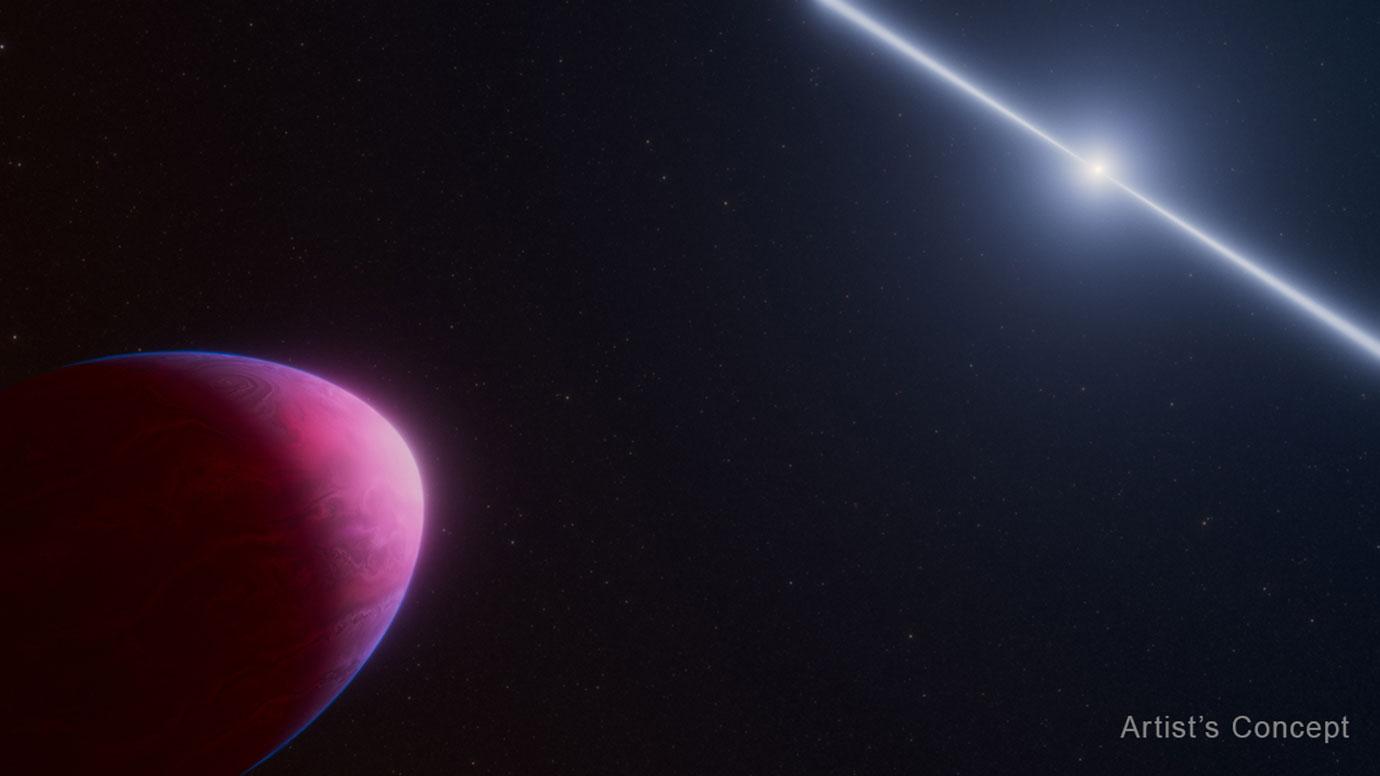
Image (Credit): Artist’s rendering of of an exoplanet orbiting a rapidly spinning neutron star called a pulsar. (NASA, ESA, CSA, Ralf Crawford (STScI))
A handful of enigmatic Jupiter-mass objects have been discovered orbiting pulsars. One such object, PSR\,J2322-2650b, uniquely resembles a hot Jupiter exoplanet due to its minimum density of 1.8 g/cm^3 and its ~1900 K equilibrium temperature. We use JWST to observe PSR J2322-2650b’s emission spectrum across an entire orbit. In stark contrast to every known exoplanet orbiting a main-sequence star, we find an atmosphere rich in molecular carbon (C3, C2) with strong westward winds. Our observations open up new exoplanetary chemical (ultra-high C/O and C/N ratios of >100 and >10,000, respectively) and dynamical regimes (ultra-fast rotation with external irradiation) to observational study. The extreme carbon enrichment poses a severe challenge to the current understanding of “black widow” companions, which were expected to consist of a wider range of elements due to their origins as stripped stellar cores.
Citation: Michael Zhang et al. A carbon-rich atmosphere on a windy pulsar planet. ApJL (2025).
Rapidly growing satellite constellations have raised strong concerns among the scientific community. Reflections from satellites can be visible to the unaided eye and extremely bright for professional telescopes. These trails already affect astronomical images across the complete electromagnetic spectrum, with a noticeable cost for operations and mitigation efforts. Contrary to popular perception, satellite trails affect not only ground-based observatories but also space observatories such as the Hubble Space Telescope. However, the current number of satellites is only a fraction (less than 3%) of those to be launched in the next decade. Here we show a forecast of the satellite trail contamination levels for a series of international low-Earth-orbit telescopes on the basis of the proposed telecommunication industry constellations. Our results show that if these constellations are completed, one-third of the images of the Hubble Space Telescope will be contaminated, while the SPHEREx (Spectro-Photometer for the History of the Universe, Epoch of Reionization and Ices Explorer), ARRAKIHS (Analysis of Resolved Remnants of Accreted galaxies as a Key Instrument for Halo Surveys) and Xuntian space telescopes will have more than 96% of their exposures affected, with 5.6, 69 and 92 trails per exposure, respectively, with an average surface brightness of μ = 19 ± 2 mag arcsec−2. Our results demonstrate that light contamination is a growing threat for space telescope operations. We propose a series of actions to minimize the impact of satellite constellations, allowing researchers to predict, model and correct unwanted satellite light pollution from science observations.