Study Findings: Direct Imaging and Astrometric Detection of a Gas Giant Planet Orbiting an Accelerating Star

Image (Credit): Artist’s rendering of Gaia mapping the stars of the Milky Way. (European Space Agency)

Science abstract:

Direct imaging of gas giant exoplanets provides information on their atmospheres and the architectures of planetary systems. However, few planets have been detected in blind surveys with direct imaging. Using astrometry from the Gaia and Hipparcos spacecraft, we identified dynamical evidence for a gas giant planet around the nearby star HIP 99770. We confirmed the detection of this planet with direct imaging using the Subaru Coronagraphic Extreme Adaptive Optics instrument. The planet, HIP 99770 b, orbits 17 astronomical units from its host star, receiving an amount of light similar to that reaching Jupiter. Its dynamical mass is 13.9 to 16.1 Jupiter masses. The planet-to-star mass ratio [(7 to 8) × 10−3] is similar to that of other directly imaged planets. The planet’s atmospheric spectrum indicates an older, less cloudy analog of the previously imaged exoplanets around HR 8799.

Citation: Thayne Currie, G. Mirek Brandt, Timothy D. Brandt, Brianna Lacy, Adam Burrows, Olivier Guyon, Motohide Tamura, Ranger Y. Liu, Sabina Sagynbayeva, Taylor Tobin, Jeffrey Chilcote, Tyler Groff, Christian Marois, William Thompson, Simon J. Murphy, Masayuki Kuzuhara, Kellen Lawson, Julien Lozi, Vincent Deo, Sebastien Vievard, Nour Skaf, Taichi Uyama, Nemanja Jovanovic, Frantz Martinache, N. Jeremy Kasdin, Tomoyuki Kudo, Michael McElwain, Markus Janson, John Wisniewski, Klaus Hodapp, Jun Nishikawa, Krzysztof Hełminiak, Jungmi Kwon, Masahiko Hayashi. Direct imaging and astrometric detection of a gas giant planet orbiting an accelerating star. Science (2023).
https://doi.org/10.1126/science.abo6192

Study-related stories:

Study Findings: Acceleration of 1I/‘Oumuamua from Radiolytically Produced H2 in H2O Ice

Image (Credit): Artist’s concept of interstellar object1I/2017 U1 (‘Oumuamua) as it passed through the solar system after its discovery in October 2017. (European Southern Observatory / M. Kornmesser)

Nature abstract:

In 2017, 1I/‘Oumuamua was identified as the first known interstellar object in the Solar System. Although typical cometary activity tracers were not detected, ‘Oumuamua showed a notable non-gravitational acceleration. So far, there has been no explanation that can reconcile these constraints. Owing to energetic considerations, outgassing of hyper-volatile molecules is favoured over heavier volatiles such as H2O and CO2. However, there are theoretical and/or observational inconsistencies with existing models invoking the sublimation of pure H2, N2 and CO. Non-outgassing explanations require fine-tuned formation mechanisms and/or unrealistic progenitor production rates. Here we report that the acceleration of ‘Oumuamua is due to the release of entrapped molecular hydrogen that formed through energetic processing of an H2O-rich icy body. In this model, ‘Oumuamua began as an icy planetesimal that was irradiated at low temperatures by cosmic rays during its interstellar journey, and experienced warming during its passage through the Solar System. This explanation is supported by a large body of experimental work showing that H2 is efficiently and generically produced from H2O ice processing, and that the entrapped H2 is released over a broad range of temperatures during annealing of the amorphous water matrix. We show that this mechanism can explain many of ‘Oumuamua’s peculiar properties without fine-tuning. This provides further support that ‘Oumuamua originated as a planetesimal relic broadly similar to Solar System comets.

Citation: Bergner, J.B., Seligman, D.Z. Acceleration of 1I/‘Oumuamua from radiolytically produced H2 in H2O ice. Nature 615, 610–613 (2023).
https://doi.org/10.1038/s41586-022-05687-w

Study-related stories:

Note: Harvard astronomer Avi Loeb, who has written a book about Oumuamua, raised some concerns the about new study in this EarthSky article.

Study Findings: Framework for the Architecture of Exoplanetary Systems

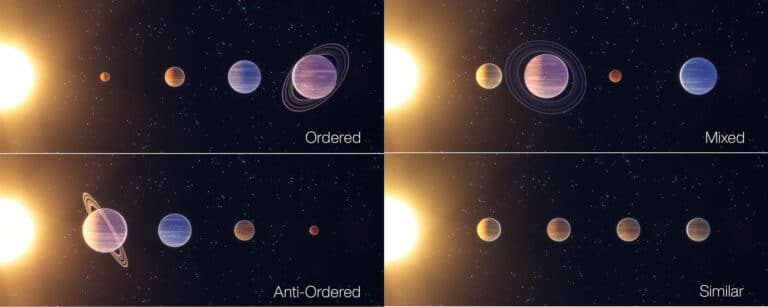
Image (Credit): Artist’s rendering of the four classes of planetary system architecture discussed in the paper below. (© NCCR PlanetS, / Tobias Stierli)

Astronomy and Astrophysics abstract:

We present a novel, model-independent framework for studying the architecture of an exoplanetary system at the system level. This framework allows us to characterise, quantify, and classify the architecture of an individual planetary system. Our aim in this endeavour is to generate a systematic method to study the arrangement and distribution of various planetary quantities within a single planetary system. We propose that the space of planetary system architectures be partitioned into four classes: similar, mixed, anti-ordered, and ordered. We applied our framework to observed and synthetic multi-planetary systems, thereby studying their architectures of mass, radius, density, core mass, and the core water mass fraction. We explored the relationships between a system’s (mass) architecture and other properties. Our work suggests that: (a) similar architectures are the most common outcome of planet formation; (b) internal structure and composition of planets shows a strong link with their system architecture; (c) most systems inherit their mass architecture from their core mass architecture; (d) most planets that started inside the ice line and formed in-situ are found in systems with a similar architecture; and (e) most anti-ordered systems are expected to be rich in wet planets, while most observed mass ordered systems are expected to have many dry planets. We find, in good agreement with theory, that observations are generally biased towards the discovery of systems whose density architectures are similar, mixed, or anti-ordered. This study probes novel questions and new parameter spaces for understanding theory and observations. Future studies may utilise our framework to not only constrain the knowledge of individual planets, but also the multi-faceted architecture of an entire planetary system. We also speculate on the role of system architectures in hosting habitable worlds.

Citation: L. Mishra, Y. Alibert, S. Udry, C. Mordasini, A framework for the architecture of exoplanetary systems. I. Four classes of planetary system architecture, Astronomy and Astrophysics (Accepted December 2022).
https://doi.org/10.1126/sciadv.abn2103

Study-related stories:

Study Findings: Fusible Mantle Cumulates Trigger Young Mare Volcanism on the Cooling Moon

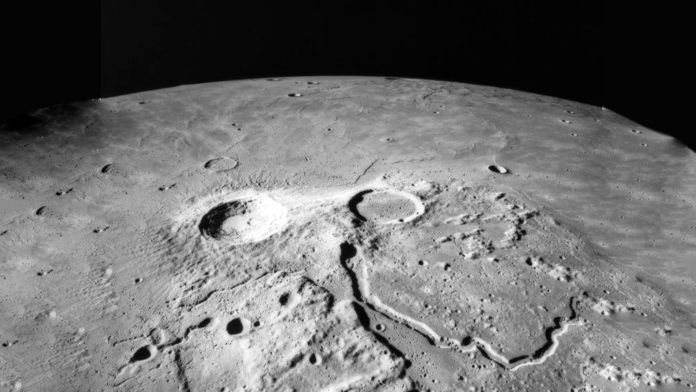
Image (Credit): The Moon’s snakelike Schroeter’s Valley, believed to have been created by lava flowing over the surface. (NASA/Johnson)

Science Advances abstract:

[China’s] Chang’E-5 (CE5) mission has demonstrated that lunar volcanism was still active until two billion years ago, much younger than the previous isotopically dated lunar basalts. How the small Moon retained enough heat to drive such late volcanism is unknown, particularly as the CE5 mantle source was anhydrous and depleted in heat-producing elements. We conduct fractional crystallization and mantle melting simulations that show that mantle melting point depression by the presence of fusible, easily melted components could trigger young volcanism. Enriched in calcium oxide and titanium dioxide compared to older Apollo magmas, the young CE5 magma was, thus, sourced from the overturn of the late-stage fusible cumulates of the lunar magma ocean. Mantle melting point depression is the first mechanism to account for young volcanism on the Moon that is consistent with the newly returned CE5 basalts.

Citation: Su, B., Yuan, J., Chen, Y., et al. Fusible mantle cumulates trigger young mare volcanism on the cooling Moon. Science Advances (2022).
https://doi.org/10.1126/sciadv.abn2103

Study-related stories:

Study Findings: Early Mars Habitability and Global Cooling by H2-based Methanogens

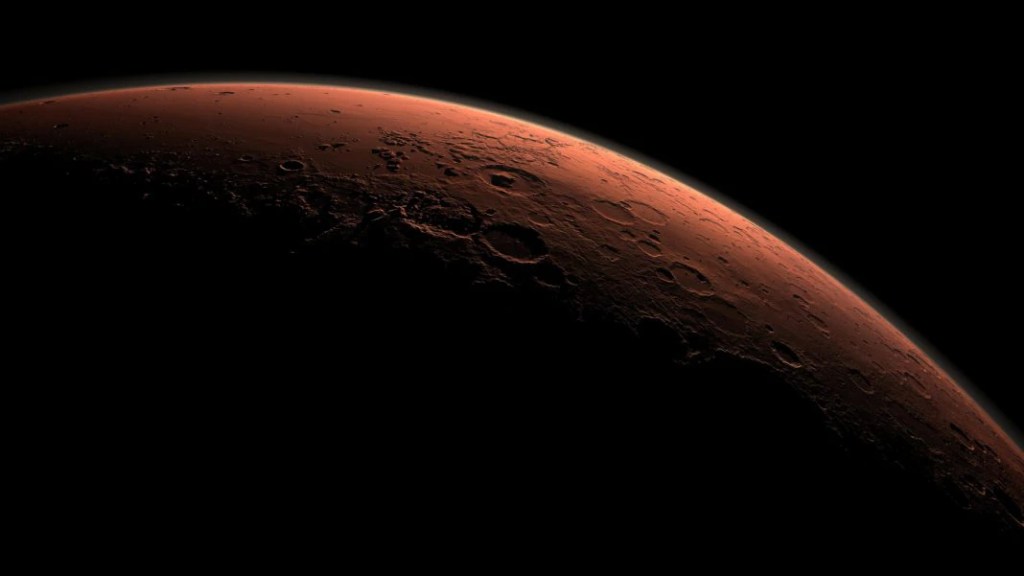
Image (Credit): Image of present day Mars. (NASA)

Nature Astronomy abstract:

During the Noachian, Mars’ crust may have provided a favourable environment for microbial life. The porous brine-saturated regolith would have created a physical space sheltered from ultraviolet and cosmic radiation and provided a solvent, whereas the below-ground temperature and diffusion of a dense, reduced atmosphere may have supported simple microbial organisms that consumed H2 and CO2 as energy and carbon sources and produced methane as a waste. On Earth, hydrogenotrophic methanogenesis was among the earliest metabolisms, but its viability on early Mars has never been quantitatively evaluated. Here we present a probabilistic assessment of Mars’ Noachian habitability to H2-based methanogens and quantify their biological feedback on Mars’ atmosphere and climate. We find that subsurface habitability was very likely, and limited mainly by the extent of surface ice coverage. Biomass productivity could have been as high as in the early Earth’s ocean. However, the predicted atmospheric composition shift caused by methanogenesis would have triggered a global cooling event, ending potential early warm conditions, compromising surface habitability and forcing the biosphere deep into the Martian crust. Spatial projections of our predictions point to lowland sites at low-to-medium latitudes as good candidates to uncover traces of this early life at or near the surface.

Citation: Sauterey, B., Charnay, B., Affholder, A. et al. Early Mars habitability and global cooling by H2-based methanogens. Nat Astron (2022). https://doi.org/10.1038/s41550-022-01786-w

Study-related stories: