Study Findings: Core Metamorphism Controls the Dynamic Habitability of Mid-sized Ocean Worlds—The Case of Ceres

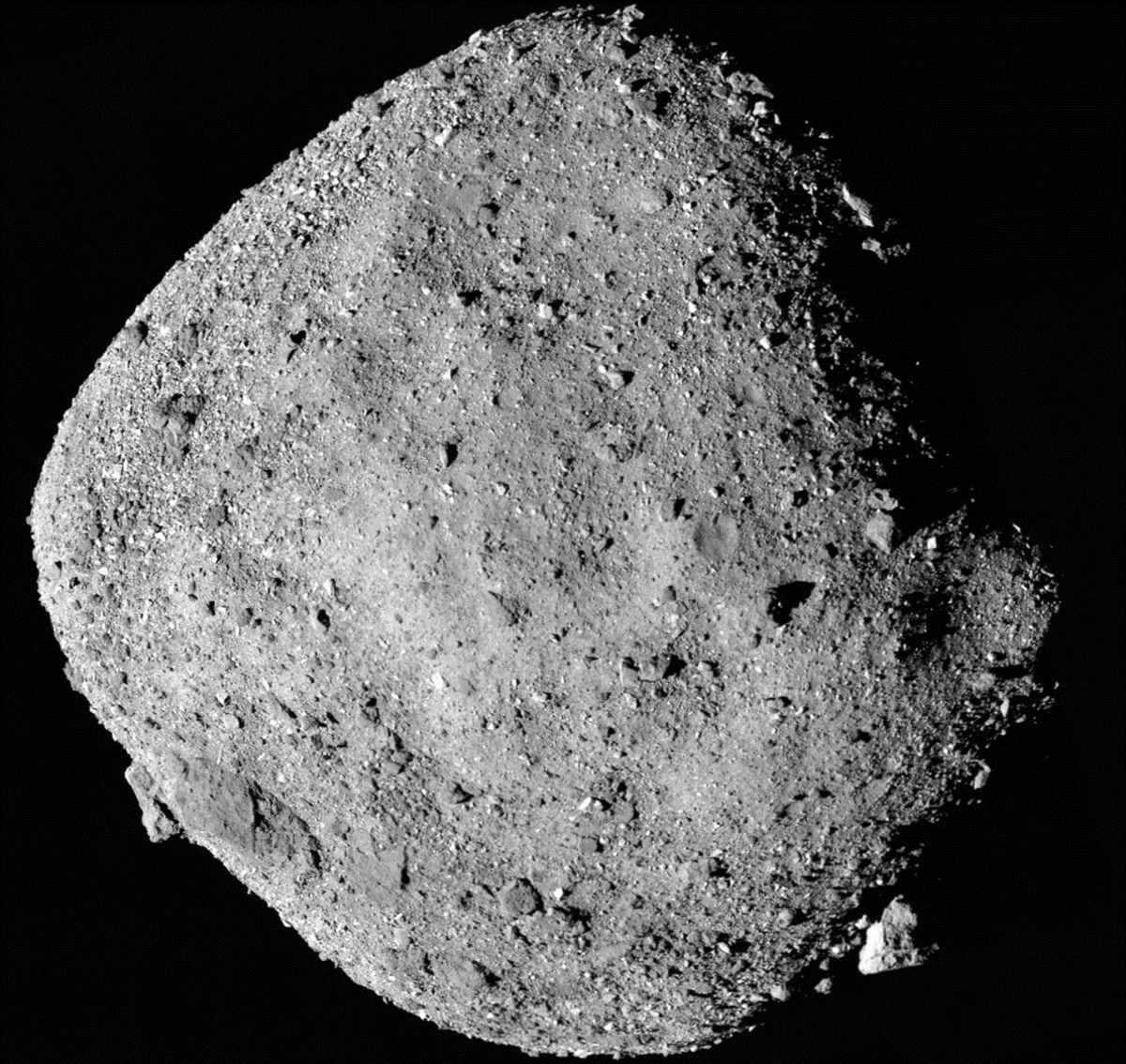
Image (Credit): Dwarf planet Ceres. (NASA/JPL)

Science Advances abstract of the study findings:

Ceres’s surface mineralogy and density structure indicate an aqueous past. Observations from the Dawn mission revealed that Ceres likely hosted a global subsurface ocean in its early history, which was the site of pervasive aqueous alteration of accreted material. Subsurface environmental constraints inferred from Ceres’s surface mineralogy, combined with Ceres’s high abundance of carbon, suggest that the dwarf planet may have been habitable for microbial life. We present a coupled chemical and thermal evolution model tracking Ceres’s interior aqueous environment through time. If the rocky interior reached ≳550 K, then fluids released by rock metamorphism would have promoted conditions favorable for habitability by introducing redox disequilibrium into the ocean, a source of chemical energy for chemotrophs. We find that this period would have been between ~0.5 and 2 billion years after Ceres’s formation. Since then, Ceres’s ocean has likely become a cold, concentrated brine with fewer sources of energy, making it less likely to be habitable at present.

Citation: Samuel W. Courville, S.W., Castillo-Rogez J.C., Daswani, M.M. et al. Core metamorphism controls the dynamic habitability of mid-sized ocean worlds—The case of Ceres, Science Advances, Vol 11, Issue 34 (August 20, 2025).

https://doi.org/10.1126/sciadv.adt3283

Study-related stories:

The Register – “Dwarf Planet Ceres May Have Been Habitable – for Microbes – a Couple of Billion Years Back”

Perplexity – “Dwarf Planet Ceres May Have Harbored Ancient Microbial Life”

Astrobiology – “Ceres May Have Had Long-Standing Energy to Fuel Habitability”

Study Findings: The Case for Mars Terraforming Research

Image (Credit): NASA infographic highlighting NASA’s twin robot geologists, the Mars Exploration Rovers (MER) Spirit and Opportunity. (NASA/JPL-Caltech)

Nature Astronomy abstract of the study findings:

Terraforming Mars has long captured the imagination but has received surprisingly little rigorous study. Progress in Mars science, climate science, launch capabilities and bioscience motivates a fresh look at Mars terraforming research. Since Sagan’s time, it has been understood that terraforming Mars would involve warming to enable oxygenic photosynthesis by engineered microbes, followed by slow oxygen build-up enabling more complex life. Before we can assess whether warming Mars is worthwhile, relative to the alternative of leaving Mars as a pristine wilderness, we must confront the practical requirements, cost and possible risks. Here we discuss what we know about Mars’s volatile inventories and soil composition, and possible approaches to warm Mars and increase atmospheric O2. New techniques have emerged that could raise Mars’s average global temperature by tens of degrees within a few decades. Research priorities include focusing on understanding fundamental physical, chemical and biological constraints that will shape any future decisions about Mars. Such research would drive advances in Mars exploration, bioscience and climate modelling.

Citation: DeBenedictis, E.A., Kite, E.S., Wordsworth, R.D. et al. The case for Mars terraforming research. Nat Astron 9, 634–639 (2025).

https://doi.org/10.1038/s41550-025-02548-0

Study-related stories:

Sci.News – “Can We Make Mars Habitable through Terraforming?”

SciTechDaily – “Terraforming Mars: Scientists Reveal the 3-Step Plan to Breathe Life Into a Dead Planet”

Los Alamos National Laboratories – “Is Terraforming Mars Possible?”

Study Findings: Carbonate Formation and Fluctuating Habitability on Mars

Image (Credit): Mars as captured by NASA Mars Global Surveyor MOC wide angle cameras. (NASA/JPL/MSSS)

Nature abstract of the study findings:

The cause of Mars’s loss of surface habitability is unclear, with isotopic data suggesting a ‘missing sink’ of carbonate. Past climates with surface and shallow-subsurface liquid water are recorded by Mars’s sedimentary rocks, including strata in the approximately 4-km-thick record at Gale Crater. Those waters were intermittent, spatially patchy and discontinuous, and continued remarkably late in Mars’s history—attributes that can be understood if, as on Earth, sedimentary-rock formation sequestered carbon dioxide as abundant carbonate (recently confirmed in situ at Gale). Here we show that a negative feedback among solar luminosity, liquid water and carbonate formation can explain the existence of intermittent Martian oases. In our model, increasing solar luminosity promoted the stability of liquid water, which in turn formed carbonate, reduced the partial pressure of atmospheric carbon dioxide and limited liquid water. Chaotic orbital forcing modulated wet–dry cycles. The negative feedback restricted liquid water to oases and Mars self-regulated as a desert planet. We model snowmelt as the water source, but the feedback can also work with groundwater as the water source. Model output suggests that Gale faithfully records the expected primary episodes of liquid water stability in the surface and near-surface environment. Eventually, atmospheric thickness approaches water’s triple point, curtailing the sustained stability of liquid water and thus habitability in the surface environment. We assume that the carbonate content found at Gale is representative, and as a result we present a testable idea rather than definitive evidence.

Citation: Kite, E.S., Tutolo, B.M., Turner, M.L. et al. Carbonate formation and fluctuating habitability on Mars. Nature 643, 60–66 (2025).

https://doi.org/10.1038/s41586-025-09161-1

Study-related stories:

University of Chicago – “Was Mars Doomed to be a Desert? Study Proposes New Explanation”

Science Alert – “NASA Discovery Could Explain Why We’ve Never Found Life on Mars”

The Register – “Mars Was Once a Desert with Intermittent Oases, Curiosity Data Suggests”

Study Findings: The Influence of Passing Field Stars on the Solar System’s Dynamical Future

Credit: Image by Yol Gezer from Pixabay.

Icarus abstract of the study findings:

The long-term dynamical future of the Sun’s planets has been simulated and statistically analyzed in great detail, but most prior work considers the solar system as completely isolated, neglecting the potential influence of field star passages. To understand the dynamical significance of field star encounters, we simulate several thousand realizations of the modern solar system in the presence of passing field stars for 5 Gyrs. We find that the impulse gradient of the strongest stellar encounter largely determines the net dynamical effect of field stars. Because the expected strength of such an encounter is uncertain by multiple orders of magnitude, the possible significance of field stars can be large. Our simulations indicate that isolated models of the solar system can underestimate the degree of our giant planets’ future secular orbital changes by over an order of magnitude. In addition, our planets and Pluto are significantly less stable than previously thought. Field stars transform Pluto from a completely stable object over 5 Gyrs to one with a ∼5% instability probability. Furthermore, field stars increase the odds of Mercury’s instability by ∼50%–80%. We also find a ∼0.3% chance that Mars will be lost through collision or ejection and a ∼0.2% probability that Earth will be involved in a planetary collision or ejected. Compared to previously studied instabilities in isolated solar systems models, those induced by field stars are much more likely to involve the loss of multiple planets. In addition, they typically happen sooner in our solar system’s future, making field star passages the most likely cause of instability for the next 4–4.5 Gyrs.

Citation: Kaib, Nathan A. and Raymond, Sean N., The influence of passing field stars on the solar system’s dynamical future, Icarus (2005).

https://doi.org/10.1016/j.icarus.2025.116632

Study-related stories:

The New York Times

Science News

Planetary Science Institute

Study Findings: No Certainty of a Milky Way–Andromeda Collision

Image (Credit): The Andromeda galaxy, or M31, spans 260,000 light-years across. (NASA/JPL-Caltech)

Nature Astronomy abstract of the study findings:

It is commonly believed that our own Milky Way is on a collision course with the neighbouring Andromeda galaxy. As a result of their merger, predicted in around 5 billion years, the two large spiral galaxies that define the present Local Group would form a new elliptical galaxy. Here we consider the latest and most accurate observations by the Gaia and Hubble space telescopes, along with recent consensus mass estimates, to derive possible future scenarios and identify the main sources of uncertainty in the evolution of the Local Group over the next 10 billion years. We found that the next most massive Local Group member galaxies—namely, M33 and the Large Magellanic Cloud—distinctly and radically affect the Milky Way–Andromeda orbit. Although including M33 increases the merger probability, the orbit of the Large Magellanic Cloud runs perpendicular to the Milky Way–Andromeda orbit and makes their merger less probable. In the full system, we found that uncertainties in the present positions, motions and masses of all galaxies leave room for drastically different outcomes and a probability of close to 50% that there will be no Milky Way–Andromeda merger during the next 10 billion years. Based on the best available data, the fate of our Galaxy is still completely open.

Citation: Sawala, T., Delhomelle, J., Deason, A.J. et al. No certainty of a Milky Way–Andromeda collision. Nat Astron (2025).
https://doi.org/10.1038/s41550-025-02563-1

Study-related stories:

PBS

National Geographic

Daily Finland