Space Quote: The Workings of Our Sun

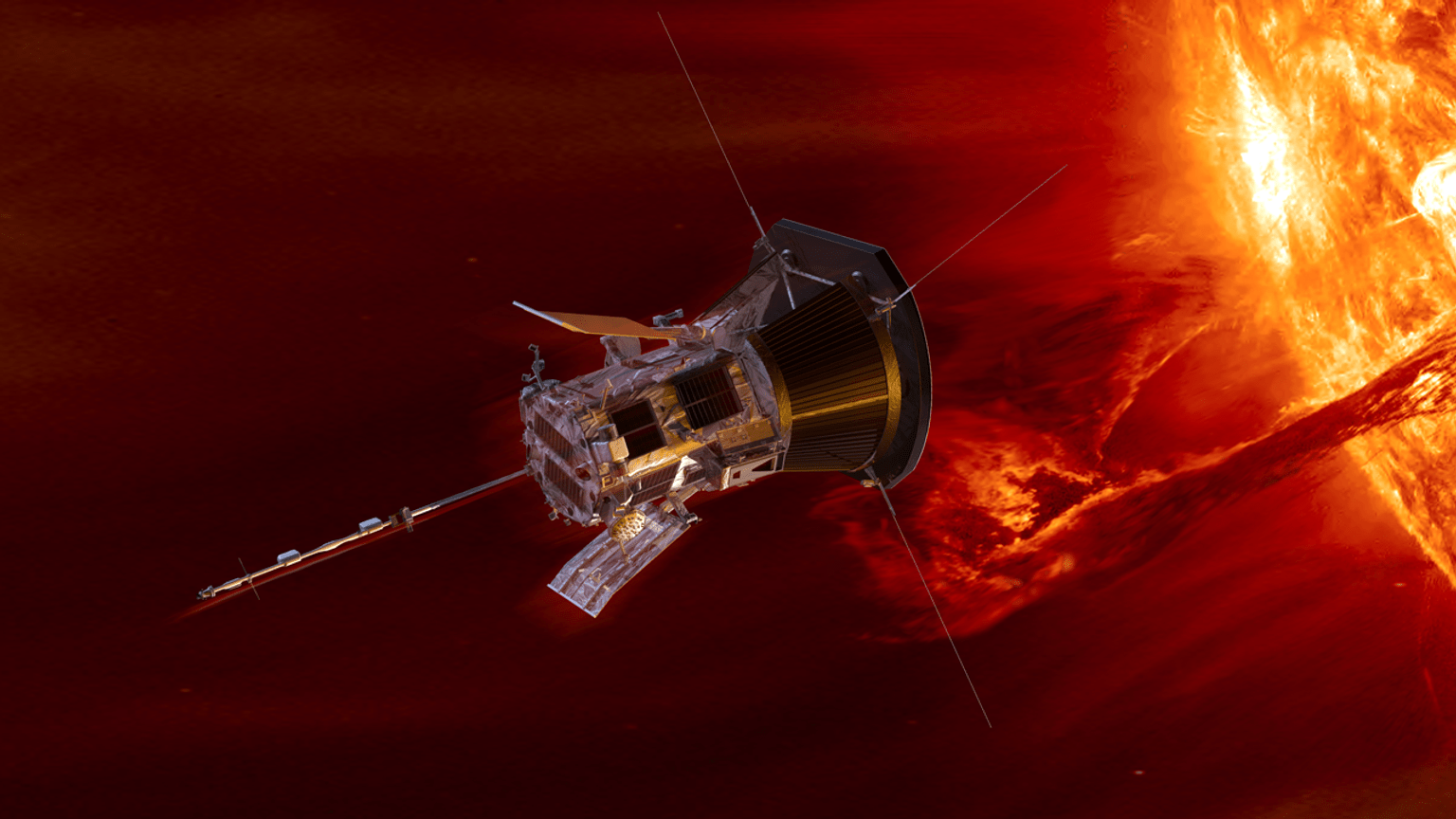
Image (Credit): Artist’s rendering of NASA’s Parker Solar Probe approaching the Sun. (NASA)

“Flying this close to the Sun is a historic moment in humanity’s first mission to a star…By studying the Sun up close, we can better understand its impacts throughout our solar system, including on the technology we use daily on Earth and in space, as well as learn about the workings of stars across the universe to aid in our search for habitable worlds beyond our home planet.”

Statement by Nicky Fox, who leads the Science Mission Directorate at NASA Headquarters in Washington, in reference to NASA’s Parker Solar Probe recent flyby of the Sun.

Space Stories: Solar Probe’s Close Flyby, Cosmic Tunnels, and More Complexities in Planet Formation

Credit: NASA

Here are some recent stories of interest.

Sky & Telescope:Parker Solar Probe Swings By Sun in Closest Approach Yet

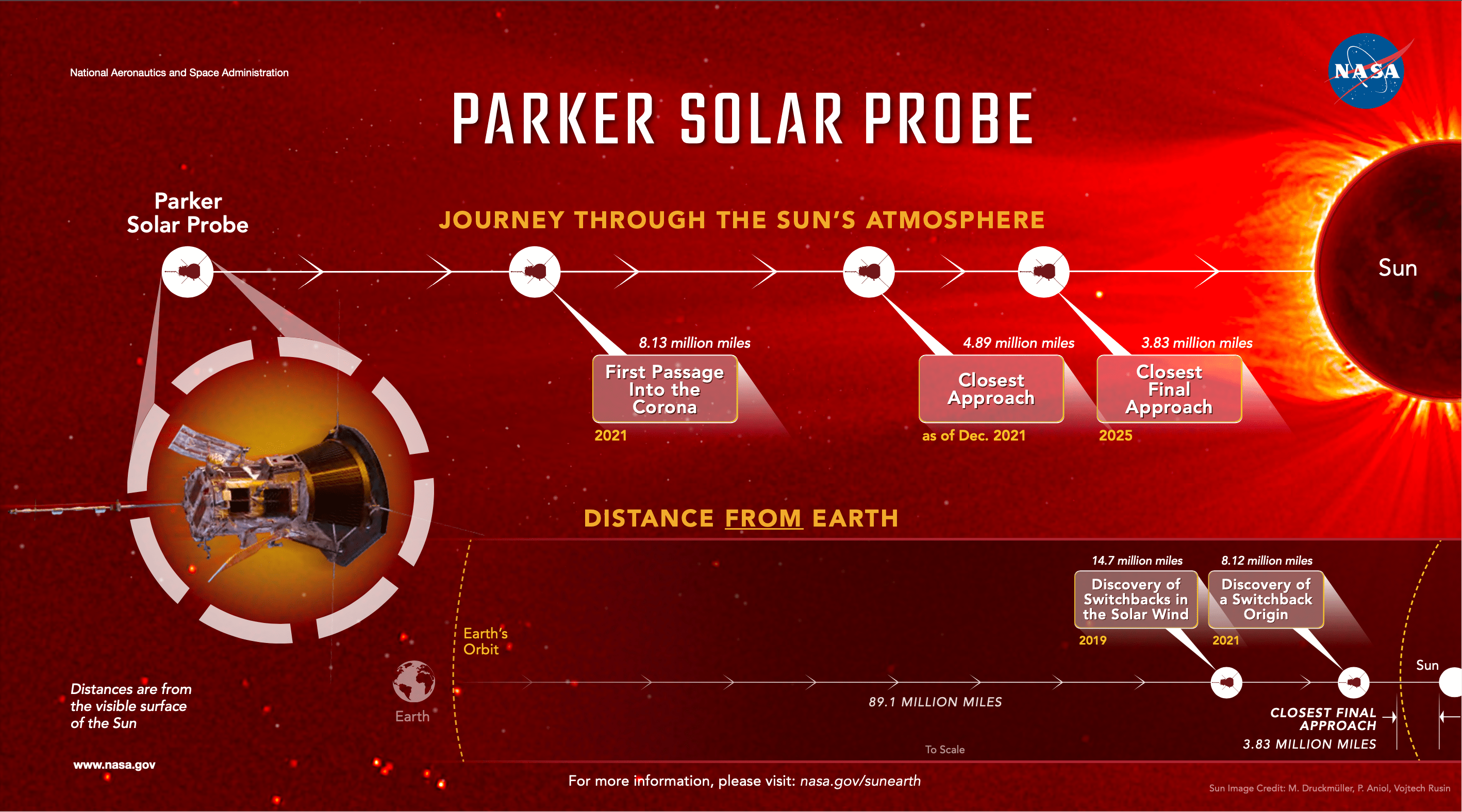
NASA’s Parker Solar Probe is about to go where no spacecraft has gone before. A final flyby of Venus last month has sped up Parker for the mission’s next solar perihelion, set to occur on December 24 at 6:40 EST / 11:40 UT. At just 6.2 million km (3.9 million miles) from the solar surface — about nine times the Sun’s radius — this perihelion will be the closest for the mission. Parker is breaking its own record to once again become the closest human-made object to ever approach the Sun…the mission is totally autonomous in taking measurements; it should start transmitting data back to Earth within a week after this pass, though it has the capability to carry out operations on its own for up to two months if needed.

BRG: Astronomers Say They Found a Tunnel Connecting Our Solar System to Other Stars

Astronomers have made a startling discovery. Using data from the eRosita X-ray instrument, researchers say they’ve discovered a “cosmic tunnel” that connects our solar system to other stars. Scientists have long known that our solar system exists in a Local Hot Bubble. This bubble is believed to have formed following several supernovas over the past several million years and is estimated to be around 300 light-years across. Using data from the eRosita, researchers from the Max Planck Institute say they found evidence of a cosmic tunnel stretching from our solar system out toward the Centaurus constellation. The tunnel appears to move through the material that makes up the Local Hot Bubble

Northwestern Now: Young Exoplanet’s Atmosphere Unexpectedly Differs from its Birthplace

Just as some children physically resemble their parents, many scientists have long thought that developing planets should resemble the swirling disk of gas and dust that births them. But, in a new study, a Northwestern University-led team of astrophysicists discovered the resemblance might be looser than previously thought. By studying a still-forming exoplanet and its surrounding natal disk using new instrumentation at W.M. Keck Observatory, the researchers uncovered a mismatched composition of gases in the planet’s atmosphere compared to gases within the disk. The surprising finding potentially confirms long-held skepticism that scientists’ current model of planet formation is too simplified.

Things To Do: Maine Solar System Model

Credit: University of Maine at Presque Isle

If you are looking for something fun in a slightly cooler climate this summer, you may want to venture to the Maine Solar System Model. Its a joint science project created by the University of Maine and northern Maine communities.

Built between 1999 and 2003, this model allows you to better understand the distances between planets as you drive around the Maine countryside, starting with a model of the Sun in the north or Pluto about 40 miles to the south. You can also visit the dwarf planet Eris about 55 miles south of Pluto if you want to be adventurous.

This is much better than spotting cows or playing “I see something blue” on those longer car rides. You can learn something new while driving around a beautiful part of America.

Space Stories: OSIRIS-APEX Survives Sun Flyby, Nearby Exoplanet May Be Habitable, and More Rogue Planets Rolling About

Here are some recent stories of interest.

NASA: NASA’s OSIRIS-APEX Unscathed After Searing Pass of Sun

Mission engineers were confident NASA’s OSIRIS-APEX (Origins, Spectral Interpretation, Resource Identification – Apophis Explorer) spacecraft could weather its closest ever pass of the Sun on Jan. 2, 2024. Their models had predicted that, despite traveling 25 million miles closer to the heat of the Sun than it was originally designed to, OSIRIS-APEX and its components would remain safe. The mission team confirmed that the spacecraft indeed had come out of the experience unscathed after downloading stored telemetry data in mid-March. The team also tested OSIRIS-APEX’s instruments in early April, once the spacecraft was far enough from the Sun to return to normal operations. 

USA Today: NASA Discovers Potentially Habitable Exoplanet 40 Light Years from Earth

NASA announced the discovery of a planet 40 light years from Earth that orbits every 12.8 days and is possibly even habitable. Gliese 12 b is a “super Earth exoplanet” that is nearly the same size as Earth or slightly smaller, according to a NASA news release. Exoplanets are planets outside of our solar system, NASA’s website says. “We’ve found the nearest, transiting, temperate, Earth-size world located to date,” Masayuki Kuzuhara, a project assistant professor at the Astrobiology Center in Tokyo, said in a statement. “Although we don’t yet know whether it possesses an atmosphere, we’ve been thinking of it as an exo-Venus, with similar size and energy received from its star as our planetary neighbor in the solar system.”

Phys.org: Starless and Forever Alone: More ‘Rogue’ Planets Discovered

The Euclid space telescope has discovered seven more rogue planets, shining a light on the dark and lonely worlds floating freely through the universe untethered to any star. Without being bound to a star, as the Earth is to the sun, there are no days or years on these planets, which languish in perpetual night. Yet scientists believe there is a chance they could be able to host life—and estimate there may be trillions dotted throughout the Milky Way.

Space Stories: Spaceplane Planned for ISS, AI Assists Astronomy, and Water Older Than the Sun

Image (Credit): Artist’s rendering of the Dream Chaser DC-100 spaceplane. (Sierra Space)

Here are some recent stories of interest.

New Atlas: World’s First Commercial Spaceplane in Final Stages Before Debut ISS Flight

The world’s first winged commercial spaceplane has arrived at NASA’s Kennedy Space Center in Florida, its final destination before its first mission to the International Space Station (ISS) later this year. Following rigorous testing at Ohio’s Neil Armstrong Test Facility, the Dream Chaser DC-100 spaceplane named Tenacity got the green light to commence final pre-launch preparations, such as finishing its thermal protection system and payload integration, before it hitches a ride on a United Launch Alliance (ULA) Vulcan rocket to deliver 7,800 pounds (3,540 kg) of food, water and science experiments to the ISS.

MIT Technology Review: Astronomers are Enlisting AI to Prepare for a Data Downpour

In deserts across Australia and South Africa, astronomers are planting forests of metallic detectors that will together scour the cosmos for radio signals. When it boots up in five years or so, the Square Kilometer Array Observatory will look for new information about the universe’s first stars and the different stages of galactic evolution.  But after syncing hundreds of thousands of dishes and antennas, astronomers will quickly face a new challenge: combing through some 300 petabytes of cosmological data a year—enough to fill a million laptops…In preparation for the information deluge, astronomers are turning to AI for assistance, optimizing algorithms to pick out patterns in large and notoriously finicky data sets. Some are now working to establish institutes dedicated to marrying the fields of computer science and astronomy—and grappling with the terms of the new partnership.

BBC Sky at Night: Earth’s Water is Even Older Than the Sun, Having Formed Billions of Years Ago, Say Astronomers

How old is Earth’s water? Could it be older even than the planet itself? A team of astronomers say they’ve found the “missing link” that shows how water is delivered from gaseous star-forming regions in space to planets like Earth. The research suggests that Earth’s water is even older than the Sun. The news comes as a result of studies of a dusty planet-forming disc surrounding a star 1,300 lightyears from Earth