Study Findings: Regression to the Mean Can Explain Saturation of Geomagnetic Storms

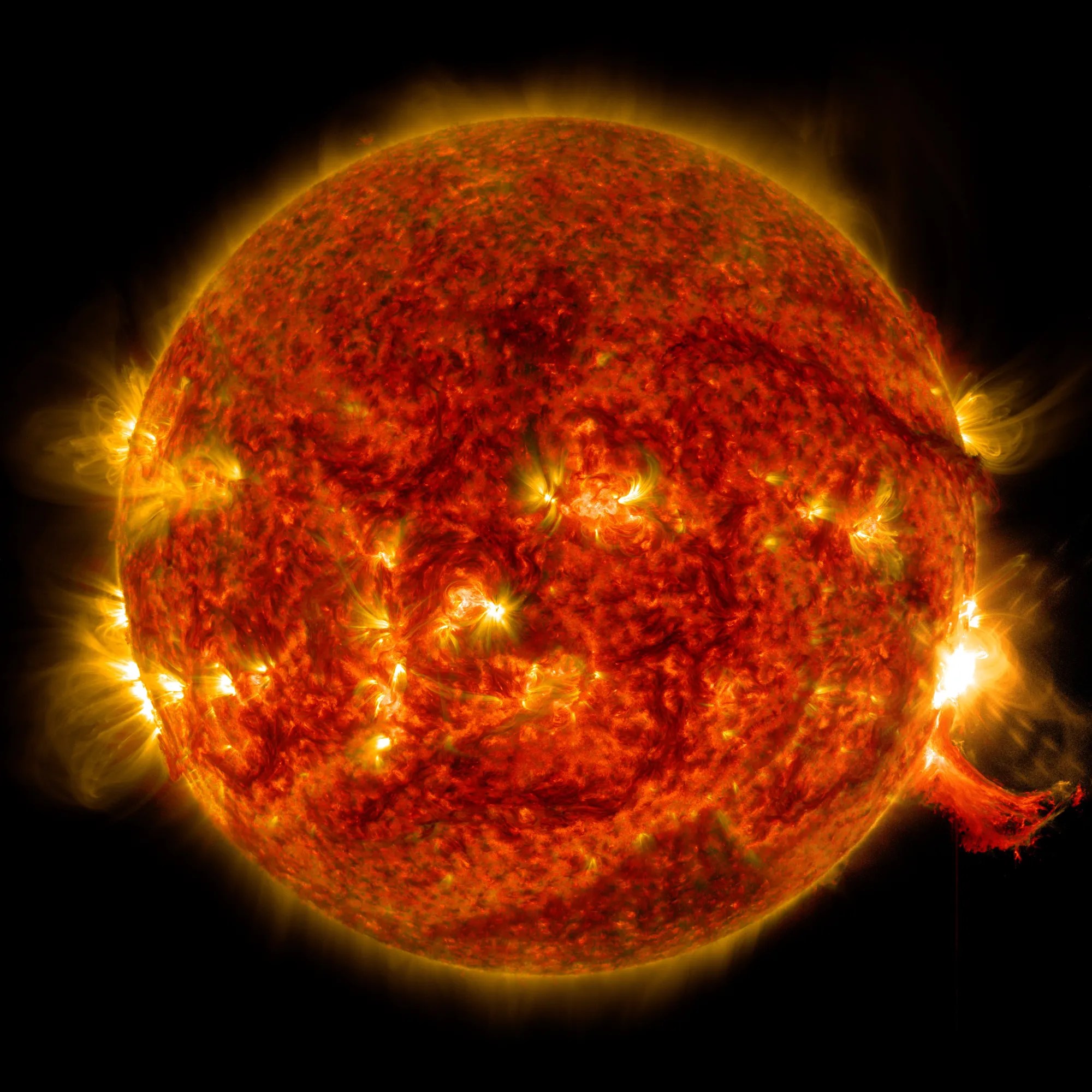
Image (Credit): A May 2024 image of a solar flare captured by NASA’s Solar Dynamics Observatory (SDO). (NASA SDO)

Nature abstract of study findings:

Extreme space weather events on Earth occur during intervals of strong solar wind driving. The solar wind drives plasma convection and currents in the near-Earth space environment. For low values of the driver, the Earth’s response is linear, estimated by parameters such as the polar cap index based on ground magnetometer activity. Curiously, for extreme solar wind driving, the Earth’s response appears not to increase beyond a saturation limit. Theorists have advanced a host of explanations for this saturation effect, but there is no consensus. Here we demonstrate that this saturation is a manifestation of the regression to the mean effect arising from random uncertainty in the timing and magnitude of solar wind measurements. Our results reveal that data analysis underpinning the saturation theories is nonlinearly biased, thereby challenging the validity of the theories. Correcting for the uncertainties reveals that the Earth’s response to solar wind driving is linear throughout, and that the impact of extreme geomagnetic storms can be twice as large as previously thought. We show that regression to the mean is a fundamental property of the relationship between measurement and the truth, where the truth corresponding to the measurement is closer to the mean. This effect is particularly pronounced for uncertain measurements of extreme values and is likely to manifest across various fields, from extreme climate studies to chronic medical pain.

Citation: Sivadas, N., Sibeck, D., Subramanyan, V. et al. Regression to the mean can explain saturation of geomagnetic storms. Nature 655, 1143–1147 (2026).

DOI: https://doi.org/10.1038/s41586-026-10757-4

Study-related stories:

Wired – “An Extreme Solar Storm May Be Even More Devastating Than Previously Imagined”

SciTechDaily – “Earth May Be Twice As Vulnerable to Extreme Solar Storms As Scientists Thought”

NASA – “New NASA Study Says Possibly No Limit to Solar Storm Effects”

Space Stories: Too Much Satellite Sunlight, Sugar and Spice in Space, and Super Black Satellite Paint

Credit: Pixabay

Here are some recent space-related stories of interest.

Universe Space Tech: The Earendil-1 Satellite, Equipped with its Large Mirror, Has Caused Discontent Among Astronomers

The United States Federal Communications Commission (FCC) has granted approval to Reflect Orbital to proceed with testing its innovative Earendil-1 satellite. This spacecraft features a substantial mirror engineered to redirect sunlight towards the nighttime side of Earth. The primary objective of the startup is to augment energy supply to solar power facilities and illuminate extensive regions up to 5 kilometers in width. By the year 2035, the company intends to deploy a constellation comprising 50,000 such orbital reflectors. Notwithstanding the potential advantages for agriculture and emergency services, the initiative has elicited grave concerns within the community.

CBS News: “Astronomers Discover Sugar in Space That’s Also Found in Raspberries: ‘Just Floating Out in the Galaxy‘”

The space between stars just got a little sweeter. Astronomers have detected a type of sugar in space that’s also found in raspberries and self-tanners. The sugar, called erythrulose, lurks in what’s called the interstellar medium: thin clouds of gas and dust littered between stars. Sugar does more than sweeten tea and powder doughnuts. Different varieties fuel our cells and even make up DNA. Scientists are itching to know how sugars form because they’re a key ingredient for life as we know it.

Science Alert: Vantablack: World’s Blackest Paint Could Solve A Major Problem For Astronomy

Low Earth orbit is becoming increasingly crowded with satellites, and they’re quietly erasing our view of the Universe…Chaturvedi and a team of researchers in the UK think they might have the answer: Vantablack 310, a specific formulation of one of the blackest materials ever developed, intended for use on spacecraft. In lab tests, coating satellites with Vantablack 310 meant that only 2 percent of incoming light was reflected.

Note: Here is the podcast version of this post.

Space Quote: That’s All We Need in This Year’s Election

Image (Credit): Solar flares on the Sun spilling radiation into the solar system. (NASA)

“In 2003, during a local Belgian election, a candidate received over 4,000 extra votes on a computerized voting machine — more than was physically possible, triggering an investigation…The leading explanation for each of these events is what’s known as a bit flip: an electronic glitch caused by radiation from space. Although uncommon, they can have significant consequences. And as our reliance on electronics continues to increase, so does our vulnerability to bit flips.

-Quote from a recent article from Astronomy magazine titled “Our Planet’s Electronic Vulnerability.” The article goes on to explain how high-energy radiation from the Sun as well as deep space can cause a “bit flip” that is difficult to detect. Given the use of electronic voting machines in US elections, we can only hope that this radiation issue does not come up in the fall election. Asking the voters to “wait for the science” before jumping to conclusions is not a viable option.

Space Stories: ESA & China Are Smiling, Blue Origin Beats SpaceX to the Moon, and JWST Analyzes Exoplanet Atmosphere

Here are some recent space-related stories.

European Space Agency: Smile Lifts Off on Quest to Reveal Earth’s Invisible Shield Against the Solar Wind

The Smile spacecraft lifted off on a Vega-C rocket from Europe’s Spaceport in French Guiana at 04:52 BST / 05:52 CEST (00:52 local time) on 19 May 2026. The launch marks the beginning of an ambitious mission to better understand solar storms, geomagnetic storms, and the science of space weather…Smile is a collaboration between the European Space Agency (ESA) and the Chinese Academy of Sciences (CAS). It will reveal how Earth responds to the streams of particles and bursts of radiation from the Sun, using an X-ray camera to make the world’s first X-ray observations of Earth’s magnetic shield, and an ultraviolet camera to watch the resulting northern lights non-stop for 45 hours at a time.

The Guardian: “Nasa Selects Jeff Bezos’s Blue Origin for First of Three Uncrewed Lunar Missions

Nasa announced on Tuesday ambitious plans for three uncrewed lunar missions this year to kickstart construction of a $20bn moon base, and said it had chosen the Amazon founder Jeff Bezos’s Blue Origin, ahead of Elon Musk’s SpaceX, to conduct the first...[NASA’s Administrator] said the three missions planned for 2026 would be followed by “more than a dozen” more in the coming years to test systems and equipment. He said the highly successful Artemis II mission last month that sent four astronauts around the moon for the first time since 1972 had been both a catalyst and incentive to advance the moon base plan.

Astrobiology: Astronomers Observe Exoplanet Atmospheres With New Cloud-detecting Method

Every morning, clouds roll in, and by evening, they have cleared off. This sounds like a weather forecast for a coastal city here on Earth — but it’s for WASP-94A b, a well-studied gas giant orbiting a star located nearly 700 light-years away. A new study published in the journal Science documents the first detection of repeating cloud cycles on a hot Jupiter exoplanet. The first author of the study is Sagnick Mukherjee, a 51 Pegasi b postdoctoral fellow at Arizona State University’s School of Earth and Space Exploration. Mukherjee is part of a research team that analyzed data from the James Webb Space Telescope targeting WASP-94 A b, a gas giant in the constellation Microscopium. The team discovered that the planet’s morning side is blanketed in clouds of magnesium silicate, the same mineral found in common rocks, while its evening side is under clear skies.

Note: Here is the podcast version of this post.