Space Stories: Layoffs at NASA’s JPL, Rocky Giants in our Solar System, and New Findings from Apollo 17

Here are some recent space-related stories of interest.

NBC News: NASA’s Jet Propulsion Laboratory Lays Off 550 Workers

NASA’s Jet Propulsion Laboratory announced Monday that it will cut around 550 jobs — around 10% of its staff. In a statement posted online, the lab’s director, Dave Gallagher, said the layoffs are part of a broad “realignment of its workforce” and not a result of the government shutdown. The cuts will affect positions across the NASA center’s technical, business and support areas, he said.

Space.com: Uranus and Neptune May Not Be ‘Ice Giants’ After All, New Research Suggests

Astronomers have long called Uranus and Neptune the “ice giants” because models suggested that these outer planets’ interiors are largely made of mixtures of water, ammonia and other ices — compounds that freeze easily in deep space. But new research reveals that we actually know very little about what’s going on inside these planets, causing researchers to propose that Uranus and Neptune be called “rocky giants” instead.

Brown University: “With New Analysis, Apollo Samples Brought to Earth in 1972 Reveal Exotic Sulfur Hidden in Moon’s Mantle

In a study published in JGR: Planets, researchers report a sulfuric surprise in rock samples taken from the Moon’s Taurus Littrow region during Apollo 17. The analysis shows that volcanic material in the sample contains sulfur compounds that are highly depleted of sulfur-33 (or 33S), one of four radioactively stable sulfur isotopes. The depleted 33S samples contrast sharply with sulfur isotope ratios found on Earth, the researchers say.

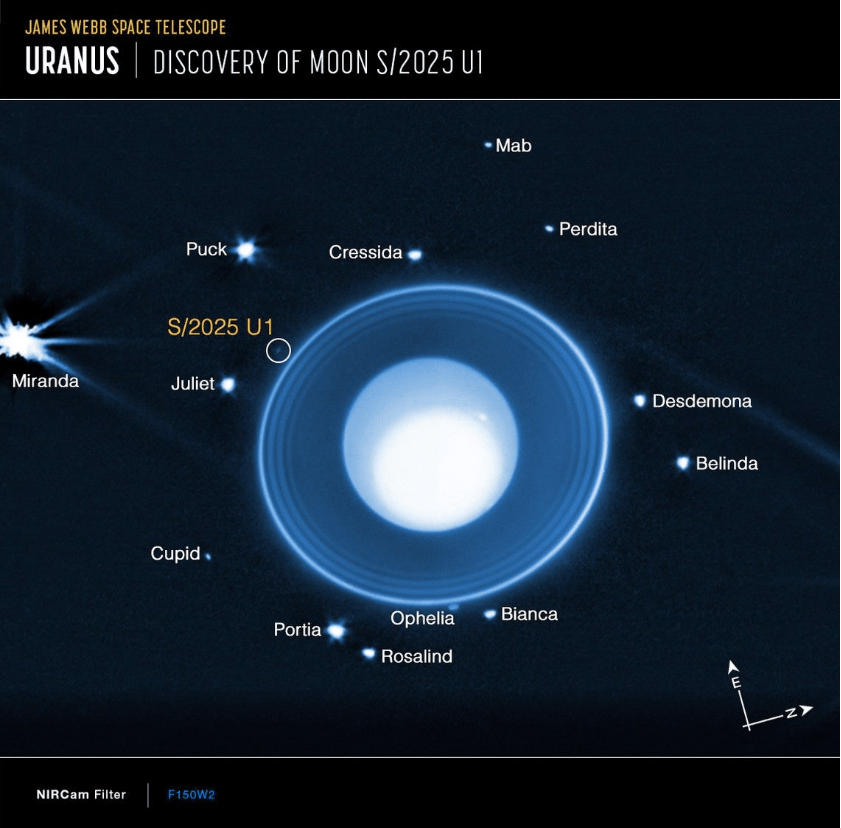
We Welcome S/2025 U1 to the Family of Moons

Credit: NASA, ESA, CSA, STScI, M. El Moutamid (SwRI), M. Hedman (University of Idaho)

Uranus has a new moon. Voyager missed it, but the James Webb Space Telescope discovered it earlier this year.

Named S/2025 U1 for the time being, it is the 29th known moon of Uranus. It is also quite small, being only six miles in diameter. Even the Martian Deimos is 7.5 miles in diameter.

Given the names of the other local moons, such as Puck, Cupid, Ophelia, and Juliet, one can guess that a few astronomers are brushing up on their Shakespeare at the moment. However, the International Astronomical Union will have the final say.

It’s just nice to have something simple to acknowledge in the space realm given all the politics mucking things up here on Earth. We all need to look up from the news once in a while to appreciate the bigger picture.

Space Stories: New Glenn’s Martian Probes, AI Space Doctors, and Questions About a Mission to Uranus

Image (Credit): Blue Origin’s New Glenn Rocket. (Blue Origin)

Here are some recent space-related stories of interest.

Space.com: Blue Origin’s 2nd New Glenn Rocket Launch will Fly Twin NASA Mars Probes to Space on Sep. 29

Blue Origin is gearing up for the second-ever launch of its powerful New Glenn rocket, which will loft NASA’s ESCAPADE mission to Mars. The company says it has been working closely with NASA on preparations leading up to New Glenn’s next launch, dubbed NG-2, and is targeting no earlier than (NET) Sep. 29. The twin ESCAPADE (Escape and Plasma Acceleration and Dynamics Explorers) probes have been awaiting their turn aboard New Glenn, which was originally slated to carry the satellites on its maiden launch in January. However, NASA opted not to risk a costly mission delay due to the debut liftoff of the new rocket.

American Bazaar: NASA and Google Test AI Medical Assistant for Astronaut Missions

NASA, which is committing to a new era of human spaceflight with its Artemis mission, is working with Google to test a proof of concept for Crew Medical Officer Digital Assistant (CMO‑DA), a type of Clinical Decision Support System (CDSS). This has been created to allow astronauts to diagnose and treat symptoms when no doctor is available or communications to Earth are blacked out. “Trained on spaceflight literature, the AI system uses cutting-edge natural language processing and machine learning techniques to safely provide real-time analyses of crew health and performance,” Google representatives said in a statement.

Scientific American:“NASA Budget Cuts Could End U.S. Exploration of the Outer Solar System

In the spring of 2022 the U.S. space community selected its top priority for the nation’s next decade of science and exploration: a mission to Uranus, the gassy, bluish planet only seen up close during a brief spacecraft flyby in 1986. More than 2.6 billion kilometers from Earth at its nearest approach, Uranus still beckons with what it could reveal about the solar system’s early history—and the overwhelming numbers of Uranus-sized worlds that astronomers have spied around other stars. Now President Donald Trump’s proposed cuts to NASA could push those discoveries further away than ever—not by directly canceling the mission but by abandoning the fuel needed to pull it off.

Space Stories: More Space Tourists, Chinese Maglev Rocket Launches, and New Hubble Findings on Uranus

Image (Credit): Launch of the Fram2 mission earlier this week. (SpaceX)

Here are some recent stories of interest.

South China Morning Post: SpaceX Launches Fram2: 4 Astronauts Seek to Make Historic Flight Over Earth’s Poles

A SpaceX spacecraft carrying four international astronauts is on a pioneering journey circling Earth over its poles after launching Monday night from Florida…Fram2 follows in the footsteps of other commercial spaceflight ventures, including Inspiration4 and Polaris Dawn – two missions also bankrolled and led by billionaire Jared Isaacman. In fact, the Fram2 crew is now traveling on the same Dragon spacecraft that the Polaris Dawn crew rode to orbit in September for a five-day mission in which they completed a historic spacewalk.

South China Morning Post: China in Bid to Challenge SpaceX by Deploying Maglev Rocket Launch Pad by 2028

In a bid to disrupt the United States’ long-held dominance in space exploration, China is quietly advancing a radical new rocket launch system – powered not by roaring engines but by electromagnetic force – that could propel satellites into orbit with unprecedented speed and efficiency. At the heart of the ambitious project is Galactic Energy, a private aerospace company that plans to debut the world’s first electromagnetic rocket launch pad by 2028, a project that could redraw the competitive lines of the global space industry.

Space Telescope Science Institute: 20-Year Hubble Study of Uranus Yields New Atmospheric Insights

Halfway through its fourth decade, Hubble’s long life has proven invaluable for studying the atmosphere of the mysterious ice giant Uranus. By repeatedly training Hubble on the distant cyan planet over the course of 20 years, researchers chronicled a two-decade story of seasonal changes. These astronomers have gained new understanding of the atmospheric dynamics of Uranus, which can serve as a proxy for studying exoplanets of similar size and composition.

Space Stories: Potential Life on Uranus, a Sick ISS Astronaut, and a Feasting Black Hole

Image (Credit): Uranus captured the James Webb Telescope’s Near-Infrared Camera (NIRCam). This Webb image also shows 9 of the planet’s 27 moons. (NASA, ESA, CSA, STScI)

BBC: New Study on Moons of Uranus Raises Chance of Life

The Voyager 2 observations had suggested that its two largest moons — Titania and Oberon — often orbit outside the magnetosphere. However, the new study indicates they tend to stay inside the protective bubble, making it easier for scientists to magnetically detect potential subsurface oceans. “Both are thought to be prime candidates for hosting liquid water oceans in the Uranian system due to their large size relative to the other major moons,” Jet Propulsion Laboratory planetary scientist and study co-author Corey Cochrane said.

ScotsmanNasa Astronauts Tight-lipped on Who was Ill After Long Space Station Mission

Three Nasa astronauts whose prolonged space station mission ended with a trip to hospital last month have declined to say which one of them was sick. Astronauts Matthew Dominick, Michael Barratt and Jeanette Epps publicly discussed their spaceflight for the first time since returning from the International Space Station on October 25.

NOIRLabNSF NOIRLab Astronomers Discover the Fastest-Feeding Black Hole in the Early Universe

Supermassive black holes exist at the center of most galaxies, and modern telescopes continue to observe them at surprisingly early times in the Universe’s evolution. It’s difficult to understand how these black holes were able to grow so big so rapidly. But with the discovery of a low-mass supermassive black hole feasting on material at an extreme rate, seen just 1.5 billion years after the Big Bang, astronomers now have valuable new insights into the mechanisms of rapidly growing black holes in the early Universe.