Space Stories: More Space Tourists, Chinese Maglev Rocket Launches, and New Hubble Findings on Uranus

Image (Credit): Launch of the Fram2 mission earlier this week. (SpaceX)

Here are some recent stories of interest.

South China Morning Post: SpaceX Launches Fram2: 4 Astronauts Seek to Make Historic Flight Over Earth’s Poles

A SpaceX spacecraft carrying four international astronauts is on a pioneering journey circling Earth over its poles after launching Monday night from Florida…Fram2 follows in the footsteps of other commercial spaceflight ventures, including Inspiration4 and Polaris Dawn – two missions also bankrolled and led by billionaire Jared Isaacman. In fact, the Fram2 crew is now traveling on the same Dragon spacecraft that the Polaris Dawn crew rode to orbit in September for a five-day mission in which they completed a historic spacewalk.

South China Morning Post: China in Bid to Challenge SpaceX by Deploying Maglev Rocket Launch Pad by 2028

In a bid to disrupt the United States’ long-held dominance in space exploration, China is quietly advancing a radical new rocket launch system – powered not by roaring engines but by electromagnetic force – that could propel satellites into orbit with unprecedented speed and efficiency. At the heart of the ambitious project is Galactic Energy, a private aerospace company that plans to debut the world’s first electromagnetic rocket launch pad by 2028, a project that could redraw the competitive lines of the global space industry.

Space Telescope Science Institute: 20-Year Hubble Study of Uranus Yields New Atmospheric Insights

Halfway through its fourth decade, Hubble’s long life has proven invaluable for studying the atmosphere of the mysterious ice giant Uranus. By repeatedly training Hubble on the distant cyan planet over the course of 20 years, researchers chronicled a two-decade story of seasonal changes. These astronomers have gained new understanding of the atmospheric dynamics of Uranus, which can serve as a proxy for studying exoplanets of similar size and composition.
Space Stories: Potential Life on Uranus, a Sick ISS Astronaut, and a Feasting Black Hole

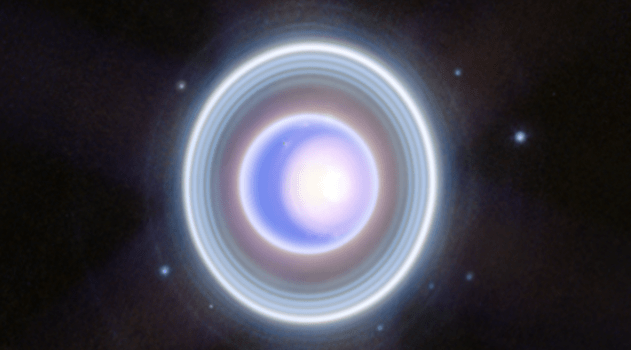
Image (Credit): Uranus captured the James Webb Telescope’s Near-Infrared Camera (NIRCam). This Webb image also shows 9 of the planet’s 27 moons. (NASA, ESA, CSA, STScI)

BBC: New Study on Moons of Uranus Raises Chance of Life

The Voyager 2 observations had suggested that its two largest moons — Titania and Oberon — often orbit outside the magnetosphere. However, the new study indicates they tend to stay inside the protective bubble, making it easier for scientists to magnetically detect potential subsurface oceans. “Both are thought to be prime candidates for hosting liquid water oceans in the Uranian system due to their large size relative to the other major moons,” Jet Propulsion Laboratory planetary scientist and study co-author Corey Cochrane said.

ScotsmanNasa Astronauts Tight-lipped on Who was Ill After Long Space Station Mission

Three Nasa astronauts whose prolonged space station mission ended with a trip to hospital last month have declined to say which one of them was sick. Astronauts Matthew Dominick, Michael Barratt and Jeanette Epps publicly discussed their spaceflight for the first time since returning from the International Space Station on October 25.

NOIRLabNSF NOIRLab Astronomers Discover the Fastest-Feeding Black Hole in the Early Universe

Supermassive black holes exist at the center of most galaxies, and modern telescopes continue to observe them at surprisingly early times in the Universe’s evolution. It’s difficult to understand how these black holes were able to grow so big so rapidly. But with the discovery of a low-mass supermassive black hole feasting on material at an extreme rate, seen just 1.5 billion years after the Big Bang, astronomers now have valuable new insights into the mechanisms of rapidly growing black holes in the early Universe.

Space Stories: Water Found on Miranda, NASA Still Pondering VIPER Mission to Moon, and the ISS Has Been Leaking for Some Time

Image (Credit): Uranian moon Miranda as seen by Voyager 2 on January 24, 1986. (Jet Propulsion Laboratory)

Here are some recent stories of interest.

John Hopkins Applied Physics LaboratoryUranus’ Moon Miranda May Have an Ocean Beneath Its Surface, New Study Finds

A new study suggests Uranus’ moon Miranda may harbor a water ocean beneath its surface, a finding that would challenge many assumptions about the moon’s history and composition and could put it in the company of the few select worlds in our solar system with potentially life-sustaining environments. “To find evidence of an ocean inside a small object like Miranda is incredibly surprising,” said Tom Nordheim, a planetary scientist at the Johns Hopkins Applied Physics Laboratory (APL) in Laurel, Maryland, a study co-author, and the principal investigator on the project that funded the study. “It helps build on the story that some of these moons at Uranus may be really interesting — that there may be several ocean worlds around one of the most distant planets in our solar system, which is both exciting and bizarre.”

Space NewsNASA Evaluating “Next Steps” for VIPER Lunar Rover Mission

NASA expects to determine by early next year the next steps for a lunar rover mission it canceled in July amid some confusion over the timing of that decision. Speaking at an Oct. 28 meeting of the Lunar Exploration Analysis Group (LEAG), Joel Kearns, deputy associate administrator for exploration in NASA’s Science Mission Directorate, said the agency was reviewing responses to a request for information (RFI) the agency issued in August seeking alternative uses for its Volatiles Investigating Polar Exploration Rover (VIPER) spacecraft.

Scientific AmericanThe International Space Station Has Been Leaking for Five Years

In the hostile conditions beyond Earth, a spacecraft is all that stands between an astronaut and certain death. So having yearslong seemingly unfixable leaks on the International Space Station (ISS) sounds like a nightmare scenario. It’s also a reality, one that a recent agency report calls “a top safety risk.” Amid months of headlines about astronauts stranded by Boeing’s Starliner vehicle and NASA’s announcement of a contract with Elon Musk’s SpaceX to destroy the ISS early next decade, the ongoing concerns about the leaks come as another reminder that supporting a long-term population in space is a challenge that’s quite literally out of this world.

Space Stories: Oceans on Ariel, Dinosaur-Killer Asteroid from Beyond Jupiter, and the Launch of the Polaris Dawn Mission

Image (Credit): Uranus and distant galaxies as seen by the James Webb Space Telescope. (NASA, ESA, CSA, STScI)

Here are some recent stories of interest.

ForbesNASA’s Webb Telescope Finds Evidence For An Ocean World Around Uranus

New observations by the James Webb Space Telescope suggest that an icy moon around Uranus may have an underground liquid ocean. Ariel is one of 27 moons around Uranus, the seventh planet from the sun and the third largest planet in the solar system. It’s one of four moons that scientists have long been interested in as part of a search for water across the solar system, the others being Umbriel, Titania and Oberon.

Nature: Dinosaur-killing Chicxulub Asteroid Formed in Solar System’s Outer Reaches

The object that smashed into Earth and kick-started the extinction that wiped out almost all dinosaurs 66 million years ago was an asteroid that originally formed beyond the orbit of Jupiter, according to geochemical evidence from the impact site in Chicxulub, Mexico. The findings, published on 15 August in Science, suggest that the mass extinction was the result of a train of events that began during the birth of the Solar System. Scientists had long suspected that the Chicxulub impactor, as it is known, was an asteroid from the outer Solar System, and these observations bolster the case.

Space DailyPolaris Dawn Mission Set for August 26 to Advance Commercial Space Exploration

The Polaris Program, focused on testing and developing new spaceflight technology, is preparing to launch its first mission, Polaris Dawn, aboard SpaceX’s Falcon 9 rocket on Monday, August 26, 2024. This mission marks a significant step forward in commercial space exploration. Key objectives include testing a next-generation spacesuit during the first commercial spacewalk, attempting to achieve the highest altitude for a human spaceflight since the Apollo missions, and evaluating a new communication system through Starlink.

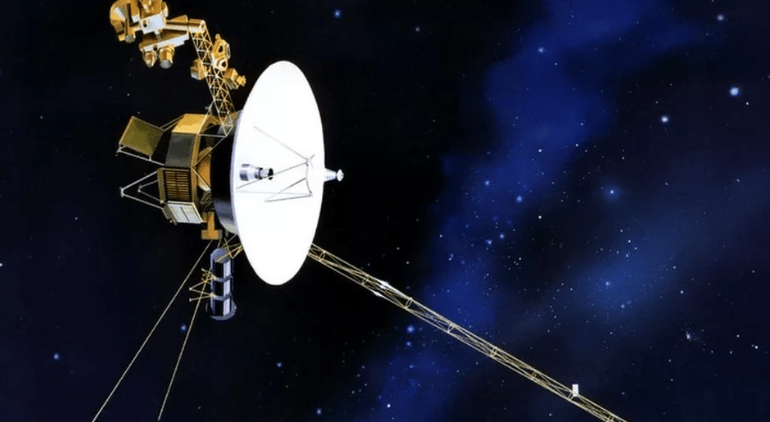
Voyager 2 is Still Talking to Us

After two weeks with no word, Voyager 2 is back to communicating with us as it continues its journey beyond our solar system. The whole incident started when NASA sent a bad command, but all is well.

Voyager 2 first left Earth back in August 1977 and exited the solar system in December 2018. Like Voyager 1, which is also outside the solar system now, Voyager 2 had the initial task of studying the planets. Voyager 2 focused on Jupiter, Saturn, Uranus and Neptune. It has shown it was capable of much more as it dragged the human race to the bleeding edge of space.

You can read all about Voyager 2’s accomplishments at this NASA site, including:

  • Voyager 2 is the only spacecraft to study all four of the solar system’s giant planets at close range.
  • Voyager 2 discovered a 14th moon at Jupiter.
  • Voyager 2 was the first human-made object to fly past Uranus.
  • At Uranus, Voyager 2 discovered 10 new moons and two new rings.
  • Voyager 2 was the first human-made object to fly by Neptune.
  • At Neptune, Voyager 2 discovered five moons, four rings, and a “Great Dark Spot.”

An impressive list of accomplishments, and the spacecraft is still ticking as it goes into the great unknown.

We need to keep these achievements in mind as we battle over this year’s NASA budget. We also need to remember that there was supposed to be four Voyager-like spacecraft rather than two, but budget cuts nixed the second set. Meaning we can still get some great things done even if we don’t have the budget to fund every piece of a grand vision.