Television: More Space Stories This Summer

Image (Credit): The eight plants of our solar system. (NOVA)

If you are looking for space series beyond the Moon, PBS has a few more shows for you. With the James Webb Space Telescope releasing the first photos next week, now is the time to brush up on the mission with a NOVA special. And check out the earlier NOVA piece on the planets as well. Dates and times may vary by region.

NOVA: Ultimate Space Telescope, July 13 at 9pm (28 minutes):

How did NASA engineers build and launch the most ambitious telescope of all time? Follow the dramatic story of the James Webb Space Telescope—the most complex machine ever launched into space. If it works, scientists believe that this new eye on the universe will peer deeper back in time and space than ever before to the birth of galaxies, and may even be able to “sniff” the atmospheres of exoplanets as we search for signs of life beyond Earth. But getting it to work is no easy task. The telescope is far bigger than its predecessor, the famous Hubble Space Telescope, and it needs to make its observations a million miles away from Earth—so there will be no chance to go out and fix it. That means there’s no room for error; the most ambitious telescope ever built needs to work perfectly. Meet the engineers making it happen and join them on their high stakes journey to uncover new secrets of the universe.

NOVA: The Planets, July 7 & 14 at 8pm (5 episodes)

Among the stars in the night sky wander the eight-plus worlds of our own solar system—each home to truly awe-inspiring sights. Volcanoes three times higher than Everest, geysers erupting with icy plumes, cyclones larger than Earth lasting hundreds of years. Each of our celestial neighbors has a distinct personality and a unique story. In this five-part series, NOVA will explore the awesome beauty of “The Planets,” including Saturn’s 175,000-mile-wide rings, Mars’ ancient waterfalls four times the size of any found on Earth, and Neptune’s winds—12 times stronger than any hurricane felt on our planet. Using unique special effects and extraordinary footage captured by orbiters, landers and rovers, we’ll treat viewers to an up-close look at these faraway worlds. We’ll stand on the dark side of Pluto, lit only by the reflected light of its moons, watch the sun set over an ancient Martian waterfall, and witness a storm twice the size of Earth from high above Saturn. And, we’ll reveal how each of them has affected our own planet: Earth. 

Whatever Happened to NASA’s Mariner 8?

Image (Credit): The planet of Mars. (NASA)

An earlier post noted the anniversary of NASA’s Mariner 9 spacecraft to Mars, launched on May 30, 1971, but what about Mariner 8? What happened to that Mars bound spacecraft?

Both Mariner 8 and 9 we developed together so one could replace the other if needed, which was pretty smart. The Russians did the same thing with their first trip to Mars in 1971, successfully sending Mars 2 (launched May 19) and Mars 3 (launched May 28).

Mariner 8 was supposed to be the first U.S. spacecraft to orbit Mars. It was launched on May 8, 1971 but never achieved Earth orbit due to a launch vehicle failure. Instead, it fell into the Atlantic Ocean.

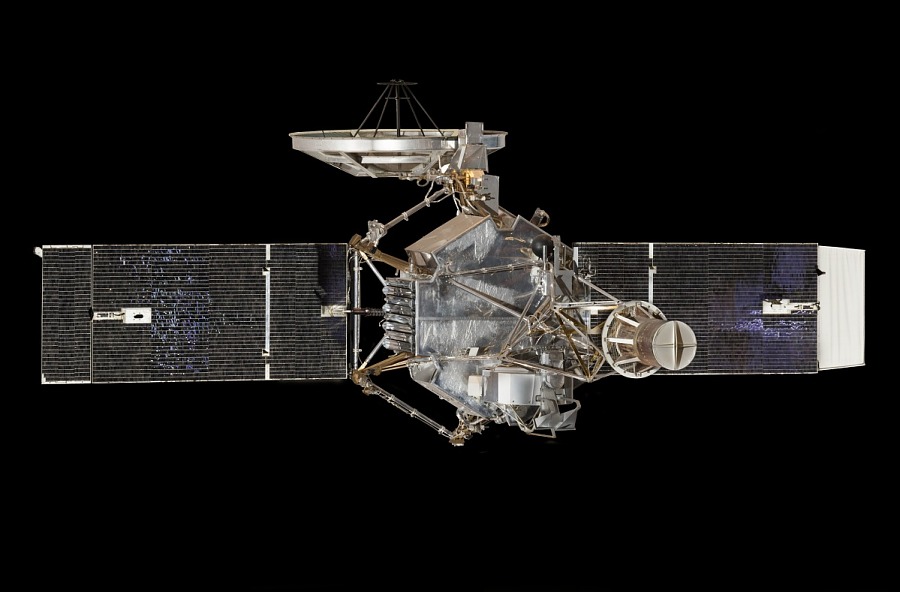
Of the 10 Mariner missions, 7 were successfully took space craft to Mars, Venus, and Mercury. Unfortunately, like Mariner 8, Mariner 1 failed after launch. Fortunately, like Mariner 9, Mariner 2 was a back up spacecraft that ensure mission success. Mariner 3 failed after launch because of a battery issue, but its double Mariner 4 was successful. Here are the 10 missions (you can find more about them here):

  • Mariner 1: Venus mission launched on July 22, 1962. — Failed
  • Mariner 2: Venus mission launched on August 27, 1962. — Success
  • Mariner 3: Mars mission launched on November 5, 1964. — Failed
  • Mariner 4: Mars mission launched on November 28, 1964. — Success
  • Mariner 5: Venus mission launched on June 14, 1967. — Success
  • Mariner 6: Mars mission launched on February 25, 1969. — Success
  • Mariner 7: Mars mission launched on February 25, 1969. — Success
  • Mariner 8: Mars mission launched on May 8, 1971. — Failed
  • Mariner 9: Mars mission launched on May 30, 1971. — Success
  • Mariner 10: Mercury and Venue mission launched on November 3, 1973. — Success

While three spacecraft failed, all of the missions were successful because of the redundancy built into the system. We do not seem to have such luxuries anymore, though NASA’s Mars Exploration Rover (MER) mission had two Mars rovers, Spirit and Opportunity, to increase the chances of success. 

Image (Credit): Mariner 2 spacecraft. (Smithsonian National Air and Space Museum)

A Day in Astronomy: Pioneer Venus

Image (Credit): Artist’s version of the Pioneer Venus Orbiter above Venus. (NASA)

On this day in 1978, NASA launched Pioneer Venus from Cape Canaveral, Florida. The mission had two components:

  • the Pioneer Venus Orbiter that remained in orbit around the planet until 1992 when it entered the Venusian atmosphere and burned up, and
  • the Pioneer Venus Multiprobe (known as Pioneer 13) that carried four probes later dropped into the Venusian atmosphere.

NASA described the descent of the four probes:

When the probes separated from the Multiprobe bus, they went “off the air” because they did not have sufficient on-board power or solar cells to replenish their batteries. Preprogrammed instructions were wired into them and their timers had been set before they separated from the bus. The on-board countdown timers were scheduled to bring each probe into operation again three hours before the probes began their descent through the Venusian atmosphere. On 9 December 1978, just 22 minutes before entry, the Large Probe began to transmit radio signals to Earth. Only 17 minutes before hurtling into the Venusian atmosphere at almost 42,000 km/hr (26,100 mph), all the Small Probes started transmitting.

All four probes were designed for a descent time of approximately 55 minutes before impacting the surface. None were designed to withstand the impact. However one Small Probe (the Day Probe) did survive and sent data from the surface for 67 minutes. Engineering data radioed back from the Day Probe showed that its internal temperature climbed steadily to a high of 126 degrees C (260 degrees F). Then its batteries were depleted, and its radio became silent.

A 2020 Nature Astronomy article noted that one of the probes may have detected signs of life in the Venusian atmosphere. The paper, Phosphine Gas in the Cloud Decks of Venus, has been controversial and was later modified to clarify some of the findings. However, a separate study in the Geophysical Research Letter, Venus’ Mass Spectra Show Signs of Disequilibria in the Middle Clouds, confirmed some of these finding and adding to the argument with the discovery of other chemicals that could also be linked to biological processes. The debate will continue as we learn more.

The Chairwoman of the UAE Space Agency and the Mission to Mars

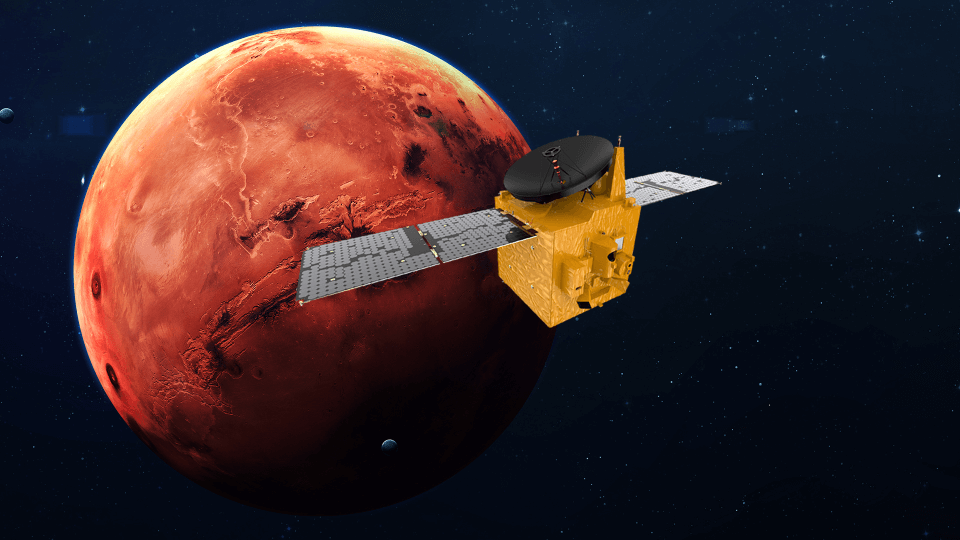
Image (Credit): Artist’s image of UAE’s Hope probe orbiting Mars. (UAE Space Agency)

You may want to visit Time magazine and view the article “The Woman Who Took the UAE to Mars.” It summarizes Sarah Al Amiri’s efforts related to the United Arab Emirates’ mission to Mars as well as her plans for the country’s space agency, which she now heads as Chairwoman.

Prior to becoming Chairwoman, Ms. Amiri was deputy project manager of a mission to map the Martian atmosphere. Her team, which was 80 percent female, developed the Hope probe to accomplish this goal. The probe was launched aboard a Japanese rocket in July 2020 and now orbits Mars. The data obtained from this mission is being shared openly to assist others studying the Martian atmosphere.

Another mission mentioned in the Time article by Chairwoman Amiri is a tour of seven asteroids as well as a flyby of Venus. A UAE space page defines the mission in this way:

The spacecraft will undertake a 3.6 billion-kilometre, five-year journey, which will see it perform gravity assist manoeuvres by orbiting first Venus, then Earth in order to build the velocity required in order to reach the main asteroid belt, located beyond Mars…The mission will study seven main belt asteroids…The mission will make its first close planetary approach orbiting Venus in mid-2028, followed by a close orbit of Earth in mid-2029. It will make its first fly-by of a main asteroid belt object in 2030, going on to observe a total of seven main belt asteroids before its final landing on an asteroid 560 million kilometres from Earth in 2033. This will make the Emirates the fourth nation to land a spacecraft on an asteroid.

What was not mentioned in the story but is available via another UAE government page is plans for several other space endeavors, including:

  • Sending a rover to the Moon in 2024. The rover’s name is Rashid, named in honor of the late Sheikh Rashid bin Saeed Al Maktoum, former Ruler of Dubai.
  • Establishing a settlement on Mars by 2117, and building a Mars Science City within the UAE to make this Martian mission possible.

Should We Return to Uranus?

Source/Credit: A NASA composite image of Uranus taken from Voyager 2 and the Hubble Space Telescope.

In an earlier posting, I highlighted some scientific papers calling for a return to Neptune rather than Uranus, in part because of Neptune’s moon Triton. But what is the argument for a mission to Uranus? Below I highlight one of the papers submitted to the Planetary Science and Astrobiology Decadal Survey 2023-2032 arguing the merits of a NASA mission to Uranus.

The paper, “The Science Case for Spacecraft Exploration of the Uranian Satellites,” states:

The large moons of Uranus are possible ocean worlds that exhibit a variety of surface features, hinting at endogenic geologic activity in the recent past. These moons are rich in water ice, as well as carbon-bearing and likely nitrogen-bearing constituents, which represent some of the key components for life as we know it. However, our understanding of Uranus and its moons is severely limited by the absence of data collected by an orbiting spacecraft…

An orbiter would vastly improve our understanding of these possible ocean worlds and allow us to assess the nature of water and organics in the Uranian system, thereby improving our knowledge of these moons’ astrobiological potential. A Flagship mission to Uranus can be carried out with existing chemical propulsion technology by making use of a Jupiter gravity assist in the 2030 – 2034 timeframe, leading to a flight time of only ~11 years, arriving in the early to mid 2040’s (outlined in the Ice Giants Pre-Decadal Survey Mission Study Report: https://www.lpi.usra.edu/icegiants/mission_study/Full-Report.pdf).

The five large moons discussed in the paper are Miranda, Ariel, Umbriel, Titania, and Oberon. Titania and Oberon where the first to be discovered back in 1787, followed by the later discoveries of Ariel, Umbriel, and Miranda (in that order). Unlike the moons of other planets, the moons of Uranus are named after magical spirits in English literature.

All of these ocean worlds have gained greater interest as we learn about the dynamics of life on of our own planet. As noted in an article in the MIT Technology Review:

It was once thought the solar system was probably a barren wasteland apart from Earth. Rocky neighbors were too dry and cold like Mars, or too hot and hellish like Venus. The other planets were gas giants, and life on those worlds or their satellite moons was basically inconceivable. Earth seemed to be a miracle of a miracle.

But life isn’t that simple. We now know that life on Earth is able to thrive in even the harshest, most brutal environments, in super cold and super dry conditions, depths of unimaginable pressures, and without the need to use sunlight as a source of energy. At the same time, our cursory understanding of these obscure worlds has expanded tremendously. 

We have plenty of worlds to explore in our own solar system as other scientists continue their search for exoplanets and exomoons. The only question now is which local worlds will we visit in our next round of space missions.