Private Space Missions: Is Venus Next?

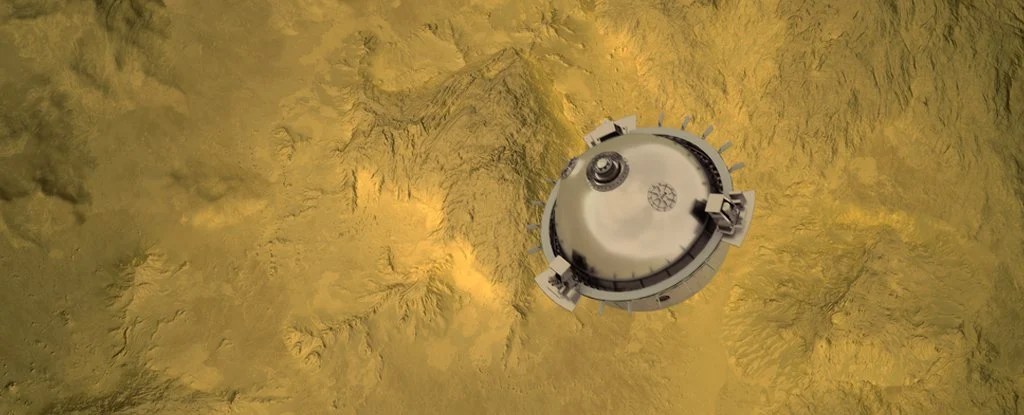
Source/Credit: Venus from Mattias Malmer/NASA/JPL..

NBC news reports that a privately-funding space probe could visit Venus as early as next year as phase one of a three-part mission. The goal of the Venus Life Finder Mission, involving MIT alumni and Rocket Lab, is to search for signs of life or microbial-type life. This effort is another encouraging sign of increased interest in scientific missions throughout the solar system.

An earlier press release on the Venus Life Finder site stated:

The Venus Life Finder Missions are a series of focused astrobiology mission concepts to search for habitability, signs of life, and life itself in the Venus atmosphere. While people have speculated on life in the Venus clouds for decades, we are now able to act with cost-effective and highly-focused missions. A major motivation are unexplained atmospheric chemical anomalies, including the “mysterious UV-absorber”, tens of ppm O2,  SO2 and H2O vertical abundance profiles, the possible presence of PH3 and NH3, and the unknown composition of Mode 3 cloud particles. These anomalies, which have lingered for decades, might be tied to habitability and life’s activities or be indicative of unknown chemistry itself worth exploring.  Our proposed series of VLF missions aim to study Venus’ cloud particles and to continue where the pioneering in situ probe missions from nearly four decades ago left off. The world is poised on the brink of a revolution in space science. Our goal is not to supplant any other efforts but to take advantage of an opportunity for high-risk, high-reward science, which stands to possibly answer one of the greatest scientific mysteries of all, and in the process pioneer a new model of private/public partnership in space exploration.

It has been more than a decade since a government has sent a mission to Venus. The last US mission to Venus was the Magellan launched in May 1989, which started to orbit Venus in 1990 and continued to do so for four years. The European Space Agency sent the Venus Express to the planet in November 2005, while Japan sent the Akatsuki in May 2010.

Interest continues among government parties. For example, just last year NASA announced two new missions to Venus:

— DAVINCI+ (Deep Atmosphere Venus Investigation of Noble gases, Chemistry, and Imaging) to measure the composition of Venus’ atmosphere to understand how it formed and evolved, as well as determine whether the planet ever had an ocean. The mission consists of a descent sphere that will plunge through the planet’s thick atmosphere, making precise measurements of noble gases and other elements to understand why Venus’ atmosphere is a runaway hothouse compared the Earth’s. It will also will return the first high resolution pictures of the unique geological features on Venus known as “tesserae,” which may be comparable to Earth’s continents, suggesting that Venus has plate tectonics.

— VERITAS (Venus Emissivity, Radio Science, InSAR, Topography, and Spectroscopy) to map Venus’ surface to determine the planet’s geologic history and understand why it developed so differently than Earth. In addition, it will map infrared emissions from Venus’ surface to map its rock type, which is largely unknown, and determine whether active volcanoes are releasing water vapor into the atmosphere. 

Source: Venuscloudlife.com.

NASA’s Travel Agency

Source: NASA’s Jet Propulsion Laboratory.

If you are getting tired of staying home these days, NASA has some fun destinations in mind for you. Late last year, NASA’s Jet Propulsion Laboratory (JPL) put together “Visions of the Future” to show you where the space agency hopes to go someday. You may not want to pack just yet, but whether it is this solar system or some other solar system, NASA wants to help.

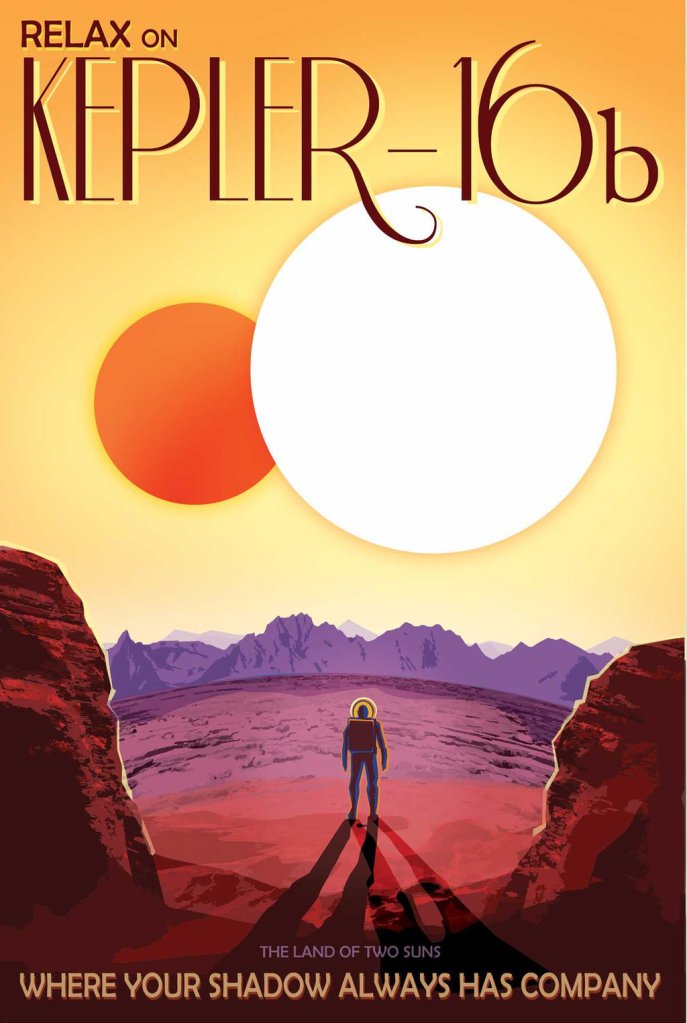
The poster above for Kepler-16b comes with this enticing description:

Like Luke Skywalker’s planet “Tatooine” in Star Wars, Kepler-16b orbits a pair of stars. Depicted here as a terrestrial planet, Kepler-16b might also be a gas giant like Saturn. Prospects for life on this unusual world aren’t good, as it has a temperature similar to that of dry ice. But the discovery indicates that the movie’s iconic double-sunset is anything but science fiction.

You might also enjoy this NASA video showing some space activities in these prime locations.

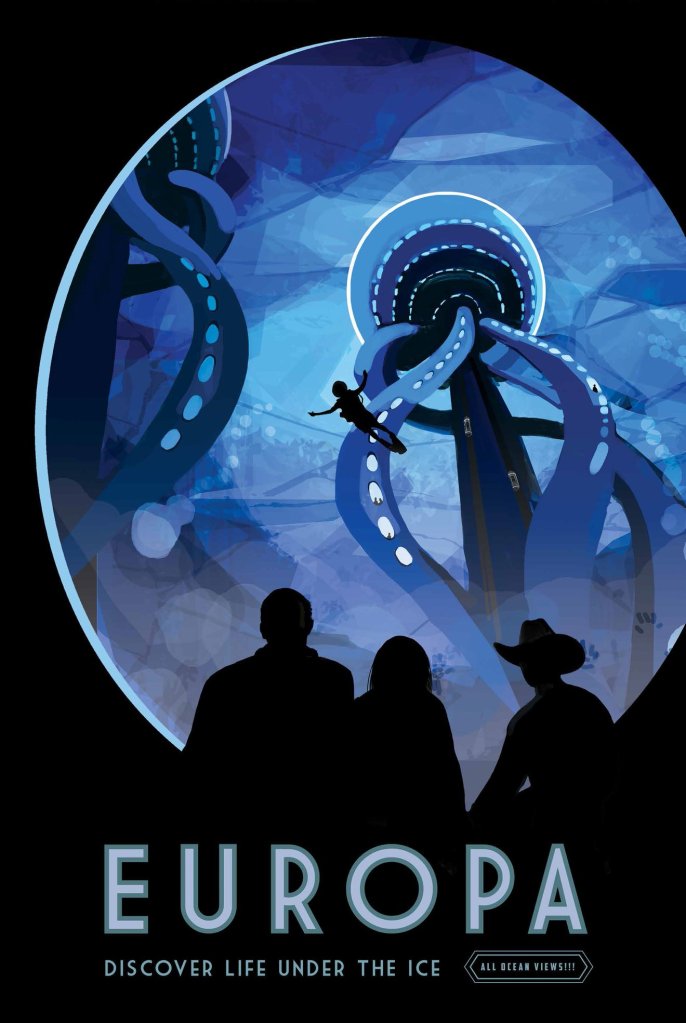
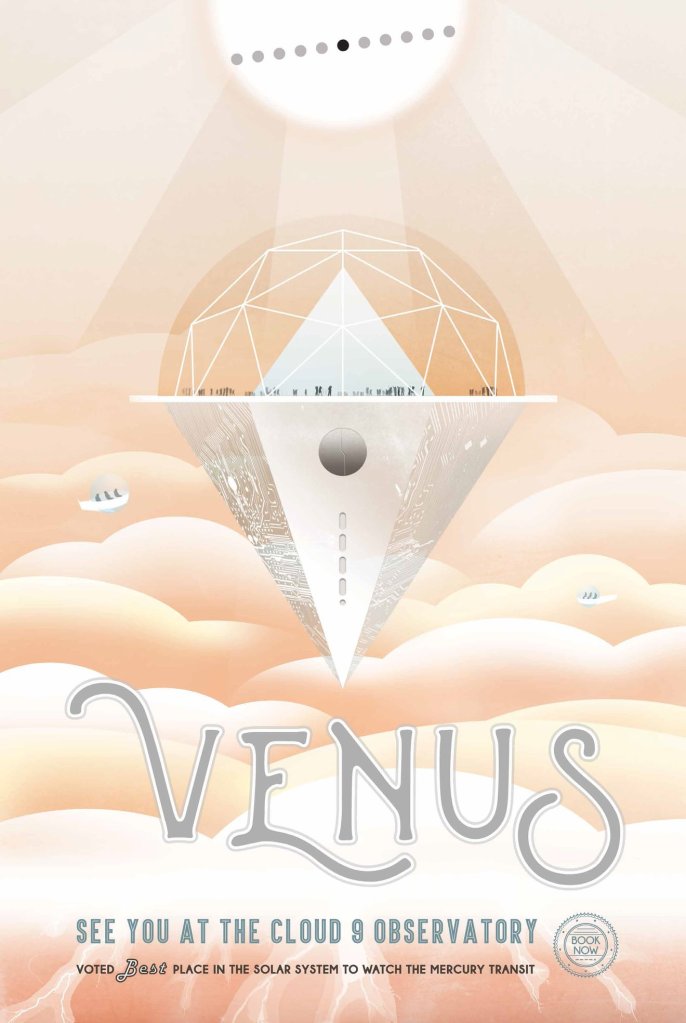
I dropped in a few more posters below, but be sure to check out all of them. A big thanks also to the folks at JPL for these fun images. The 14 posters were created by nine artists, designers, and illustrators.

Of course, these free photos are already being sold on Etsy.com and elsewhere as posters and t-shirts.

Source: NASA’s Jet Propulsion Laboratory.

Top 10 Astronomy Stories from 2021

Source: Sciencealert.com webpage – “We’re Going Back to Venus! NASA Announces Two New Missions by 2030.”

Before we get too far into 2022, it is worth considering some of the top astronomy stories from 2021. Space.com put together a nice list that I highlighted below.

  1. Discovery of Comet Bernardinelli-Bernstein: “…It may be 10 times wider and 1,000 times more massive than a typical comet.”
  2. Amateur astronomer discovers a new moon around Jupiter: “The new moon, called EJc0061, belongs to the Carme group of Jovian moons.”
  3. NASA will return to Venus this decade: “…NASA has not launched a dedicated mission to the planet since 1989.”
  4. The sun is reawakening: “In early November, for instance, a series of solar outbursts triggered a large geomagnetic storm on our planet.”
  5. James Webb Space Telescope flies into space: “…JWST is heading to an observational perch located about a million miles from our planet.”
  6. Event Horizon Telescope takes high-resolution image of black hole jet: “The end result is a resolution that is 16 times sharper and an image that is 10 times more accurate than what was possible before.”
  7. Scientists spot the closest-known black hole to Earth: “Just 1,500 light-years from Earth…”
  8. Earth’s second ‘moon’ flies off into space: “…the object, known as 2020 SO, is a leftover fragment of a 1960s rocket booster from the American Surveyor moon missions.”
  9. Parker Solar Probe travels through the sun’s atmosphere: “The probe managed to get as low as 15 solar radii, or 8.1 million miles (13 million km) from the sun’s surface.”
  10. Perseverance begins studying rocks on Mars: “Perseverance is taking its observations from the 28-mile-wide (45 kilometers) Jezero Crater, which was home to a river delta and a deep lake billions of years ago.”

Visit the Space.com website for more details on each of these astronomy science stories.