In Case You Missed It/Video: Missed Opportunity on Exomoons

Image (Credit): Assistant Professor of Astronomy David Kipping sharing his story of rejection. By the way, the image behind him is the exomoon Pandora from the movie Avatar. (Cool Worlds Lab)

A few months back, Assistant Professor of Astronomy David Kipping shared a short video regarding his organization’s failure to secure James Webb Space Telescope (JWST) time to search for exomoons that he knows are there. His organization, Cool Worlds Lab, has done some amazing work studying and publicizing issues related to astronomy. You should visit his site for some challenging topics.

What is unique about his video is that it was recorded only one hour after he learned that his organization would not be able to use JWST for his exomoon search and he wanted to share what rejection felt like “in real time.” He goes on to say that such rejection is part of science, as brutal as it may feel at the moment, noting that for every seven JWST proposals, only one will be approved.

Fortunately, we have scientists out there with very thick skin sharing new ideas and proposals. And Dr. Kipping will not be giving up on his exomoon push anytime soon. That is good news for all of us.

Video: Another Look at Pluto’s Status as a Planet

Image (Credit): Pluto as seen by the New Horizons spacecraft. (NASA/Johns Hopkins University Applied Physics Laboratory/Southwest Research Institute)

You may enjoy last week’s Astronomy magazine video that is part of This Week in Astronomy with Dave Eicher titled “Is Pluto a Planet?“. The issue on the table is whether scientists were a little too quick to dismiss Pluto’s status under new criteria given that we may have not understood whether the Earth even met this criteria. Is Earth a dwarf planet?

Check out the video and the accompanying article, and then visit the NASA page on the earlier New Horizons mission for some interesting background on the little planet, or dwarf planet, depending on your view.

Pondering ‘Oumuamua on International Asteroid Day

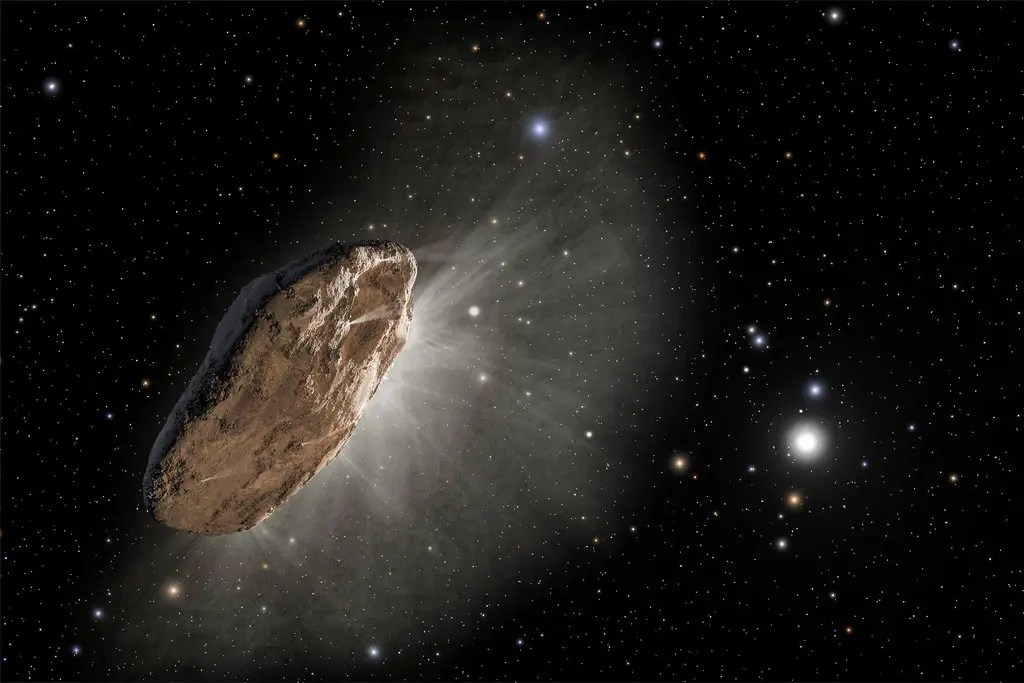
Image (Credit): Artist’s rendering of Oumuamua, an asteroid from outside out solar system. (JPL/NASA)

On International Asteroid Day, I thought it was worth revisiting an earlier video from Cool Worlds Lab on the first detected asteroid from outside our solar system. The video, “‘Oumuamua: An Interstellar Visitor,” notes that scientists have never seen an asteroid within our solar system with these cigar-shaped dimension.

Scientists now believe that more that 10,000 of such alien comments are now present in our solar system. That may offer us an opportunity for a future mission to study such an asteroid and learn about another solar system (given that the asteroids tend to stick around for about 10 years). It may also give us a better idea as whether such asteroids could have introduced life into our solar system.

This is quite a bit to ponder on this day dedicated to pondering asteroids.

Video: Cool Worlds and the Fermi Paradox

A recent video from the YouTube channel Cool Worlds titled “The Fermi Paradox Has An Incredibly Simple Solution” is a fun review of the Fermi Paradox, which asks “Where are they?” in reference to alien visitors. The video goes into the meaning of the question as well as possible interpretations of the paradox itself.

Professor David Kipping from the Department of Astronomy at Columbia University does a nice job of explaining some of the “answers” to the so-called paradox, and even introduces one of his own called the “Weak Anthropic Principle.” I do not want to spoil the story, so I recommend you view the short video on your own. It is enlightening.

The scariest bit of the presentation involves “self-replicating universal constructors” that could colonize the galaxy with present-day rocket technology. Moreover, such constructors may be in development by businesses today with programs such as ChatGPT, as warned by many parties today. Under this scenario, the colonization of our galaxy would start in a Microsoft or Google lab, with humans playing no part in that eventual future because we will not be needed.

Sweet dreams as you ponder that.

Check out the Cool Worlds YouTube page for other fascinating videos.

Note: The creators of the YouTube channel Cool Worlds is also planning a podcast in the near future. That should be a nice addition to the group’s educational material.

Video: More on ChatGPT and Astronomy

Credit: Dalle-2

If you have questions about the future of AI and astronomy, I recommend you visit Cool World Lab’s latest video titled “ChatGPT Takes A College Level Astrophysics Exam.” The video addresses concerns that ChatGPT can be used by students to cheat on tests and homework, and highlights how the program is far from perfect (as shown below in a clip from the video).

To test the abilities of ChatGPT, the host submitted questions from an astronomy final exam to see what would happen. The results were interesting, particularly when math was involved. I do not want to give away the final score (you should watch the video for yourself), but let’s just say a good student can do better than ChatGPT at the moment.

What happens in the future with this new technology is anyone’s guess, though in-class tests may be the best approach if a teacher truly want to know the capabilities of a student. Cheating happens all the time, and it will probably happen on the homework. We just need to ensure the final test is a real test of the student alone

Image (Credit): One of the questions asked in ChatGPT Takes A College Level Astrophysics Exam. (Cool World Labs)

Extra: The video also promotes Ground News so you can determine who is generating the “facts” you read in the news, human or otherwise. Check it out.