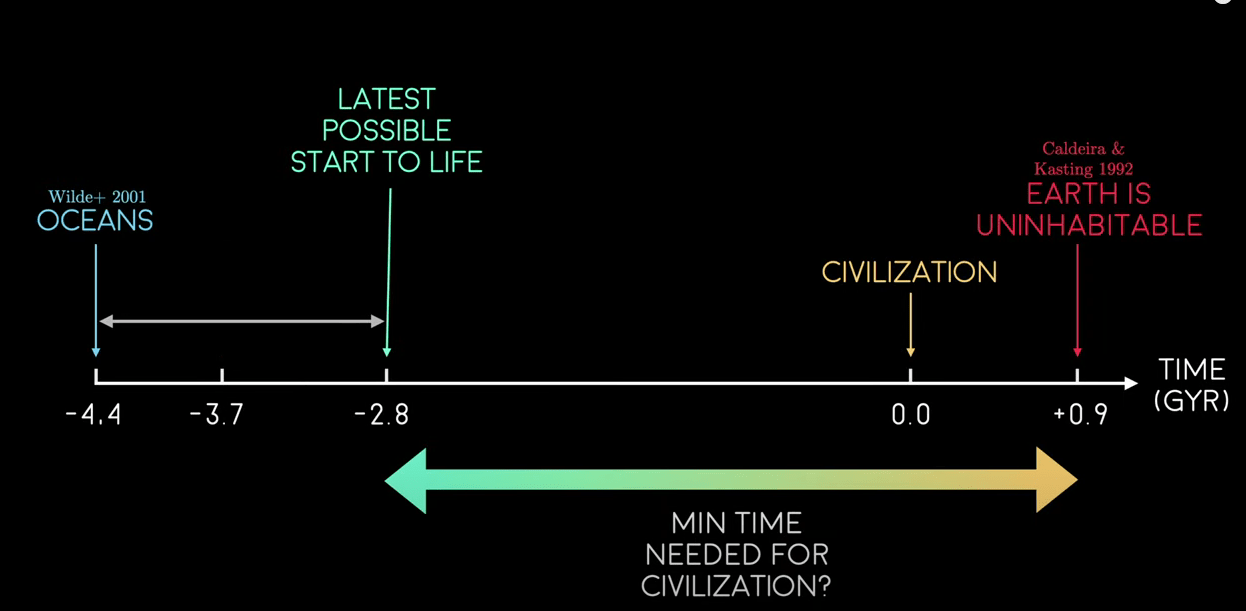
…a hypothetical type of “loud” alien civilization that are known for inhibiting the development of other technological civilizations in their area of influence. The concept of quiet and loud aliens is used to model hypotheses about the existence of extraterrestrial intelligence, particularly in the context of the Fermi Paradox.
You can read all about this theory at grabbyaliens.com. Then you can listen to Professor David Kipping provide three reasons why he does not believe this theory is workable.
As always, he provides an entertaining and enlightening view of the cosmos.
A JuMBO means Jupiter-mass binary objects, which is just part of the story in this video. The presentation starts with a finding from astronomers using the James Webb Space Telescope, who identify 520 rogue planet candidates. This is interesting in itself, but the intriguing part is that a number of these planets are found in pairs. This would not make a lot of sense if we believed these planets were once within a solar system before being pushing into space.
The video discusses the various theories explaining these JuMBOs and rogue planets in general. It also discusses the potential impact on our own solar system, such as whether we lost one of our own planets in the past and/or a nearby rogue planet (and its moons) is out there today waiting to be discovered.
As always, Cool Worlds Lab keeps astronomy even more interesting.
Image (Credit): A graphic explaining the various instruments on the Chandra X-ray Observatory. (NASA)
Even with a good space week in hand, we still need to keep an eye on NASA’s budget to maintain a robust set of programs to explore the cosmos. A recent Youtube video by Cool Worlds Labs, “NASA’s in Trouble,” highlights those budgetary issues and focuses on what individuals can do as well, such as visiting https://www.savechandra.org/ and asking Congress to restore funds cut from the Chandra X-ray Observatory.
Professor David Kipping makes it clear he is not going to remain silent while these cuts are being considered. He and his team demonstrate their love for astronomy in every video and podcast, making them great ambassadors in this debate for continued NASA funding.
The video is forthright about the internal issues creating budgetary issues. For example, the considerable cost overruns and delays prior to the launch of the now successful James Webb Space Telescope came at a cost to other NASA programs over many years. And similar overruns are expected with future large projects as well, further squeezing other line items in the budget.
The video also highlights some promising developments that could help to lower costs in the future, though the issue on the table now is NASA’s FY 2025 budget.
View the video for yourself to learn more about the proposed budget cuts as well as what you can do to help.
Aeon is a website of ideas run by Aeon Media. It’s mission is to explore and communicate knowledge that addresses our shared need to make sense of the world.
While it covers quite a few topics, I wanted to highlight some of its videos on astronomy and space travel. Below are just a few I recommend. You should explore the site on your own to learn more.
Image (Credit): Moving the Artemis I mission into place. (NASA)
With the recent glitches related to the two commercial Moon missions, an earlier NASA video on the Artemis program became all too relevant. In the video, “Farther and Faster: NASA’s Journey to the Moon with Artemis,” we hear that the stakes are high as we attempt to return to the Moon, and how we could be the generation that loses the Moon if we don’t get it right.
In addition to the risks, the video also highlights the great successes already with the Artemis I mission, as you may recall from back in 2022:
Over the course of 25.5 days, Orion performed two lunar flybys, coming within 80 miles (129 kilometers) of the lunar surface. At its farthest distance during the mission, Orion traveled nearly 270,000 miles (435,000 kilometers) from our home planet. On Dec. 11, 2022, NASA’s Orion spacecraft successfully completed a parachute-assisted splashdown in the Pacific Ocean at 9:40 a.m. PST (12:40 p.m. EST) as the final major milestone of the Artemis I mission.
Artemis I set new performance records, exceeded efficiency expectations, and established new safety baselines for humans in deep space. This is a prelude to what comes next—following the success of Artemis I, human beings will fly around the Moon on Artemis II.
It is worth pondering what we have ahead of us. NASA may be having a few issues with its commercial partners, but the main mission has done well. We cannot be discouraged with a few delays as long as we keep the course. We have done it before and there is no reason we cannot do it again. I say slow and steady.
Mars is the goal, but we need to prove ourselves with the Moon. Check out the video and determine for yourself if we have already made a fair amount of progress.