Space Stories: Planning Commercial Space Stations, Sloppy Black Holes, and Happy Birthday Voyager I

Image (Credit): Artist’s earlier rendering of a commercial space station called Orbital Reef envisioned by Blue Origin and  Sierra Space. (Blue Origin)

Here are some recent space-related stories of interest.

Space News: NASA Releases Details on Revised Next Phase of Commercial Space Station Development

NASA expects to spend up to $1.5 billion to support at least two companies to demonstrate crew-tended space stations as part of the agency’s revised approach to transition from the International Space Station. NASA released Sept. 5 a draft version of an announcement for partnership proposal, or AFPP, for the second phase of its Commercial Low Earth Orbit Development Program. NASA is seeking comments on the draft through Sept. 12. The draft reflects a new approach for supporting development of commercial space stations outlined in a July 31 policy directive by Acting Administrator Sean Duffy. Rather than award fixed-price contracts to cover certification of commercial space stations for use by NASA astronauts, it called for the use of funded Space Act Agreements for continued support of the design and development of such stations.

University of Michigan News: Small Black Holes are Surprisingly Sloppy Eaters

When stellar-mass black holes—”small” black holes that are still a few times more massive than the sun—are actively gobbling up matter, they’re even more of a hot mess than scientists expected. That’s according to an international research team, led by Jon Miller of the University of Michigan, that uncovered this surprise that could have galactic implications. What researchers learn from stellar-mass black holes can help them better understand supermassive black holes, the behemoths that steer the evolution of galaxies like our Milky Way.

USA Today: “Voyager 1 Marks 48 Years in Space. Here’s What to Know About Ramous NASA Mission

For nearly five decades, NASA’s twin Voyager probes have plumbed the cosmos in search of answers to some of astronomy’s most perplexing mysteries about our solar system and its place in the wider universe. And now, both of the pioneering spacecraft – which launched two weeks apart in the late-1970s into space – have officially turned 48 years old. Voyager 2 was the first to have its birthday in August, followed now by Voyager 1, which marked its anniversary early in September.

Podcast: Cool Worlds Considers Communicating with Aliens

Credit: Cool Worlds

You may enjoy this week’s episode from the Cool Worlds Podcast all about leaving evidence of our civilization for alien visitors, or even a future civilization here on Earth. The episode, “Nick Searra – Alien Communication, Golden Record, Future Relics,” covers a lot of ground from the Pioneer and Voyager missions to the idea of placing time capsules about our civilization on the Moon or even within the orbit of Jupiter.

The guest is Nick Searra, who is Founder and Executive Directory of the Interstellar Foundation. The Interstellar Foundation has a clear mission – to create messages that represent the diversity and creativity of humanity, inspire future generations of explorers, and communicate with potential extraterrestrial life.

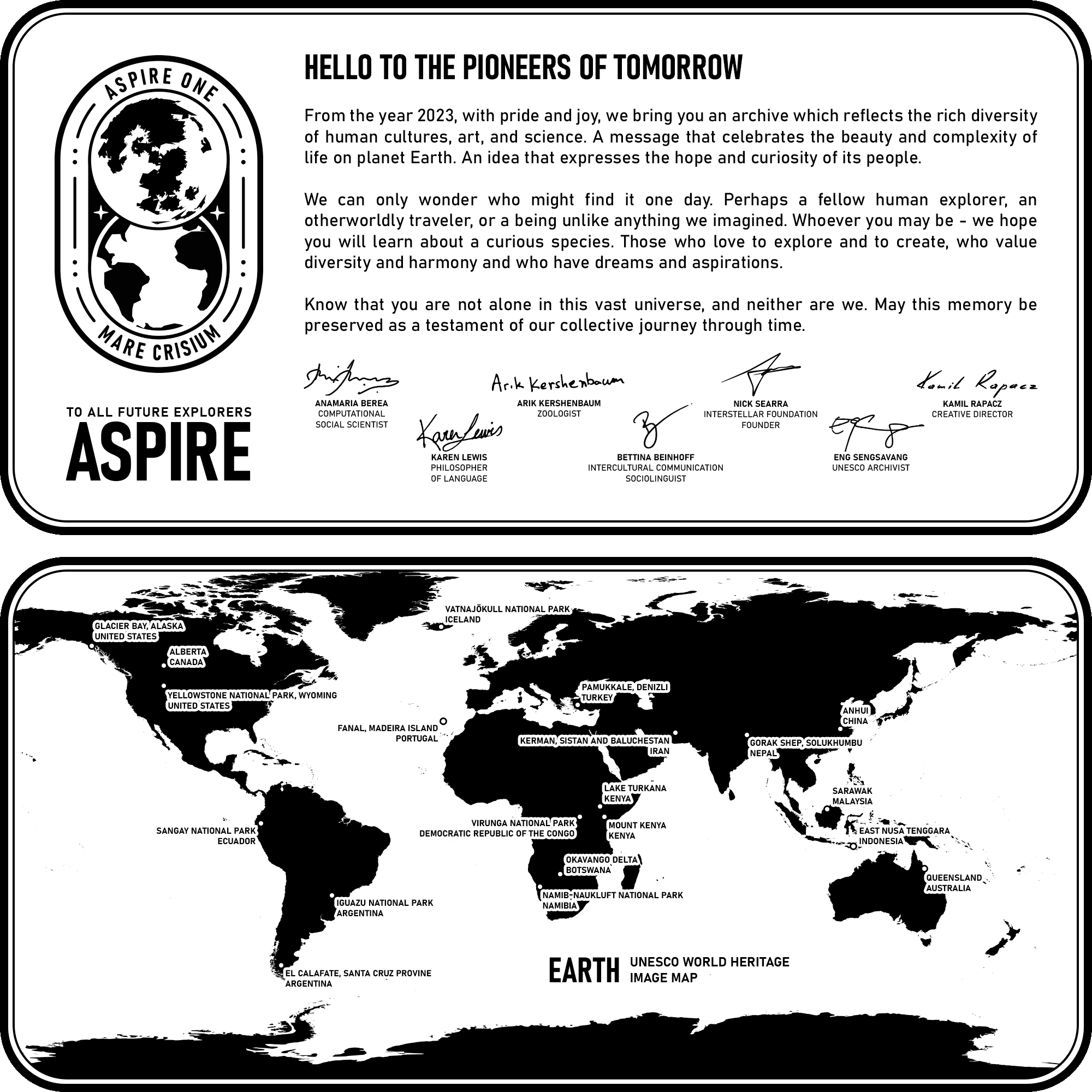
On the site, you an read about the Foundation’s Aspire One, which was an effort to create a lunar record to preserve Earth’s cultural and scientific heritage on the Moon. Preserved records include UNESCO archives, World Heritage images, and other scientific, historical, and cultural material. This message is already on its way to the Moon via this week’s launch of the Blue Ghost lunar lander.

A second messaging mission, Aspire Two, is now in development.

The podcast discussion and related website basically cover the continuation of work stared by Carl Sagan with the launch of Pioneer 10 back in 1972. I recommend you check out both of them.

Image (Credit): Sample images from Aspire One. (Interstellar Foundation)

Space Quote: Message in a Bottle to the Universe

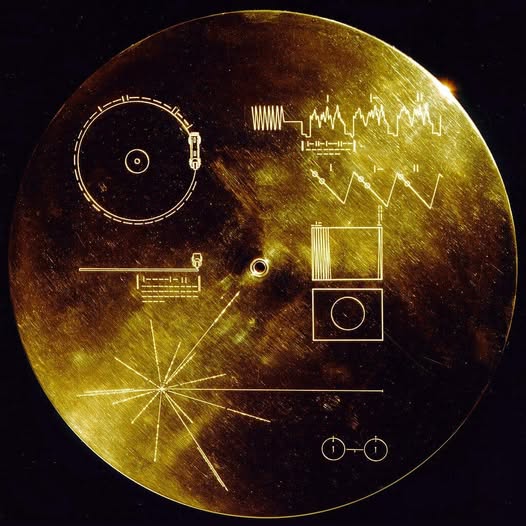
Image (Credit): Golden Record placed on Voyager I and II. (NASA)

“This Voyager spacecraft was constructed by the United States of America. We are a community of 240 million human beings among the more than 4 billion who inhabit the planet Earth. We human beings are still divided into nation states, but these states are rapidly becoming a single global civilization.

We cast this message into the cosmos. It is likely to survive a billion years into our future, when our civilization is profoundly altered and the surface of the Earth may be vastly changed. Of the 200 billion stars in the Milky Way galaxy, some–perhaps many–may have inhabited planets and spacefaring civilizations. If one such civilization intercepts Voyager and can understand these recorded contents, here is our message:

This is a present from a small distant world, a token of our sounds, our science, our images, our music, our thoughts, and our feelings. We are attempting to survive our time so we may live into yours. We hope someday, having solved the problems we face, to join a community of galactic civilizations. This record represents our hope and our determination, and our good will in a vast and awesome universe.”

Statement by then President Jimmy Carter in July 29, 1977 that was placed in both Voyager I and II, both of which are now barreling beyond our solar system. Voyager II was launched on August 20, 1977 followed by Voyager I on September 5, 1977.

Looking Back at What Did Not Work in 2024

Image (Credit): NASA’s new Advanced Composite Solar Sail System. (NASA)

It is worthwhile reflecting on all of the space successes in 2024, though if we believe we learn from our mistakes then it would seem the mission shortcomings are worth highlighting as well.

Fortunately, Live Science has prepared a list for our review. Its article “10 Times Space Missions Went Very Wrong in 2024” includes well known stories, such as the stranded Starliner and SpaceX rocket woes, as well as less covered items, such as:

  • Tumbling Solar Sail – the failure of NASA’s new Advanced Composite Solar Sail System (ACS3);
  • Shattering Spacecraft – multiple cases of new space debris and close calls that could have impacted other space missions; and
  • Multiple Voyager Issues – the continued decline of the two Voyager probes as they reach further into space.

Check out the story for a full list of issues.

Note: This website has also covered a number of flubs, including:

Space Stories: Potential Life on Uranus, a Sick ISS Astronaut, and a Feasting Black Hole

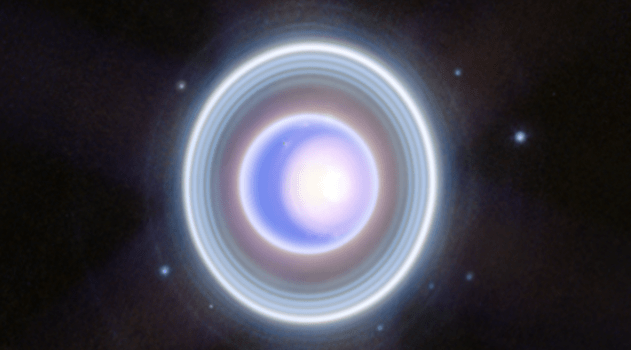
Image (Credit): Uranus captured the James Webb Telescope’s Near-Infrared Camera (NIRCam). This Webb image also shows 9 of the planet’s 27 moons. (NASA, ESA, CSA, STScI)

BBC: New Study on Moons of Uranus Raises Chance of Life

The Voyager 2 observations had suggested that its two largest moons — Titania and Oberon — often orbit outside the magnetosphere. However, the new study indicates they tend to stay inside the protective bubble, making it easier for scientists to magnetically detect potential subsurface oceans. “Both are thought to be prime candidates for hosting liquid water oceans in the Uranian system due to their large size relative to the other major moons,” Jet Propulsion Laboratory planetary scientist and study co-author Corey Cochrane said.

ScotsmanNasa Astronauts Tight-lipped on Who was Ill After Long Space Station Mission

Three Nasa astronauts whose prolonged space station mission ended with a trip to hospital last month have declined to say which one of them was sick. Astronauts Matthew Dominick, Michael Barratt and Jeanette Epps publicly discussed their spaceflight for the first time since returning from the International Space Station on October 25.

NOIRLabNSF NOIRLab Astronomers Discover the Fastest-Feeding Black Hole in the Early Universe

Supermassive black holes exist at the center of most galaxies, and modern telescopes continue to observe them at surprisingly early times in the Universe’s evolution. It’s difficult to understand how these black holes were able to grow so big so rapidly. But with the discovery of a low-mass supermassive black hole feasting on material at an extreme rate, seen just 1.5 billion years after the Big Bang, astronomers now have valuable new insights into the mechanisms of rapidly growing black holes in the early Universe.