Space Stories: Potential Life on Uranus, a Sick ISS Astronaut, and a Feasting Black Hole

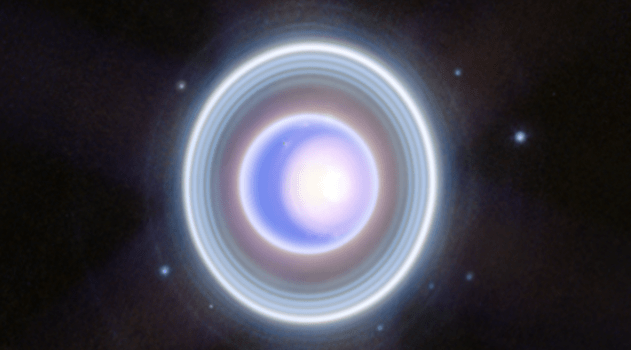
Image (Credit): Uranus captured the James Webb Telescope’s Near-Infrared Camera (NIRCam). This Webb image also shows 9 of the planet’s 27 moons. (NASA, ESA, CSA, STScI)

BBC: New Study on Moons of Uranus Raises Chance of Life

The Voyager 2 observations had suggested that its two largest moons — Titania and Oberon — often orbit outside the magnetosphere. However, the new study indicates they tend to stay inside the protective bubble, making it easier for scientists to magnetically detect potential subsurface oceans. “Both are thought to be prime candidates for hosting liquid water oceans in the Uranian system due to their large size relative to the other major moons,” Jet Propulsion Laboratory planetary scientist and study co-author Corey Cochrane said.

ScotsmanNasa Astronauts Tight-lipped on Who was Ill After Long Space Station Mission

Three Nasa astronauts whose prolonged space station mission ended with a trip to hospital last month have declined to say which one of them was sick. Astronauts Matthew Dominick, Michael Barratt and Jeanette Epps publicly discussed their spaceflight for the first time since returning from the International Space Station on October 25.

NOIRLabNSF NOIRLab Astronomers Discover the Fastest-Feeding Black Hole in the Early Universe

Supermassive black holes exist at the center of most galaxies, and modern telescopes continue to observe them at surprisingly early times in the Universe’s evolution. It’s difficult to understand how these black holes were able to grow so big so rapidly. But with the discovery of a low-mass supermassive black hole feasting on material at an extreme rate, seen just 1.5 billion years after the Big Bang, astronomers now have valuable new insights into the mechanisms of rapidly growing black holes in the early Universe.

Voyager 2 Still Operating, But With One Less Instrument

Image (Credit): Instruments on the Voyager spacecraft. (NASA/JPL-Caltech)

Last week, NASA announced its decision to turn off one of Voyager 2’s scientific instruments to save energy. The plasma science instrument is now silent. It was used to measure the amount of plasma, or electrically charged atoms, as well as the direction it is flowing. The same instrument on Voyager 1 stopped working in 1980.

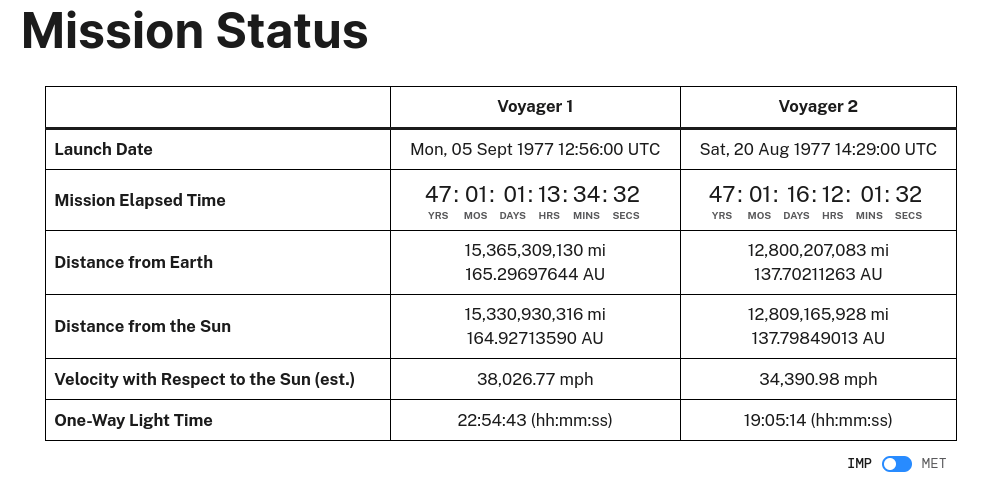
It is just amazing that the two Voyagers continue on their voyage beyond our solar system while sharing the experience with us. As of a few minutes ago, Voyager 1 was about 15.4 billion miles away (Voyager 2 is a little closer) and it took about 22 hours and 54 minutes for light to travel from the Voyager 1 spacecraft to Earth.

You can go to this NASA site to learn more about the mission as well as the status of the various scientific instruments.

Voyager 1 is Communicating Again

Image (Credit): Artist’s rendering of the Voyager 1 spacecraft. (NASA)

The Voyager 1 spacecraft is communicating properly again after having issues since November 2023. NASA was able to fix the spacecraft that is currently more than 15 billion miles from Earth, which is a pretty impressive feat.

Late last week, NASA noted:

The team partially resolved the issue in April when they prompted the spacecraft to begin returning engineering data, which includes information about the health and status of the spacecraft. On May 19, the mission team executed the second step of that repair process and beamed a command to the spacecraft to begin returning science data. Two of the four science instruments returned to their normal operating modes immediately. Two other instruments required some additional work, but now, all four are returning usable science data.

Launched back in 1977, the Voyager 1 and Voyager 2 spacecraft explored the solar system before starting a journey to the great unknown. Both are now the only spacecraft outside the heliosphere.

You can read more about the Voyager spacecraft and mission here.

Space Stories: Voyager 1 Gibberish, Lunar Rovers Underway, and the Largest Digital Camera

Image (Credit): Artist’s rendering of the Voyager 1 spacecraft. (NASA)

Here are some recent stories of interest.

ScienceAlert: NASA Has Finally Identified The Reason Behind Voyager 1’s Gibberish

For months now, the most distant spacecraft to Earth – Voyager 1 – has been talking gibberish on the interplanetary ‘radio’. The repetitive jumble of 1s and 0s it’s sending back to our planet, 24 billion kilometers (15 billion miles) away, has made no sense to scientists until now. Turns out, officials at NASA just needed to give the oh-so-distant craft a bit of a ‘poke’ to ask it how it was feeling. The system returned a software readout to Earth that scientists have now used to confirm about 3 percent of its memory is corrupted. Which is why turning the FDS on and off didn’t resolve the issue back in November of 2023.

CBS News: 3 Companies Win NASA Contracts to Develop New Artemis Moon Rover Designs

Along with funding the commercial development of new rockets, Artemis moon landers and new spacesuits, NASA is pressing ahead with plans to buy an unpressurized moon rover that can carry astronauts, science payloads — or both — across the rugged terrain of the lunar south pole, officials said Wednesday. The agency announced contract awards to three companies to develop competing designs for a Lunar Terrain Vehicle, or LTV, similar in concept to the rovers that carried the last three Apollo crews across the moon’s surface more than 50 years ago.

NOIRLab: Construction of Largest Digital Camera Ever Built for Astronomy Completed

After two decades of work, scientists and engineers at the Department of Energy’s SLAC National Accelerator Laboratory and their collaborators are celebrating the completion of the LSST Camera. Once mounted on Vera C. Observatory’s Simonyi Survey Telescope, the 3200-megapixel camera will help researchers observe our Universe in unprecedented detail. During its ten-year Legacy Survey of Space and Time, the LSST Camera will generate an enormous trove of data on the southern night sky that researchers will mine for new insights into dark energy, dark matter, the changing night sky, the Milky Way and our Solar System.