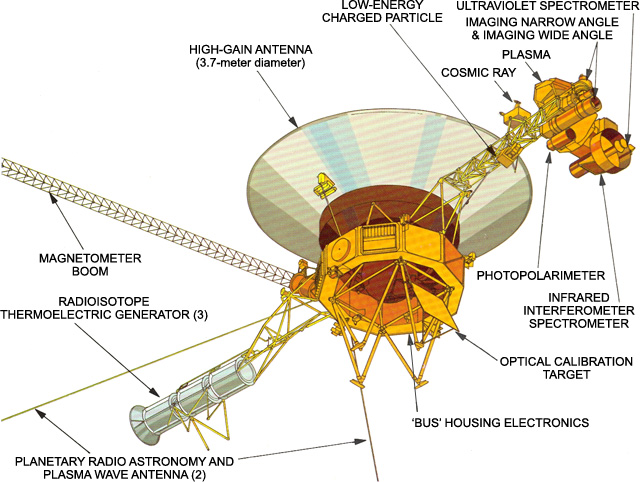
Image (Credit): Artist’s rendering of the Voyager 1 spacecraft. (NASA)
The Voyager 1 spacecraft is communicating properly again after having issues since November 2023. NASA was able to fix the spacecraft that is currently more than 15 billion miles from Earth, which is a pretty impressive feat.
The team partially resolved the issue in April when they prompted the spacecraft to begin returning engineering data, which includes information about the health and status of the spacecraft. On May 19, the mission team executed the second step of that repair process and beamed a command to the spacecraft to begin returning science data. Two of the four science instruments returned to their normal operating modes immediately. Two other instruments required some additional work, but now, all four are returning usable science data.
Launched back in 1977, the Voyager 1 and Voyager 2 spacecraft explored the solar system before starting a journey to the great unknown. Both are now the only spacecraft outside the heliosphere.
You can read more about the Voyager spacecraft and mission here.
For months now, the most distant spacecraft to Earth – Voyager 1 – has been talking gibberish on the interplanetary ‘radio’. The repetitive jumble of 1s and 0s it’s sending back to our planet, 24 billion kilometers (15 billion miles) away, has made no sense to scientists until now. Turns out, officials at NASA just needed to give the oh-so-distant craft a bit of a ‘poke’ to ask it how it was feeling. The system returned a software readout to Earth that scientists have now used to confirm about 3 percent of its memory is corrupted. Which is why turning the FDS on and off didn’t resolve the issue back in November of 2023.
Along with funding the commercial development of new rockets, Artemis moon landers and new spacesuits, NASA is pressing ahead with plans to buy an unpressurized moon rover that can carry astronauts, science payloads — or both — across the rugged terrain of the lunar south pole, officials said Wednesday. The agency announced contract awards to three companies to develop competing designs for a Lunar Terrain Vehicle, or LTV, similar in concept to the rovers that carried the last three Apollo crews across the moon’s surface more than 50 years ago.
After two decades of work, scientists and engineers at the Department of Energy’s SLAC National Accelerator Laboratory and their collaborators are celebrating the completion of the LSST Camera. Once mounted on Vera C. Observatory’s Simonyi Survey Telescope, the 3200-megapixel camera will help researchers observe our Universe in unprecedented detail. During its ten-year Legacy Survey of Space and Time, the LSST Camera will generate an enormous trove of data on the southern night sky that researchers will mine for new insights into dark energy, dark matter, the changing night sky, the Milky Way and our Solar System.
Image (Credit): One side of the panel attached to the Europa Clipper showing “water” ” in 103 languages (explained below). (NASA/JPL-Caltech)
In past NASA missions to the outer planets of our solar system, we attached messages for any distant civilization that might be out there. Both the Pioneer and Voyager missions contained such messages.
So what about NASA’s Europa Clipper mission to Jupiter’s moon set to launch in October? It too will have some messages, but these appear to be for the inhabitants of the moon rather than some distant civilization.
A triangular 7″ x 11″ metal plate attached to the spacecraft destined for Europa will carry messages on both sides. The image above shows one of these sides containing features waveforms that are visual representations of the sound waves formed by the word “water” in 103 languages.
The other side of the plate (shown below) contains a variety of messages:
the Drake Equation, which estimate the possibility of finding advanced civilizations beyond Earth;
U.S. Poet Laureate Ada Limón’s handwritten “In Praise of Mystery: A Poem for Europa”;
a reference to the radio frequencies considered plausible for interstellar communication; and
a portrait Ron Greeley, whose early efforts laid the foundation for Europa Clipper.
The spacecraft will also carry a silicon microchip containing more than 2.6 million names that were submitted by the public as part of NASA’s “Message in a Bottle” campaign.
This is all interesting in itself, but not really a message to others. I expect it is not intended for anyone else but ourselves because the Europa Clipper is not expected to leave the solar system but instead crash into another of Jupiter’s moons – Ganymede.
Note: You may wonder about the message on the New Horizons spacecraft that is also travelling to the edges of our solar system. That message is somewhat controversial. I will let you read about that one in this Slate article, “Ashes and Small Change.”
Image (Credit): One side of the panel attached to the Europa Clipper showing a poem, portrait, and more (explained above). (NASA/JPL-Caltech)
NASA is experiencing communication issues with the distant Voyager 1 spacecraft. As a result, NASA reports that no science or engineering data is being sent back to Earth.
Voyager 1 is about 15 billion miles from Earth, so its binary code signals take about 22.5 hours to reach Earth.
The communication issue with the spacecraft is expected to be resolved in the next few weeks. Of course, Voyager dates back to 1977. At some point we will need to say goodbye to our friend, but no one is ready for that.
Engineers expect each spacecraft to continue operating at least one science instrument until around 2025. Even if science data won’t likely be collected after 2025, engineering data could continue to be returned for several more years. The two Voyager spacecraft could remain in the range of the Deep Space Network through about 2036, depending on how much power the spacecraft still have to transmit a signal back to Earth.
It would be great to have another 13 years of discussions with humanity’s most distant probes.
About 46 years after NASA’s Voyager 1 and Voyager 2 launched on an epic journey to explore space, the probes’ antique hardware continues to receive tweaks from afar. One update, a software fix, ought to tend to the corrupted data that Voyager 1 began transmitting last year, and another set aims to prevent gunk from building up in both spacecraft’s thrusters. Together, these updates intend to keep the spacecraft in contact with Earth for as long as possible.
NASA’s Lucy spacecraft is preparing for its first close-up look at an asteroid. On Nov. 1, it will fly by asteroid Dinkinesh and test its instruments in preparation for visits in the next decade to multiple Trojan asteroids that circle the Sun in the same orbit as Jupiter. Dinkinesh, less than half a mile, or 1 kilometer, wide, circles the Sun in the main belt of asteroids located between the orbits of Mars and Jupiter. Lucy has been visually tracking Dinkinesh since Sept. 3; it will be the first of 10 asteroids Lucy will visit on its 12-year voyage. To observe so many, Lucy will not stop or orbit the asteroids, instead it will collect data as it speeds past them in what is called a “flyby.”
A team of astronomers has found a new clue that a recently discovered near-Earth asteroid, Kamooalewa, might be a chunk of the moon. They hypothesized that the asteroid was ejected from the lunar surface during a meteorite strike–and they found that a rare pathway could have allowed Kamooalewa to get into orbit around the sun while remaining close to the orbits of the Earth and the Moon. The research team details their findings in the Oct. 23 issue of the journal Nature Communications Earth & Environment. Kamo`oalewa has been the object of several astronomy studies in recent years. As a result, a Chinese mission launching in 2025 is set to land on the asteroid and return samples to Earth.