NASA is experiencing communication issues with the distant Voyager 1 spacecraft. As a result, NASA reports that no science or engineering data is being sent back to Earth.
Voyager 1 is about 15 billion miles from Earth, so its binary code signals take about 22.5 hours to reach Earth.
The communication issue with the spacecraft is expected to be resolved in the next few weeks. Of course, Voyager dates back to 1977. At some point we will need to say goodbye to our friend, but no one is ready for that.
Engineers expect each spacecraft to continue operating at least one science instrument until around 2025. Even if science data won’t likely be collected after 2025, engineering data could continue to be returned for several more years. The two Voyager spacecraft could remain in the range of the Deep Space Network through about 2036, depending on how much power the spacecraft still have to transmit a signal back to Earth.
It would be great to have another 13 years of discussions with humanity’s most distant probes.
About 46 years after NASA’s Voyager 1 and Voyager 2 launched on an epic journey to explore space, the probes’ antique hardware continues to receive tweaks from afar. One update, a software fix, ought to tend to the corrupted data that Voyager 1 began transmitting last year, and another set aims to prevent gunk from building up in both spacecraft’s thrusters. Together, these updates intend to keep the spacecraft in contact with Earth for as long as possible.
NASA’s Lucy spacecraft is preparing for its first close-up look at an asteroid. On Nov. 1, it will fly by asteroid Dinkinesh and test its instruments in preparation for visits in the next decade to multiple Trojan asteroids that circle the Sun in the same orbit as Jupiter. Dinkinesh, less than half a mile, or 1 kilometer, wide, circles the Sun in the main belt of asteroids located between the orbits of Mars and Jupiter. Lucy has been visually tracking Dinkinesh since Sept. 3; it will be the first of 10 asteroids Lucy will visit on its 12-year voyage. To observe so many, Lucy will not stop or orbit the asteroids, instead it will collect data as it speeds past them in what is called a “flyby.”
A team of astronomers has found a new clue that a recently discovered near-Earth asteroid, Kamooalewa, might be a chunk of the moon. They hypothesized that the asteroid was ejected from the lunar surface during a meteorite strike–and they found that a rare pathway could have allowed Kamooalewa to get into orbit around the sun while remaining close to the orbits of the Earth and the Moon. The research team details their findings in the Oct. 23 issue of the journal Nature Communications Earth & Environment. Kamo`oalewa has been the object of several astronomy studies in recent years. As a result, a Chinese mission launching in 2025 is set to land on the asteroid and return samples to Earth.
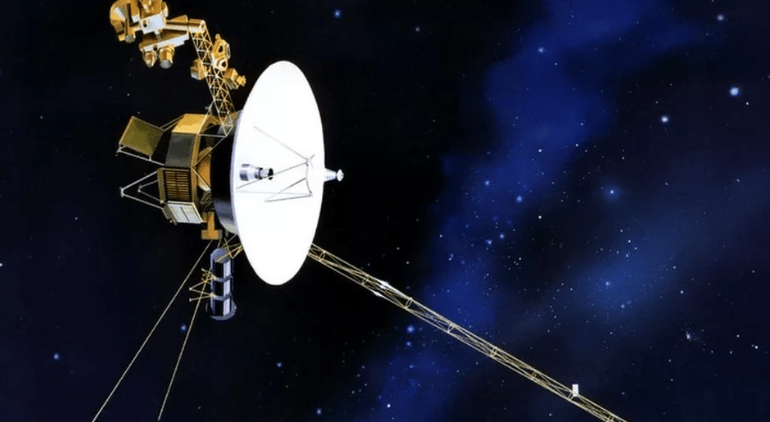
Image (Credit): Artist’s rendering of Voyager 2. (NASA)
After two weeks with no word, Voyager 2 is back to communicating with us as it continues its journey beyond our solar system. The whole incident started when NASA sent a bad command, but all is well.
Voyager 2 first left Earth back in August 1977 and exited the solar system in December 2018. Like Voyager 1, which is also outside the solar system now, Voyager 2 had the initial task of studying the planets. Voyager 2 focused on Jupiter, Saturn, Uranus and Neptune. It has shown it was capable of much more as it dragged the human race to the bleeding edge of space.
You can read all about Voyager 2’s accomplishments at this NASA site, including:
Voyager 2 is the only spacecraft to study all four of the solar system’s giant planets at close range.
Voyager 2 discovered a 14th moon at Jupiter.
Voyager 2 was the first human-made object to fly past Uranus.
At Uranus, Voyager 2 discovered 10 new moons and two new rings.
Voyager 2 was the first human-made object to fly by Neptune.
At Neptune, Voyager 2 discovered five moons, four rings, and a “Great Dark Spot.”
An impressive list of accomplishments, and the spacecraft is still ticking as it goes into the great unknown.
We need to keep these achievements in mind as we battle over this year’s NASA budget. We also need to remember that there was supposed to be four Voyager-like spacecraft rather than two, but budget cuts nixed the second set. Meaning we can still get some great things done even if we don’t have the budget to fund every piece of a grand vision.
Have you heard about the upcoming movie about Carl Sagan called Voyagers? Andrew Garfield of Spiderman fame will be playing Dr. Sagan. Daisy Edgar-Jones will play the part of Ann Druyan. The new film will be one of many shown at this year’s Cannes Film Festival, starting next week.
The film is set in 1977 as NASA is preparing to launch humanity’s first interstellar probes, the Voyager 1 and Voyager 2 missions. A team, led by Sagan, sets out to create a message to accompany them: the Golden Record, a group of images and sounds meant to express the essence of humanity and act as a first-contact greeting for any galactic lifeforms the probes might reach. But what starts out as a race-against-the-clock mission becomes an epic, unexpected love story between Sagan and his collaborator Druyan.
I have seen Andrew Garfield in a number of films and TV shows, and he never disappoints. Seeing his take on Dr. Sagan’s story should be fascinating and fun.
With all the recent films and series on twisted business icons, I will be happy to take a break and watch a film that covers one of science’s great icons. Maybe it can encourage a new generation of scientists and supporters of science.
On a recent episode of the Clear + Vivid podcast, Alan Alda interviewed NASA engineer Les Johnson about his efforts to develop a solar sail that can take us to the stars. He is the Principal Investigator for the NEA Scout, which was launched into space during the Artemis I mission and is now heading towards a near-Earth asteroid via solar sails (see above).
During the interview, Mr. Johnson discussed the NEA Scout as well as his hopes for future human travel to the stars using solar sails, noting that while slow, the sails can outperform modern rocket engines in the long-run. He also pointed out that a solar sail may be able to get us to Proxima Centauri, the closest neighboring star, in hundreds of years versus the 70,000 years it will take the Voyager spacecraft to travel that same distance. I like how he puts such a mission in perspective, pointing out it took hundreds of years to build some of the great cathedrals.
Messrs. Alda and Johnson also discussed the ethics of space travel considering astronauts will be spending generations in space with many humans never seeing either the Earth or the destination in their lifetime. Mr. Johnson said space lasers may be another option for interstellar travel at some point in the future, reducing the travel time to Proxima Centauri to 40-50 years. Given the time spans, he said it may make sense to initially send robots into space first.
Finally, the podcast covered missions closer to Earth, such as mining asteroids for water and minerals, as well as 3D printing to create what we need in space. It sounded a lot like the situation in find in the science fiction TV series The Expanse.
Overall, it was a great conversation worth a few minutes of your day. Check it out.
Extra: Mr. Johnson is also the author of several books, including the co-authored Saving Proxima. Here is a quick summary of that tale:
2072. At the lunar farside radio observatory, an old-school radio broadcast is detected, similar to those broadcast on Earth in the 1940s, but in an unknown language, coming from an impossible source—Proxima Centauri. While the nations of Earth debate making first contact, they learn that the Proximans are facing an extinction-level disaster, forcing a decision: will Earth send a ship on a multiyear trip to render aid?
Interstellar travel is not easy, and by traveling at the speeds required to arrive before disaster strikes at Proxima, humans will learn firsthand the time-dilating effects of Einstein’s Special Relativity and be forced to ponder ultimate questions: What does it mean to be human? What will it take to share the stars with another form of life? What if I return younger than my own children? The answers are far from academic, for they may determine the fate of not one, but two, civilizations.




 Our Awesome Universe