Image (Credit): The Progress MS-28 cargo spacecraft approaches the ISS on Saturday, August 17, 2024. (NASA)
The Progress MS-28 (or Progress 89 per NASA) spacecraft successfully attached itself to the International Space Station (ISS) yesterday so that three tons of supplies could be unloaded.
As with previous resupply spacecraft, it will remain attached to the station for the next six months before being ejected back towards Earth where it will burn up in the atmosphere.
One-third of Mars’ surface has shallow-buried H2O, but it is currently too cold for use by life. Proposals to warm Mars using greenhouse gases require a large mass of ingredients that are rare on Mars’ surface. However, we show here that artificial aerosols made from materials that are readily available at Mars—for example, conductive nanorods that are ~9 micrometers long—could warm Mars >5 × 10³ time smore effectively than the best gases. Such nanoparticles forward-scatter sunlight and efficiently block upwelling thermal infrared. Like the natural dust of Mars, they are swept high into Mars’ atmosphere, allowing delivery from the near-surface. For a 10-year particle lifetime, two climate models indicate that sustained release at 30 liters per second would globally warm Mars by ≳30 kelvin and start to melt the ice. Therefore, if nanoparticles can be made at scale on (or delivered to) Mars, then the barrier to warming of Mars appears to be less high than previously thought.
Citation: Ansari S, Kite ES, Ramirez R, Steele LJ, Mohseni H, Feasibility of keeping Mars warm with nanoparticles, Science Advances, (2024). 10.1126/sciadv.adn4650
NASA’s Backyard Worlds: Planet 9 program allows interested volunteers to search earlier data to potentially locate an extra planet or new brown dwarfs near our solar system. Well, one of these volunteers found something unusual – an object with a mass similar to or less than that of a small star that was traveling fast enough to eventually escape the Milky Way’s gravity and enter intergalactic space. This object was clocked at approximately 1 million miles per hour.
You can read about this object and other efforts by visiting this NASA link. You might want to look into becoming part of the citizen scientists looking for more interesting objects.
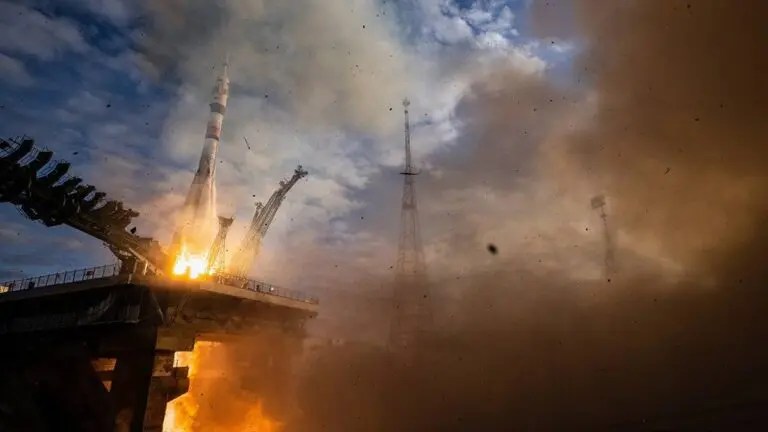
Image (Credit): The launch earlier today of the Progress MS-28 cargo spacecraft to the ISS. (TASS Russian News Agency)
This week’s image is from earlier today when the Russian’s successfully launched its Progress MS-28 cargo spacecraft via a Soyuz rocket to the International Space Station (ISS). The resupply mission was launched from the Baikonur Cosmodrome located in Kazakhstan. The spacecraft will rendezvous with the ISS on Saturday.
On August 1, Senators John W. Hickenlooper (D-CO) and Mike Crapo (R-ID) introduced a bill called The Dark and Quiet Skies Act (S.495) to assist astronomers with the night sky.
In a press release from Senator Hickenlooper’s office, we learn the Act would
…create a Center of Excellence overseen by National Institute of Standards and Technology (NIST) to develop best practices to reduce light and noise interference. The Center would boost collaboration between the astronomical community, industry, and Federal agencies to protect federally-funded scientific research that observes the sky and celestial bodies.
Specifically, this center would:
Establish and circulate best practices to reduce unintentional optical and radio interference;
Conduct research and development on tracking, identifying, modeling, and characterizing satellite interference; and
Develop mitigation technology that includes satellite paint, film, orientation adjustments, cooling techniques, or fuselage design.
The bill may be a little late to the game, particularly if the press release is correct and the sky is really getting 10 percent brighter each year, but it is certainly welcome. We already know SpaceX, Amazon, and China have grand plans to fill up the sky with satellites, so this is the time to set some rules for the U.S. companies at least.
Let’s hope any and all such efforts in this area can be coordinated to bring the greatest pressure to bear on these satellite companies. The goal should be more than protecting the night sky for telescopes. If it is true that we will see hundreds of thousands of new satellites in orbit in the years to come, we need to make some sense of this booming industry before a few massive collisions make the space over our heads full of litter and unusable.




 Our Awesome Universe